
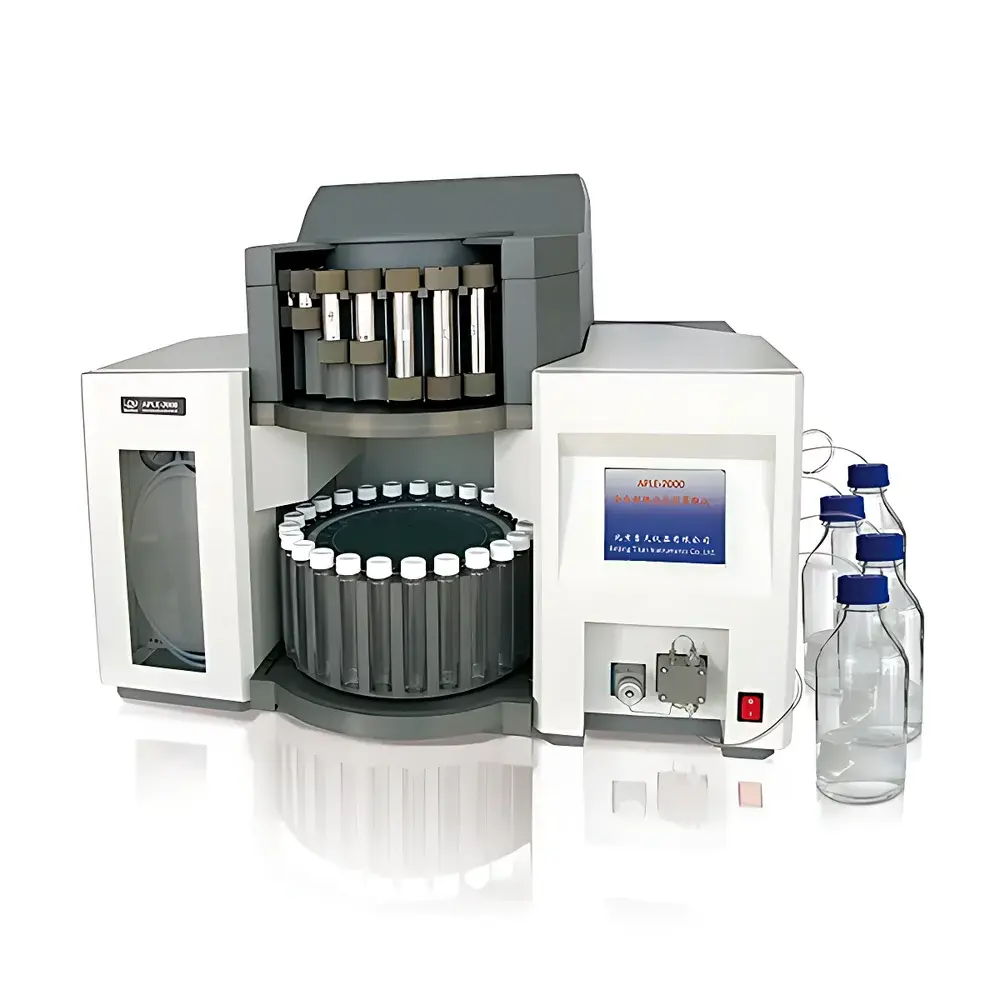
Titan Instruments APLE-3000 Automated Accelerated Solvent Extractor
| Brand | Titan Instruments |
|---|---|
| Origin | Beijing, China |
| Manufacturer Type | Original Equipment Manufacturer (OEM) |
| Instrument Type | Solid-Liquid Extraction System |
| Temperature Range | Ambient to 200 °C |
| Pressure Range | Atmospheric to 20 MPa |
| Extraction Cell Volumes | 1 mL, 5 mL, 10 mL, 22 mL, 34 mL, 66 mL, 100 mL |
| Cycle Time per Sample | 8–20 min |
| Dimensions | 78.3 × 67.5 × 77.3 cm |
Overview
The Titan Instruments APLE-3000 Automated Accelerated Solvent Extractor is a benchtop solid-liquid extraction system engineered for precision, reproducibility, and regulatory compliance in analytical laboratories. It operates on the principle of accelerated solvent extraction (ASE®), applying elevated temperature and pressure to enhance solute solubility and mass transfer kinetics while maintaining sample integrity. By heating solvents above their atmospheric boiling points under controlled pressure, the APLE-3000 achieves rapid, quantitative recovery of analytes from complex solid or semi-solid matrices—without thermal degradation or oxidation. This thermodynamic and kinetic optimization enables consistent extraction efficiency across diverse sample types, including soils, sediments, plant tissues, food commodities, pharmaceutical tablets, and polymer-based materials. Designed for integration into high-throughput workflows, the instrument supports unattended operation and aligns with modern laboratory requirements for trace-level analysis, method robustness, and data traceability.
Key Features
- Automated sequential extraction of up to 12 samples without manual intervention—reducing operator variability and improving inter-run consistency.
- Programmable temperature control (ambient to 200 °C) and pressure regulation (up to 20 MPa) to accommodate a broad spectrum of solvent systems (e.g., hexane, acetone, methanol, dichloromethane, and water-miscible mixtures).
- Modular extraction cell configuration supporting seven standardized volumes (1–100 mL), enabling method scalability from microgram-level screening to gram-scale preparative isolation.
- Hermetically sealed extraction chamber with integrated pressure relief and solvent containment—ensuring operator safety and minimizing volatile organic compound (VOC) emissions in accordance with OSHA and EU Directive 2004/37/EC.
- Rugged stainless-steel fluid path components resistant to corrosion and thermal cycling, ensuring long-term performance stability and low maintenance overhead.
- Intuitive touchscreen interface with preloaded EPA and Chinese standard methods (e.g., EPA Method 3545A, HJ 782–2016, HJ 783–2016), allowing rapid method deployment and parameter validation.
Sample Compatibility & Compliance
The APLE-3000 accommodates heterogeneous matrices such as soil, sludge, grain, leaf tissue, animal feed, activated carbon, and spent catalysts. Its extraction efficiency has been validated for target analytes including polycyclic aromatic hydrocarbons (PAHs), organochlorine pesticides (OCPs), polychlorinated biphenyls (PCBs), phthalate esters, mycotoxins, alkaloids, and lipid-soluble vitamins. The system complies with internationally recognized protocols for environmental and food testing, including U.S. EPA SW-846 Methods 3545A and 3546, ISO 14507:2005 (soil extraction), and Chinese Environmental Protection Standards HJ 782–2016 (determination of organochlorine pesticides in soil) and HJ 783–2016 (determination of PAHs in solid waste). All operational parameters—including temperature ramp rate, static dwell time, flush volume, and purge duration—are fully configurable and logged with timestamped metadata to support GLP/GMP audit readiness and FDA 21 CFR Part 11-compliant electronic records when paired with validated LIMS interfaces.
Software & Data Management
The embedded control software provides real-time monitoring of pressure transients, thermal profiles, and cycle progression. Each extraction run generates a structured log file containing method ID, cell ID, solvent batch number, operator ID, start/stop timestamps, and critical process deviations (e.g., overpressure events or temperature overshoot). Export formats include CSV and XML for seamless import into chromatographic data systems (CDS) such as Thermo Chromeleon, Agilent OpenLab CDS, or Waters Empower. Optional remote diagnostics and firmware update capability enable proactive service management. Audit trail functionality meets ISO/IEC 17025:2017 clause 7.9.2 requirements for data integrity and change control.
Applications
- Environmental laboratories: extraction of persistent organic pollutants (POPs) from contaminated soils and sediments prior to GC-MS or LC-MS/MS analysis.
- Food safety testing: quantification of pesticide residues in fruits, vegetables, and cereals per EU Regulation (EC) No 396/2005 and China GB 2763–2021.
- Pharmaceutical R&D: recovery of active pharmaceutical ingredients (APIs) and excipients from solid dosage forms for dissolution profiling and stability studies.
- Natural product research: selective isolation of terpenoids, flavonoids, and saponins from botanical matrices under optimized solvent polarity and temperature gradients.
- Petroleum geochemistry: asphaltene and saturate fractionation from crude oil residues and drill cuttings for biomarker analysis.
- Forensic toxicology: extraction of explosive residues (e.g., TNT, RDX) from swabbed surfaces and clothing substrates per ASTM E2329–22 guidelines.
FAQ
What solvents are compatible with the APLE-3000?
Commonly used solvents include acetone, methanol, ethyl acetate, dichloromethane, hexane, toluene, and water-based mixtures—provided they remain stable below 200 °C and within the pressure rating of selected cell hardware.
Does the system support method validation per ICH Q2(R2)?
Yes—when operated with documented SOPs and calibrated pressure/temperature sensors, the APLE-3000 supports assessment of accuracy, precision, specificity, linearity, range, and robustness required for analytical procedure validation.
Can extraction cells be cleaned and reused?
Stainless steel and quartz cells are autoclavable and solvent-rinseable; however, routine reuse requires verification of carryover via blank runs and adherence to cleaning validation protocols.
Is remote monitoring supported?
The instrument includes Ethernet connectivity and optional VNC-compatible remote desktop access for real-time status checks and limited parameter adjustments—subject to network security policies.
How is compliance with EPA Method 3545A verified?
Preconfigured method templates replicate specified static time (5 min), temperature (100–200 °C), pressure (1500 psi), and flush volume (60% cell volume); full compliance requires concurrent use of certified reference materials and matrix spike recovery testing.



