
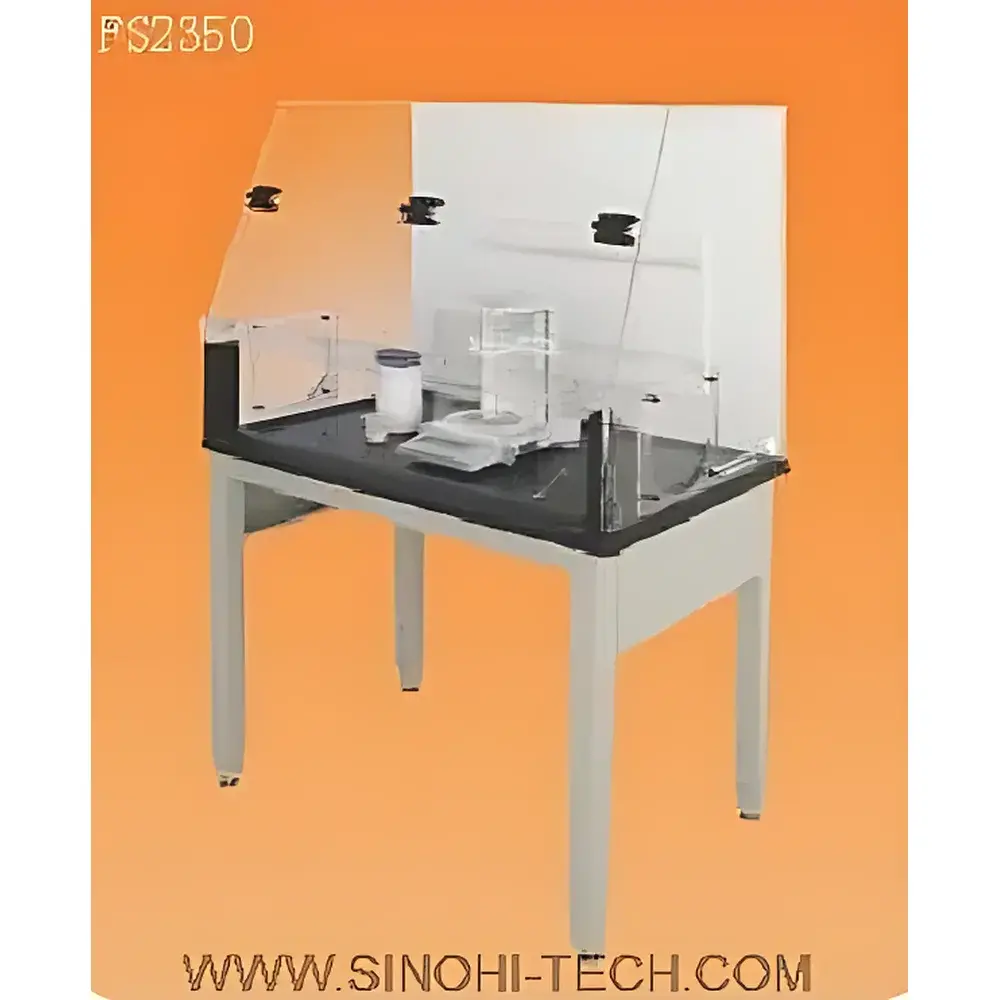
Flow Sciences FS2350 Precision Balance Safety Enclosure
| Origin | USA |
|---|---|
| Manufacturer Type | Authorized Distributor |
| Origin Category | Imported |
| Model | FS2350 |
| Pricing | Available Upon Request |
Overview
The Flow Sciences FS2350 Precision Balance Safety Enclosure is an engineered containment solution designed specifically for analytical and micro-balances operating in regulated laboratory environments. Unlike general-purpose fume hoods, the FS2350 integrates aerodynamic containment with vibration-isolated work surface geometry to preserve balance stability—critical when measuring samples at sub-milligram resolution—while simultaneously protecting personnel from airborne particulates, volatile organic compounds (VOCs), and low-toxicity hazardous chemicals. Its core principle relies on laminar, non-turbulent airflow management: air enters through a precisely calibrated front sash aperture, flows uniformly across the weighing surface via patented airfoil-shaped side baffles, and exits through rear plenum slots—minimizing eddies, recirculation zones, or pressure differentials that could induce drift or mass reading instability. This design complies with ANSI/AIHA Z9.5–2022 laboratory ventilation standards and supports GLP/GMP workflows where both measurement integrity and operator safety are co-dependent requirements.
Key Features
- Patented airfoil edge baffles ensure laminar, unidirectional airflow across the balance platform—eliminating turbulence-induced weighing errors
- Concave resin composite base with seamless, non-porous finish enables full-surface wipe-down and optional high-pressure spray cleaning per ISO 14644-1 Class 5 cleanroom maintenance protocols
- Aerodynamically optimized slot diffusers along the work surface perimeter maintain consistent face velocity (0.3–0.5 m/s) without disrupting balance calibration
- Integrated audible/visual alarm system continuously monitors and validates sash-position-corrected face velocity in real time
- Dual-side modular knockouts (2 × Ø76 mm) support optional waste bag ports, glove ports, or inert gas purging interfaces
- Structural frame constructed from powder-coated steel with reinforced acrylic viewing panels (6 mm thickness, UV-stabilized)
- No internal fans or motors—fully ducted operation ensures zero electromagnetic interference (EMI) with sensitive load cells
Sample Compatibility & Compliance
The FS2350 accommodates standard benchtop analytical balances (e.g., Mettler Toledo XSR, Sartorius Quintix, Ohaus Adventurer) up to 23″ (58.4 cm) depth and 35.75″ (90.8 cm) width. Its containment efficacy has been validated using ASHRAE 110 tracer gas testing (SF₆), demonstrating ≥99.9% capture efficiency at 0.4 m/s face velocity. The enclosure meets OSHA 29 CFR 1910.1450 requirements for laboratory chemical hygiene and aligns with EU Directive 2004/40/EC on electromagnetic fields. Optional HEPA filtration (EN 1822 H14) or activated carbon adsorption modules can be integrated for enhanced particulate or vapor control—certified per ISO 14644-3 for particle challenge testing.
Software & Data Management
While the FS2350 operates as a passive, hardware-based containment system, its alarm module outputs analog (4–20 mA) and digital (Modbus RTU) signals compatible with building management systems (BMS) and laboratory information management systems (LIMS). Real-time face velocity, sash position, and alarm status logs can be archived for FDA 21 CFR Part 11-compliant audit trails when paired with validated data acquisition software. Calibration certificates—including airflow mapping reports and tracer gas containment validation—are provided with each unit shipment and conform to ISO/IEC 17025-accredited third-party verification protocols.
Applications
- Weighing of potent pharmaceutical actives (APIs) under ICH Q5C and USP hazardous drug handling guidelines
- Preparation of certified reference materials (CRMs) requiring ISO/IEC 17034 traceability and environmental stability
- Microgram-scale gravimetric analysis in environmental testing labs (e.g., EPA Method 1613 dioxin quantification)
- Handling of nanomaterials and metal-organic frameworks (MOFs) where airborne particle generation must be suppressed below 10 nm detection thresholds
- QC/QA workflows in semiconductor-grade chemical manufacturing where electrostatic discharge (ESD)-safe grounding and particulate exclusion are mandatory
FAQ
Does the FS2350 require electrical power for basic containment operation?
No—its passive ducted design operates solely on building exhaust static pressure. Only the alarm module requires 24 V DC power.
Can it be retrofitted with variable air volume (VAV) control?
Yes—compatible with standard VAV boxes meeting ASHRAE 110 Class A performance criteria; integration requires commissioning by a certified HVAC engineer.
Is the resin base resistant to common solvents such as acetone or acetonitrile?
The phenolic resin composite exhibits >72-hour resistance to intermittent exposure per ASTM D543; continuous immersion is not recommended.
What is the minimum recommended exhaust duct velocity for optimal performance?
12–15 m/s in the main duct trunk, with ≤3% velocity variation across branch runs per ANSI/AIHA Z9.5 Annex C.
Does Flow Sciences provide installation qualification (IQ) documentation?
Yes—factory-verified IQ/OQ protocols are included, aligned with ISO 9001:2015 and compliant with EU GMP Annex 15 requirements.



