
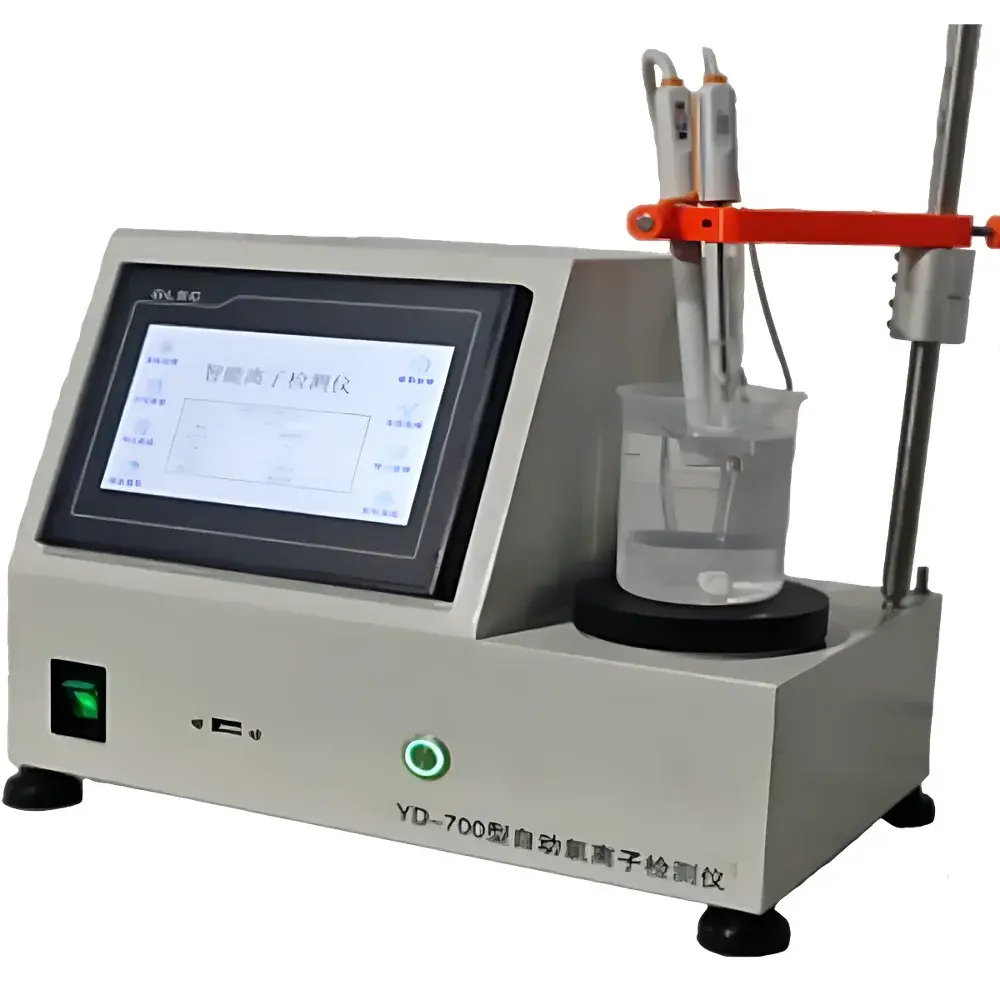
Jinhengxiang YD-700 Automated Chloride Ion Analyzer
| Brand | Jinhengxiang (JHX) |
|---|---|
| Model | YD-700 |
| Instrument Type | Benchtop Chloride Ion Analyzer |
| Detection Method | Potentiometric Ion-Selective Electrode (ISE) |
| Measurement Range | 0–200,000 mg/L Cl⁻ |
| Accuracy | ±2% of reading |
| Response Time | ≤5 minutes per sample |
| Automatic Dilution | 0–300× |
| Display | 7-inch capacitive touch screen |
| Data Export | USB 2.0 interface |
| Operating Temperature | 10–40 °C |
| Weight | 5.5 kg |
| Compliance | Designed for ISO 9001-manufactured quality control environments |
| Power Supply | AC 100–240 V, 50/60 Hz |
Overview
The Jinhengxiang YD-700 Automated Chloride Ion Analyzer is a benchtop potentiometric instrument engineered for precise, repeatable quantification of chloride ion concentration in aqueous matrices. It operates on the principle of selective potentiometry using a solid-state chloride ion-selective electrode (Cl⁻-ISE), coupled with a double-junction reference electrode to minimize liquid junction potential drift and ensure long-term stability. The system integrates automated sample handling—including programmable dilution up to 300-fold—enabling direct analysis of high-salinity samples (e.g., industrial brines, seawater concentrates, or desalination reject streams) without manual pre-dilution. Designed for routine operation in environmental monitoring labs, wastewater treatment facilities, and industrial QC settings, the YD-700 delivers trace-to-high-level chloride measurement (0–200,000 mg/L) with ≤5-minute cycle time per analysis, supporting throughput requirements aligned with ASTM D512-22 (Standard Test Method for Chloride Ion in Water) and ISO 9297:2000 (Water Quality — Determination of Chloride — Potentiometric Method).
Key Features
- Automated multi-step dilution (0–300×) with integrated peristaltic pump and precision fluidic path, minimizing operator intervention and cross-contamination risk.
- High-stability chloride ISE with extended lifetime (>12 months under continuous use) and built-in temperature compensation (PT1000 sensor).
- 7-inch industrial-grade capacitive touchscreen interface with intuitive icon-driven workflow navigation and multilingual OS support (English, Spanish, French default).
- Onboard calibration management: supports up to 5-point standard calibration curves with automatic slope validation and drift alerting.
- Rugged benchtop chassis (IP20-rated enclosure) with corrosion-resistant internal wetted components (PEEK, PTFE, and 316L stainless steel).
- Integrated QC flagging: auto-rejects out-of-tolerance readings based on electrode response slope, millivolt stability threshold, and calibration deviation limits.
Sample Compatibility & Compliance
The YD-700 accepts liquid samples with suspended solids <50 mg/L and turbidity <100 NTU; optional inline filtration module (0.45 µm PES membrane) is available for pretreatment of municipal wastewater or surface water. It complies with GLP data integrity expectations through timestamped audit trails for all calibrations, measurements, and method changes. While not FDA 21 CFR Part 11–certified out-of-the-box, the firmware supports ALCOA+ principles (Attributable, Legible, Contemporaneous, Original, Accurate) and enables export of raw mV/temperature/time datasets for third-party validation. The analyzer meets CE marking requirements for EMC Directive 2014/30/EU and Low Voltage Directive 2014/35/EU, and its measurement protocol aligns with ISO/IEC 17025:2017 clause 7.2.2 for method validation documentation.
Software & Data Management
The embedded firmware includes a local database storing ≥10,000 test records with full metadata (operator ID, sample ID, calibration ID, ambient temperature, electrode mV output, calculated concentration, and pass/fail status). Data export is supported via USB 2.0 mass storage mode—generating CSV files compatible with LIMS platforms (e.g., LabWare, STARLIMS) and statistical software (Minitab, JMP). Optional PC-based desktop software (YD-Link v3.2) provides advanced features including batch report generation (PDF/Excel), trend charting (concentration vs. time), and outlier detection using Grubbs’ test at α = 0.05. All exported files include digital signatures verifying file integrity and creation timestamp.
Applications
- Wastewater treatment plants: monitoring chloride ingress in biological nutrient removal (BNR) systems and compliance with discharge limits (e.g., EPA NPDES permit thresholds).
- Petrochemical refineries: real-time tracking of chloride-induced stress corrosion cracking (SCC) precursors in cooling water circuits and boiler feedwater.
- Power generation: feedwater purity assurance in thermal power stations where chloride >10 µg/L risks turbine blade pitting.
- Academic research: kinetic studies of chloride-mediated reactions in environmental chemistry, including halogen cycling in estuarine sediments.
- Drinking water utilities: verification of post-disinfection residual chloride levels and verification of ion exchange resin exhaustion.
FAQ
What electrode technology does the YD-700 employ?
It uses a factory-calibrated, solid-contact chloride ion-selective electrode (Ag/AgCl sensing element with polymeric membrane), optimized for low-drift performance in variable ionic strength matrices.
Can the YD-700 measure other anions such as nitrate or fluoride?
No—the instrument is dedicated to chloride quantification only; electrode selectivity coefficients (log KCl,NO₃ = −2.8, log KCl,F = −4.1) preclude reliable multi-analyte operation without hardware modification.
Is external calibration verification required before each analysis batch?
Per ISO 9297:2000, a single mid-range verification standard (e.g., 1000 mg/L Cl⁻) is recommended every 10 samples or 2 hours, whichever occurs first.
Does the system support remote diagnostics or network connectivity?
Not natively—the YD-700 lacks Ethernet/Wi-Fi modules; however, USB-connected PCs can enable remote access via secure VNC or TeamViewer when deployed in controlled IT environments.
What maintenance intervals are specified for the fluidic system?
Peristaltic pump tubing requires replacement every 6 months under continuous operation; electrode electrolyte refill (3 M KNO₃ inner filling solution) is recommended quarterly or after 200 measurements.
Related Products







