
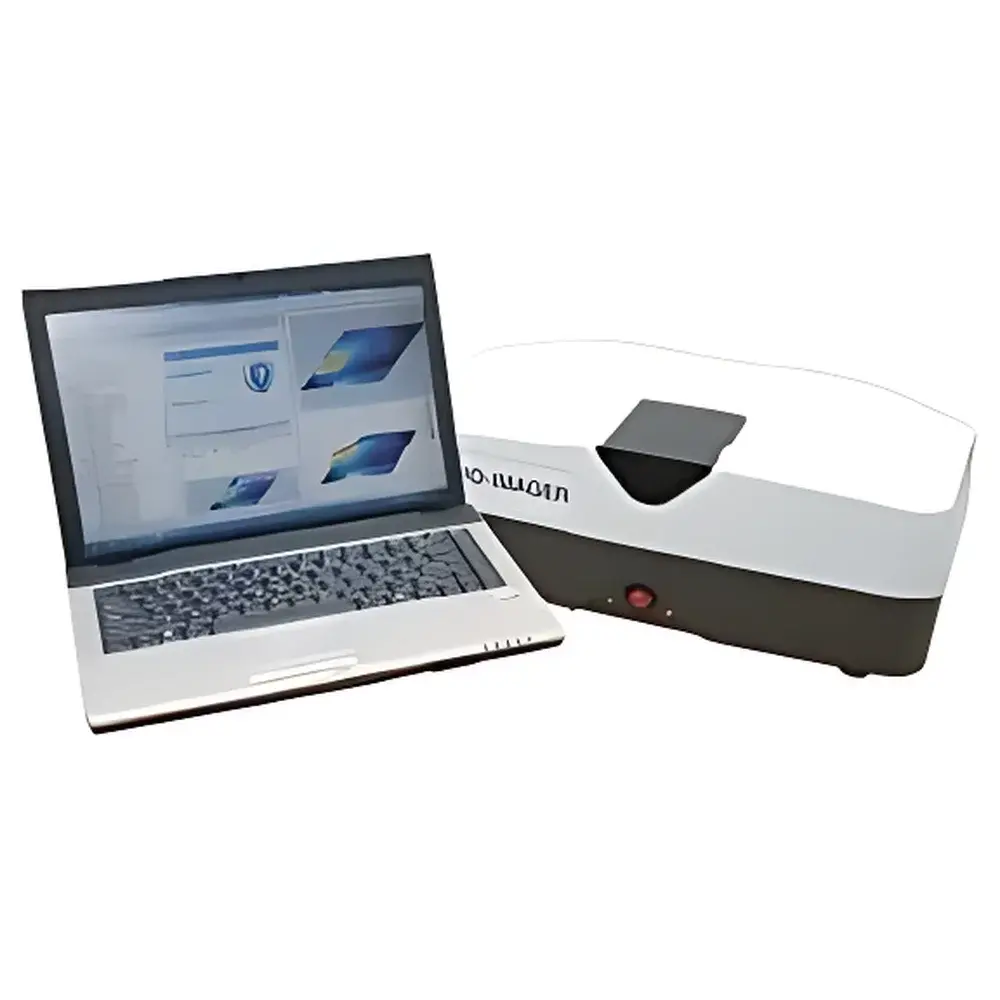
LDI FLUO-IMAGER Compact 3D Fluorescence Spectrometer for Hydrocarbon-in-Water Analysis
| Origin | France |
|---|---|
| Supplier Type | Authorized Distributor |
| Import Status | Imported |
| Model | FLUO-IMAGER |
| Instrument Type | Benchtop |
| Excitation Source | Pulsed Xenon Flash Lamp |
| Measurement Modes | Synchronous Fluorescence Scanning (SFS/EEM) + UV-Vis Absorption |
| Sample Handling | Batch and Optional Flow-Through Cell |
| Weight | 5 kg |
| Detectable Elements/Compounds | Crude Oil, Refined Fuels, PAHs, Phenolics, Chlorophyll-a (quantitative detection limits specified per compound) |
| Compliance | CE-marked, ISO/IEC 17025-compatible operation environment |
Overview
The LDI FLUO-IMAGER is a benchtop 3D fluorescence spectrometer engineered for rapid, reagent-free quantification of hydrocarbons and organic contaminants in aqueous matrices. Unlike conventional X-ray fluorescence (XRF) instruments—whose classification under “Wavelength Dispersive X-Ray Fluorescence Spectrometer” in metadata reflects legacy taxonomy—the FLUO-IMAGER operates on the principle of synchronous fluorescence spectroscopy (SFS), specifically modified excitation-emission matrix (EEM) acquisition, coupled with concurrent UV-Vis absorption spectroscopy. This dual-modal optical architecture enables direct molecular fingerprinting of polycyclic aromatic hydrocarbons (PAHs), petroleum fractions (e.g., gasoline, diesel, lubricants), phenolic compounds (phenol, cresols), and natural organic matter (NOM) such as humic and fulvic acids. The system utilizes a pulsed xenon flash lamp as its excitation source, eliminating thermal drift and enabling stable, high-reproducibility spectral acquisition across extended measurement sessions. Its compact footprint (5 kg) and integrated optical path design make it suitable for field-deployable laboratories, offshore platforms, and centralized water quality control facilities operating under ISO 17025 or EPA Method 418.1-aligned protocols.
Key Features
- Benchtop configuration with zero chemical reagent consumption: eliminates hazardous waste generation and enables sample recovery post-analysis.
- Simultaneous acquisition of SFS/EEM and UV-Vis absorption spectra within a single scan cycle—critical for correcting inner-filter effects and normalizing fluorescence intensity against sample turbidity or dissolved organic carbon (DOC) background.
- Adaptive spectral library engine: allows user-defined calibration models to be trained on site-specific water matrices (e.g., seawater, boiler feedwater, produced water), improving specificity for target analytes including naphthalene, anthracene, benzo[a]pyrene, chlorophyll-a, and alkylphenols.
- Configurable alarm thresholds: real-time concentration alerts trigger when analyte levels exceed pre-set regulatory or process-control limits (e.g., ISO 8573-1 for compressor oil carryover; ASTM D664 for acid number proxy via phenolic fluorescence).
- Automated FDOM (fluorescent dissolved organic matter) baseline subtraction: isolates anthropogenic hydrocarbon signals from natural fluorophore interference in raw surface water or groundwater.
Sample Compatibility & Compliance
The FLUO-IMAGER accepts liquid samples in standard 1-cm quartz cuvettes (batch mode) or optional flow-through cells (0.5–5 mL/min). It is validated for use with natural waters (fresh, brackish, marine), industrial effluents, cooling tower fluids, boiler feedwater, and oilfield-produced water. All spectral data acquisition and processing workflows support audit-trail generation compliant with GLP and 21 CFR Part 11 requirements when operated with validated software configurations. Instrument performance verification follows IUPAC-recommended procedures for fluorescence instrument calibration, including quinine sulfate quantum yield referencing and NIST-traceable absorbance standards. No X-ray emission is involved; thus, radiation safety certification (e.g., FDA 21 CFR 1020.40) does not apply—this is an optical spectroscopic platform, not an XRF device.
Software & Data Management
The embedded acquisition software provides real-time EEM contour mapping, peak deconvolution using parallel factor analysis (PARAFAC), and multivariate regression modeling (PLS, MLR) for quantitative prediction. Raw spectral datasets (.csv, .mat) are exportable for third-party chemometric analysis (e.g., MATLAB, Unscrambler X). Software logs include operator ID, timestamp, instrument settings, calibration history, and spectral quality metrics (signal-to-noise ratio, R² of reference fit). Data integrity safeguards include write-protected archive folders, electronic signatures for method validation, and version-controlled method templates aligned with ISO/IEC 17025 clause 7.2.2.
Applications
- Environmental monitoring: early detection of petroleum spills near drilling rigs, marinas, or pipeline corridors via in-situ PAH and alkylbenzene fluorescence signatures.
- Power generation: continuous surveillance of turbine oil ingress into condensate systems using benzene/toluene/xylene (BTX) spectral markers.
- Pharmaceutical manufacturing: verification of cleaning validation efficacy by detecting residual phenolic sanitizers in purified water loops.
- Drinking water treatment: differentiation between NOM-derived fluorescence and contamination events (e.g., diesel leakage into aquifers) using dual-excitation ratio analysis.
- Academic research: kinetic studies of photodegradation pathways for PAHs in simulated sunlight exposure experiments.
FAQ
Is the FLUO-IMAGER an X-ray fluorescence instrument?
No. Despite historical misclassification in some distributor catalogs, it is an optical fluorescence spectrometer utilizing pulsed xenon excitation and CCD-based emission detection—not X-ray tube excitation or crystal diffraction optics.
What is the typical detection limit for diesel in freshwater?
0.5 mg/L under standard 1-cm pathlength cuvette conditions; improved to 0.1 mg/L using flow-cell concentration or PARAFAC-enhanced signal extraction.
Can it quantify total petroleum hydrocarbons (TPH) without GC-MS confirmation?
It provides rapid TPH-equivalent estimates calibrated against reference standards (e.g., EPA SW-846 Method 418.1); however, definitive speciation requires chromatographic validation per regulatory submission requirements.
Does the system require annual recalibration by the manufacturer?
No. Users perform daily performance checks using built-in reference standards; full calibration verification is recommended every 6 months or after optical component replacement, following IUPAC Guide 2012-03.





