
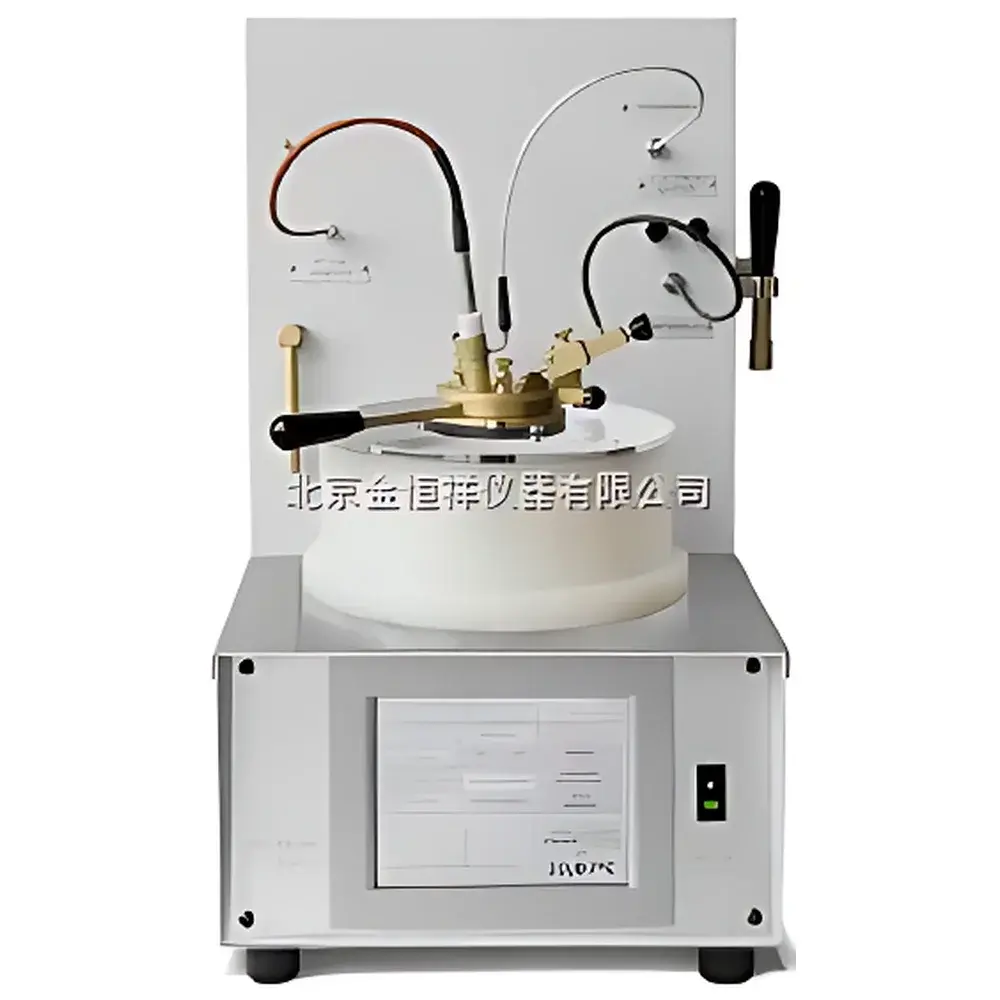
SDM 930AUT Fully Automated Closed-Cup Flash Point Tester (TAG Method)
| Brand | SDM |
|---|---|
| Origin | Italy |
| Model | 930AUT |
| Detection Method | Closed-Cup (TAG) |
| Standards Compliance | ASTM D56, D3278, D3934, D3941 |
| Temperature Sensor | PT100 |
| Cup Material | Copper |
| Heating System | Electronic Regulated Heater |
| Cooling System | Integrated Internal Cooling Coil |
| Ignition | Dual-Mode (Gas Flame & Electric Spark), Auto-Actuated per Standard Protocol |
| Temperature Accuracy | ±0.1 °C |
| Display | 800×480 Touchscreen Interface |
| Power Supply | 220 V, 50 Hz, 600 W |
| Enclosure | Acid-Resistant Epoxy-Coated Cabinet |
| Bath & Holder | Brass Construction |
| Software Platform | Windows 2000/XP/Vista Compatible |
Overview
The SDM 930AUT Fully Automated Closed-Cup Flash Point Tester is an engineered solution for precise, repeatable flash point determination of petroleum products, solvents, industrial chemicals, and waste streams in accordance with internationally recognized closed-cup test methodologies—specifically the TAG (Tagliabue) method. Based on the fundamental principle of controlled thermal ramping under sealed conditions, the instrument heats a defined volume of sample in a standardized copper cup while periodically introducing an ignition source at predetermined temperature intervals. Flash point is identified when the vapor-air mixture above the sample ignites momentarily upon exposure to the flame or spark, detected via a sensitive ionization sensor. This thermodynamic endpoint reflects the lowest temperature at which sufficient volatile vapors are generated to form an ignitable mixture—critical for hazard classification, transportation safety (UN TDG, ADR, IMDG), and regulatory compliance in refining, petrochemical, and environmental laboratories.
Key Features
- Fully automated operation from sample loading to final report generation, minimizing operator intervention and inter-laboratory variability.
- Dual-mode ignition system (adjustable gas flame and electric spark) activated precisely per ASTM D56 timing and positioning requirements.
- PT100 platinum resistance thermometer integrated directly into the test cup assembly for traceable, high-stability temperature measurement with ±0.1 °C accuracy.
- Electronically regulated heating circuit enabling linear, programmable temperature ramp rates and tight thermal control throughout the test sequence.
- Integrated internal cooling coil allows rapid post-test cooldown and stabilization between analyses—enhancing throughput in high-volume QC environments.
- Robust mechanical architecture: brass-made constant-temperature bath and cup holder; acid-resistant epoxy-coated steel enclosure for long-term durability in corrosive lab atmospheres.
- 800×480 high-contrast touchscreen interface with intuitive icon-driven navigation—no external PC required for routine operation.
Sample Compatibility & Compliance
The 930AUT supports a broad range of liquid samples including gasoline, diesel, kerosene, lubricating oils, biodiesel blends, organic solvents (e.g., acetone, toluene, ethanol), and aqueous or heterogeneous waste streams. Its design conforms strictly to the geometric, thermal, and procedural specifications of ASTM D56 (Tag Closed-Cup), ASTM D3278 (Small Scale), ASTM D3934 and D3941 (for viscous or high-boiling materials), IP 491/492/304, and ISO 1516/1523/3679. The system meets essential requirements for GLP-compliant testing environments—including audit-trail-capable software logging, user-access controls, and method versioning—and supports alignment with ISO/IEC 17025 documentation frameworks.
Software & Data Management
The embedded Windows-based software suite provides full method configuration, real-time monitoring, and comprehensive data handling without dependency on third-party platforms. It comprises four functional modules: Analysis (method selection, parameter entry, run initiation), Diagnostics (system self-check, sensor validation, error flagging), Calibration (temperature probe verification, ignition timing adjustment), and Data Processing (statistical summary, trend analysis, customizable report export). All test parameters—including ramp rate, ignition interval, hold time, and pass/fail thresholds—are fully editable and stored with timestamped metadata. Reports can be exported in PDF or CSV format, include graphical temperature-vs.-ignition-event plots, and support configurable print layouts compliant with internal QA templates or external regulatory submissions.
Applications
- Refinery QC labs performing routine flash point verification on distillate fractions prior to blending or shipment.
- Petrochemical R&D facilities evaluating volatility profiles of novel fuel formulations or bio-derived intermediates.
- Environmental testing laboratories assessing flammability hazards of contaminated soils, leachates, or industrial effluents per EPA SW-846 Method 1010A.
- Contract testing organizations delivering accredited flash point data for UN classification (Class 3 Flammable Liquids) and SDS authoring.
- Manufacturing QA departments validating solvent purity and stability across pharmaceutical, paint, and adhesive production lines.
FAQ
Does the 930AUT comply with FDA 21 CFR Part 11 requirements for electronic records?
The instrument’s software supports user authentication, electronic signatures, and audit-trail logging—core elements of Part 11—but full compliance depends on site-specific validation protocols and IT infrastructure configuration.
Can the system be integrated into a LIMS environment?
Yes—via configurable ASCII or CSV file export with structured naming conventions and time-stamped metadata, enabling seamless ingestion into most modern LIMS platforms.
What maintenance is required for the ionization detector?
The detector requires periodic cleaning with isopropyl alcohol and visual inspection for carbon buildup; no recalibration is needed unless physical damage occurs.
Is external water circulation required for the cooling coil?
No—the internal cooling coil operates passively using ambient air convection; no chiller or external coolant loop is necessary.
How is temperature uniformity verified across the cup surface?
Uniformity is ensured by the brass bath geometry, direct PT100 immersion in the cup wall, and pre-calibrated heating algorithm validated against NIST-traceable reference standards during factory certification.




