
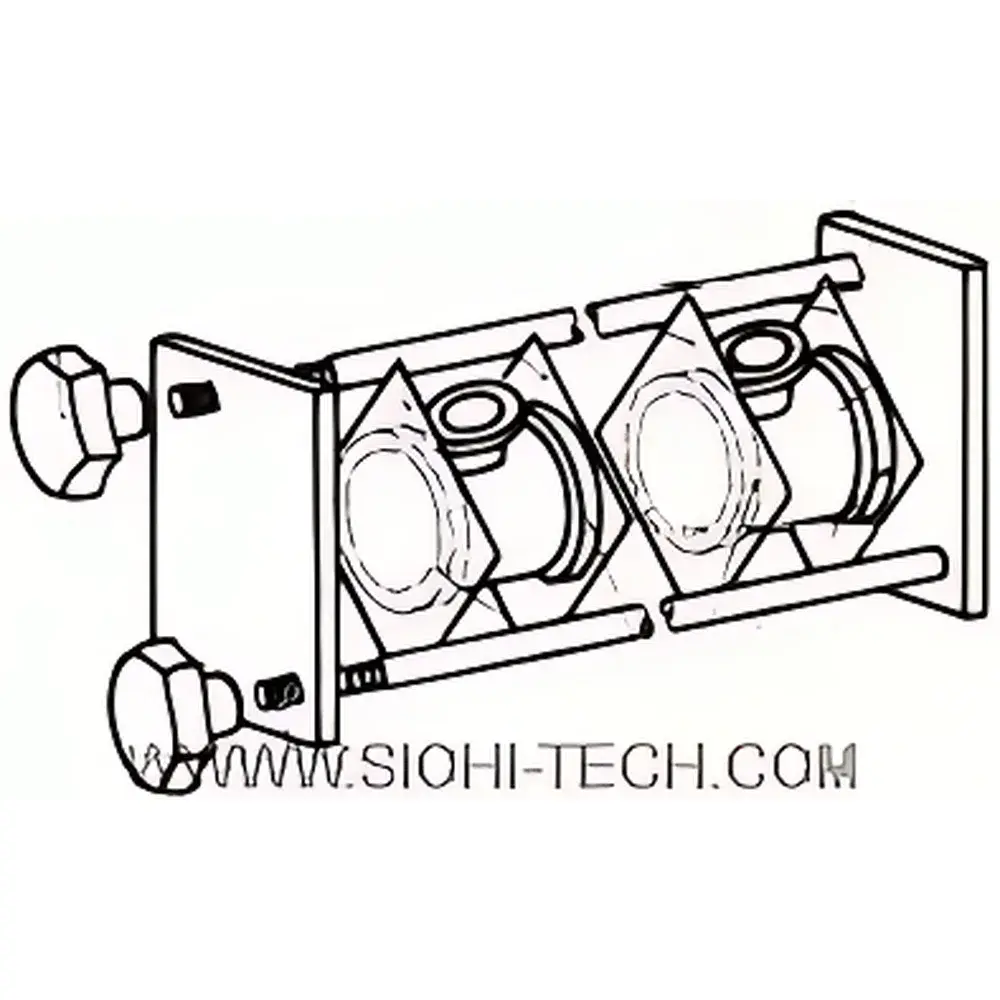
Ilisens #434 Static Corrosion Test Apparatus
| Origin | Germany |
|---|---|
| Manufacturer Type | Distributor |
| Origin Category | Imported |
| Model | #434 |
| Pricing | Upon Request |
Overview
The Ilisens #434 Static Corrosion Test Apparatus is an engineered laboratory instrument designed for standardized evaluation of coating and film resistance to aggressive chemical environments under static immersion conditions. It operates on the principle of controlled, non-agitated exposure—where test specimens are held in fixed orientation within sealed, chemically inert chambers filled with defined corrosive media (e.g., acidic, alkaline, saline, or organic solutions). Unlike dynamic corrosion testing systems, this apparatus isolates variables such as fluid flow, shear stress, or electrochemical polarization, enabling assessment of intrinsic material degradation mechanisms—including blistering, delamination, discoloration, softening, or interfacial attack—under equilibrium-phase conditions. The dual-cylinder architecture allows simultaneous comparative testing of up to four 70 × 70 × 5 mm substrates (metal, wood, or glass), with optional dual-sided exposure via sandwiched specimen configuration. Temperature-elevated operation (up to 60 °C) is supported through external environmental chamber integration, ensuring compliance with accelerated aging protocols per ISO 2812-2, ASTM D1308, and EN ISO 12944-6.
Key Features
- Dual independent cylindrical test chambers (Ø47 mm × height), fabricated from borosilicate glass for optical clarity and chemical inertness
- Corrosion-resistant construction: all non-glass components—including sealing rings (polyester-based), clamping rods, and fasteners—are selected for compatibility with HCl, NaOH, NaCl brine, acetone, ethanol, and other common test media
- Modular sealing system: four precision-machined polyester sealing rings ensure leak-tight integrity during extended exposure (up to 1,000 hours)
- Visual real-time monitoring: transparent cylinder walls permit continuous observation of surface morphology changes without sample removal or chamber disassembly
- Compact footprint (180 × 130 × 100 mm) and low mass (~1 kg net) facilitate benchtop deployment in QC labs, R&D facilities, and accredited testing laboratories
- Configurable dual-sided testing: specimens requiring evaluation on both coated surfaces are mounted between two chambers using the integrated dual-axis clamping mechanism
Sample Compatibility & Compliance
The #434 apparatus accommodates rigid planar substrates of standard dimensions (70 × 70 × 5 mm), including cold-rolled steel panels (e.g., ASTM A1008), aluminum alloy 2024-T3, sanded pine wood, and float glass. Coating thicknesses ranging from 15 µm to 250 µm are fully supported. All test procedures align with internationally recognized static immersion standards: ISO 2812-2 (paints and varnishes — determination of resistance to liquids — part 2: immersion in liquids other than water), ASTM D1308 (effect of common liquids on clear and pigmented organic coatings), and EN ISO 12944-6 (corrosion protection of steel structures by protective paint systems — laboratory performance tests). Instrument design inherently supports GLP-compliant documentation workflows when paired with traceable calibration records and dated exposure logs.
Software & Data Management
The #434 is a manually operated, hardware-only platform with no embedded electronics or firmware. As such, it requires no proprietary software, drivers, or network connectivity—reducing validation overhead in regulated environments. Test documentation is maintained externally via LIMS-integrated spreadsheets or paper-based audit trails, supporting full traceability of exposure duration, solution composition (batch number, concentration, pH), ambient temperature/humidity, and visual inspection timestamps. For FDA-regulated operations (e.g., medical device coating qualification), the apparatus meets baseline requirements for 21 CFR Part 11 compliance when used with electronic records systems that enforce user authentication, audit trail generation, and record retention policies.
Applications
- Qualification of automotive OEM primer-surfacer-topcoat systems against road salt and de-icing agents
- Validation of marine-grade antifouling coatings exposed to synthetic seawater (3.5 wt% NaCl)
- Comparative screening of powder-coated aluminum extrusions for architectural façade applications
- Stability assessment of UV-cured acrylate films on polycarbonate substrates in solvent-rich industrial cleaning environments
- Research into hydrolytic degradation kinetics of biodegradable polymer films (e.g., PLA, PHA) in buffered physiological media
FAQ
Can the #434 be used for elevated-temperature testing?
Yes—while the apparatus itself contains no heating element, it is compatible with external thermostatic cabinets or heated enclosures operating up to 60 °C. Chamber seals and glass retain integrity under these conditions.
Is the instrument suitable for volatile organic solvents?
Yes, provided the test chamber inlet ports are sealed with chemically resistant stoppers (e.g., PTFE-faced silicone) and ventilation protocols are followed per local EHS guidelines.
What substrate preparation standards are recommended?
ASTM D2200 (standard practice for preparing metal panels for testing paints) and ISO 1514 (standard panels for testing paints) are strongly advised prior to coating application and mounting.
How is reproducibility ensured across multiple users?
Standardized torque specifications for clamping screws (0.8–1.2 N·m), calibrated pipettes for solution dosing, and documented light-source positioning for visual assessment minimize inter-operator variability.
Does Ilisens provide certified reference materials or test solution kits?
No—solution preparation follows user-defined or standard-compliant formulations; however, technical application notes detailing ISO/ASTM-compliant recipes are available upon request.



