

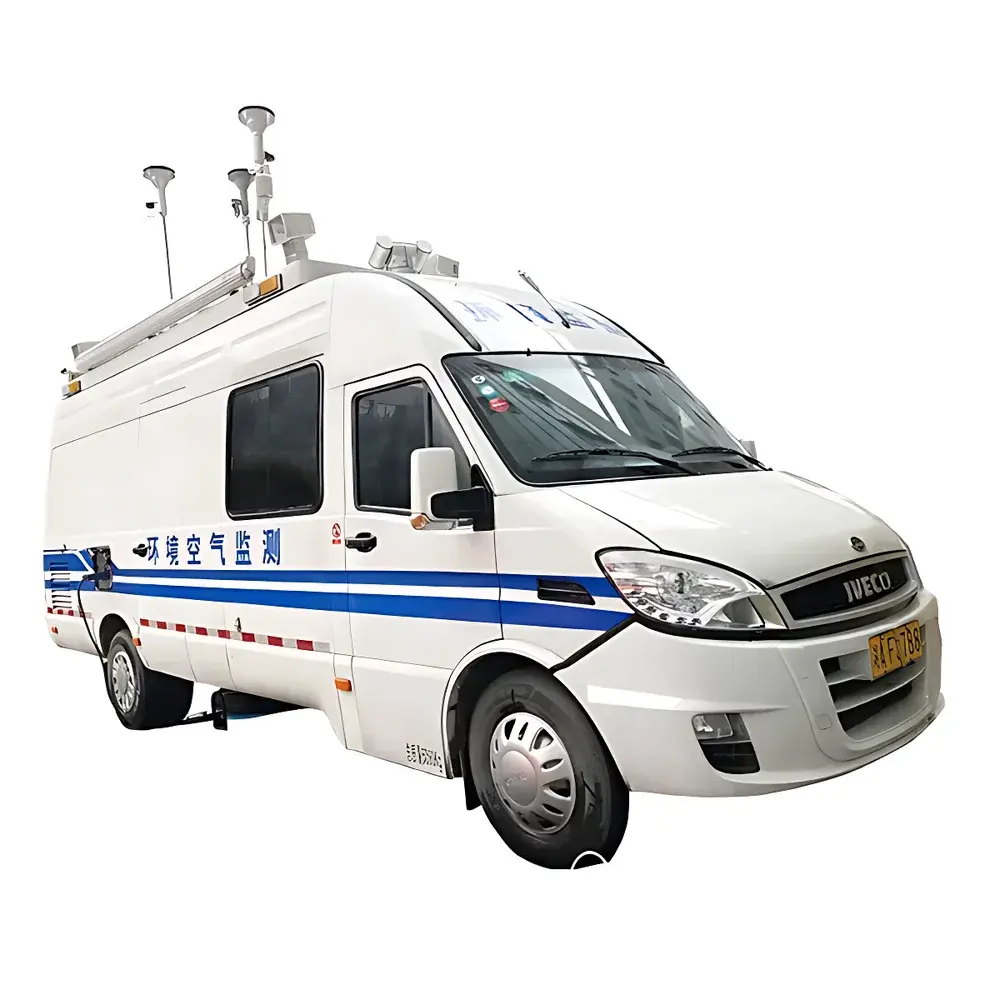
Lihero VOCs Mobile Monitoring Vehicle
| Brand | Lihero |
|---|---|
| Origin | Hunan, China |
| Manufacturer Type | Authorized Distributor |
| Country of Origin | China |
| Model | VOCs Mobile Monitoring Vehicle |
| Pricing | Available Upon Request |
Overview
The Lihero VOCs Mobile Monitoring Vehicle is a fully integrated, vehicle-mounted atmospheric monitoring platform engineered for real-time, spatially resolved detection and characterization of volatile organic compounds (VOCs) in ambient air. Built on a robust commercial chassis and equipped with modular analytical instrumentation—including gas chromatography–mass spectrometry (GC-MS) or proton-transfer-reaction time-of-flight mass spectrometry (PTR-TOF-MS), high-resolution particulate matter composition analyzers (e.g., aerosol mass spectrometers), and scanning elastic backscatter lidar systems—the system enables three-dimensional mapping of pollutant plumes across urban, industrial, and peri-urban environments. Its core measurement principle relies on continuous, automated sampling via heated inlet manifolds, real-time spectral deconvolution, and georeferenced data fusion to generate dynamic concentration fields with meter-level positional accuracy (GPS/IMU synchronized). Designed for regulatory-grade field deployment, the vehicle supports both routine surveillance and rapid-response emergency monitoring under ISO 17025-aligned operational protocols.
Key Features
- Real-time VOC speciation and quantification at sub-parts-per-trillion (pptv) detection limits, with <1-minute temporal resolution per compound class
- Co-located high-sensitivity PM2.5/PM10 chemical speciation (e.g., organics, nitrate, sulfate, ammonium, black carbon) using online aerosol mass spectrometry
- 3D atmospheric profiling via scanning UV/IR elastic lidar—capable of boundary layer height determination, plume vertical extent tracking, and aerosol optical depth derivation
- Integrated GIS-enabled data visualization suite delivering live geospatial heatmaps, trajectory modeling (HYSPLIT integration), and emission source attribution
- Climate-controlled, vibration-damped instrument cabin with redundant power supply (dual AC/DC + UPS), NEMA 12-rated environmental sealing, and onboard calibration gas manifold
- Modular architecture supporting field-upgradable sensor payloads and compliance-ready audit trails per EPA Method TO-15/TO-17 and EU Air Quality Directive 2008/50/EC requirements
Sample Compatibility & Compliance
The system is validated for ambient air matrices across diverse climatic conditions (−20 °C to +45 °C operating range; up to 95% RH non-condensing). It accommodates gaseous VOCs (C2–C12 hydrocarbons, oxygenated VOCs, halogenated compounds, aromatics), semi-volatile organic compounds (SVOCs), and size-resolved particulate matter (0.01–10 µm aerodynamic diameter). All analytical modules undergo factory calibration traceable to NIST SRMs and are verified pre-deployment against certified reference materials (CRMs) per ISO/IEC 17025:2017 clause 7.7. Data acquisition complies with EPA 40 CFR Part 58 Appendix A-1 (ambient air monitoring quality assurance) and supports GLP/GMP-aligned metadata tagging—including operator ID, GPS timestamp, instrument status flags, and calibration verification logs.
Software & Data Management
Operated via Lihero’s proprietary AeroTrack Suite, the platform provides unified control of all onboard instruments through a centralized touchscreen HMI. Raw spectral and chromatographic data are processed in real time using embedded chemometric algorithms (PCA, MCR-ALS) for untargeted peak identification and quantification. Export formats include netCDF-4 (CF-compliant), CSV with ISO 8601 timestamps, and GeoJSON for GIS interoperability. The software supports 21 CFR Part 11-compliant user authentication, electronic signatures, and immutable audit trails—including all parameter changes, calibration events, and data export actions. Remote diagnostics, firmware updates, and secure cloud synchronization (AES-256 encrypted) are enabled via LTE/5G cellular telemetry with optional satellite backup.
Applications
- Industrial fence-line monitoring and leak detection (LDAR) verification in petrochemical, pharmaceutical, and coating manufacturing facilities
- Urban air quality hotspot identification and source apportionment during smog episodes or seasonal pollution events
- Post-incident environmental assessment following chemical spills, fires, or hazardous material releases
- Validation of regional chemical transport models (e.g., CMAQ, CAMx) through high-density mobile measurement campaigns
- Supporting municipal clean air action plans with granular spatiotemporal emission inventories aligned with WHO Air Quality Guidelines
- Academic research on VOC–oxidant–aerosol interaction mechanisms under real-world atmospheric conditions
FAQ
What VOC compounds can this system detect and quantify?
The platform is configured for >150 priority VOCs listed in EPA Method TO-15 and EU Directive 2004/107/EC—including BTEX, aldehydes, terpenes, chlorinated solvents, and carbonyls—with compound-specific LODs ranging from 0.5 to 50 pptv depending on matrix interference and dwell time.
Is the lidar component capable of distinguishing aerosol types?
Yes—the dual-wavelength (355 nm / 532 nm) elastic backscatter lidar provides depolarization ratio and color ratio metrics, enabling qualitative classification of dust, smoke, sea salt, and anthropogenic aerosols per EARLINET methodology.
Can the vehicle operate autonomously during extended surveys?
It supports unattended operation for up to 8 hours on internal power, with automated start/stop triggers based on GPS geofencing, predefined route waypoints, or external event signals (e.g., API-based air quality alert feeds).
How is data integrity ensured during transmission and storage?
All data streams are digitally signed at acquisition, stored locally on RAID-1 solid-state arrays with SHA-256 hash logging, and transmitted via TLS 1.3-encrypted channels to designated secure servers compliant with ISO/IEC 27001 information security standards.
Does the system meet international certification requirements for regulatory use?
While not individually type-approved by EU Notified Bodies or US EPA, each analytical module carries relevant CE marking (EMC/LVD), and the full system has been successfully deployed in projects requiring adherence to ISO 14001, ISO 9001, and China’s HJ 653–2013 technical specifications for ambient air monitoring equipment.
Related Products







