
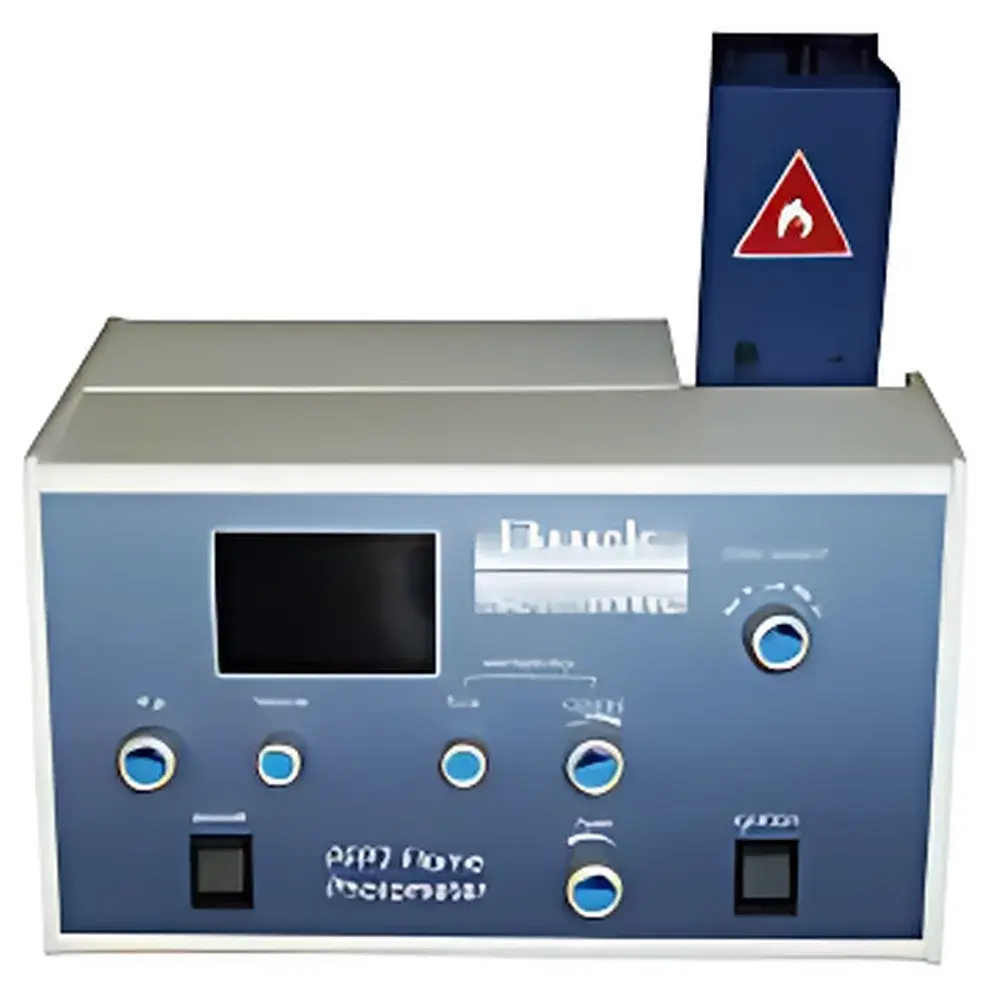
Buck PFP-7 Flame Photometer
| Origin | USA |
|---|---|
| Manufacturer Type | Authorized Distributor |
| Origin Category | Imported |
| Model | PFP-7 |
| Price Range | USD 6,800 – 13,600 |
| Power Supply | 90–125 V or 190–250 V, 50/60 Hz |
| Air Requirement | Oil-free, 6 L/min at 1 kg/cm² (14 psi) |
| Fuel Compatibility | Propane, Butane, Natural Gas, or LPG |
| Measurement Range | 0–199.9 mmol/L (Na/K), 0–199.9 ppm (Li) |
| Repeatability | ≤1% CV for 20 consecutive 50.0 mmol/L Na readings |
| Linearity | <2% deviation at 3 ppm Na/K + 5 ppm Li set to 100% |
| Interference | <0.5% cross-sensitivity among Na, K, Li |
| Recorder Output | 1.00 V at 100.0 reading |
| Dimensions | 420 × 360 × 300 mm |
| Weight | 8 kg |
Overview
The Buck PFP-7 Flame Photometer is a benchtop atomic emission spectrometer engineered for quantitative determination of alkali and alkaline earth metals—primarily sodium (Na), potassium (K), and lithium (Li)—in aqueous biological, environmental, industrial, and food samples. Based on the principle of flame atomic emission spectroscopy (FAES), the instrument atomizes and excites sample ions in a stable, temperature-controlled laminar flame; emitted radiation at characteristic wavelengths (e.g., 589 nm for Na, 766 nm for K, 670 nm for Li) is isolated via interference filters and quantified by a photomultiplier tube. Designed for clinical laboratories, quality control units, and materials testing facilities, the PFP-7 delivers direct concentration readouts in mmol/L (for serum Na/K) or ppm (for Li), eliminating manual calculation when paired with standardized dilution protocols (e.g., 1:100 or 1:200 for undiluted serum). Its robust architecture supports routine high-throughput analysis under GLP-compliant workflows and integrates seamlessly into existing laboratory infrastructures without requiring specialized optical enclosures or cooling systems.
Key Features
- One-touch piezoelectric ignition system for rapid, reliable flame startup without external spark generators
- Dual-range sensitivity control (fine/coarse) enabling precise calibration across low- and high-concentration matrices—from trace Li in pharmaceutical excipients to elevated Na/K in dialysate or urine
- Motorized filter wheel with pre-aligned interference filters for Na, K, and Li, allowing sequential multi-element analysis with <5-second filter transition time
- Real-time electronic flame monitoring with automatic shutdown upon flame extinction or instability—preventing solvent accumulation and ensuring operator safety
- Adjustable decimal point positioning (0.1, 1, or 10-unit resolution) for optimized display granularity per application requirement
- Analog recorder output (0–1 V DC, linearly scaled to 0–100.0 display units) compatible with legacy chart recorders or modern data acquisition systems
- Fuel-flexible burner assembly supporting propane, butane, natural gas, and LPG—calibrated for consistent stoichiometric combustion across fuel types
Sample Compatibility & Compliance
The PFP-7 accepts liquid samples introduced via capillary aspiration (standard 0.5–2.0 mL/min flow rate) and accommodates a wide range of matrix types: clarified serum/plasma (diluted 1:100 or 1:200), plant tissue digests, cement leachates, brewing wort, and wastewater filtrates. Sample introduction requires no nebulizer gas optimization—air pressure is fixed at 14 psi (1 kg/cm²), minimizing inter-operator variability. The system complies with ASTM D1075 (alkali content in portland cement), ISO 11843-2 (detection capability estimation), and USP (potassium chloride assay). While not FDA 21 CFR Part 11–certified out-of-the-box, its analog output and manual calibration logbook support audit-ready documentation for CLIA-waived or ISO 15189-accredited environments where electronic signature requirements are managed externally.
Software & Data Management
The PFP-7 operates as a standalone instrument with no embedded microprocessor or digital interface. All calibration, measurement, and reporting functions are executed manually using front-panel controls and visual display. Calibration curves are constructed using standard addition or two-point methods; linearity verification is performed per ASTM E180–22 guidelines. Raw analog output (1.00 V = 100.0 reading) may be digitized via third-party DAQ hardware (e.g., National Instruments USB-6009) and logged in compliant software (e.g., LabVIEW, MATLAB, or validated Excel templates) with full audit trail configuration. Internal memory is not present; all calibration parameters and sample IDs must be recorded externally per GLP Annex 11 or GMP Chapter 4 expectations.
Applications
- Clinical chemistry: Direct quantification of serum Na⁺ and K⁺ for electrolyte panel validation (CLIA Level I–II testing)
- Cement manufacturing: Alkali content (Na₂O + K₂O) assessment per ASTM C150 and EN 197-1 to mitigate alkali-silica reaction risks
- Brewing science: Calcium monitoring in brewing water and wort to optimize enzyme activity and beer stability
- Agricultural labs: Soil extract analysis for exchangeable K⁺ and Na⁺ in salinity stress studies
- Pharmaceutical QC: Lithium carbonate assay in psychiatric drug formulations per USP monograph
- Environmental testing: Sodium and potassium screening in surface water and effluent streams per EPA Method 200.7 (modified)
FAQ
What sample preparation is required for serum analysis?
Serum must be diluted 1:100 or 1:200 with deionized water prior to aspiration. No protein precipitation or filtration is needed if samples are free of particulates.
Can the PFP-7 measure calcium or magnesium?
No. The PFP-7 is configured exclusively for Na, K, and Li via fixed-wavelength interference filters. Calcium and magnesium require different excitation energies and are not supported.
Is routine maintenance documented in the user manual?
Yes. The manual includes quarterly burner alignment procedures, monthly filter inspection protocols, and annual photomultiplier dark-current verification steps—all traceable to NIST-traceable standards.
Does the instrument support automatic calibration curve generation?
No. Calibration is performed manually using standard solutions. Curve fitting (linear or quadratic) must be conducted externally using spreadsheet or statistical software.
What is the typical warm-up time before first measurement?
Allow 15 minutes after ignition for flame thermal equilibrium and photomultiplier stabilization; reproducibility specifications assume this preconditioning period has elapsed.




