
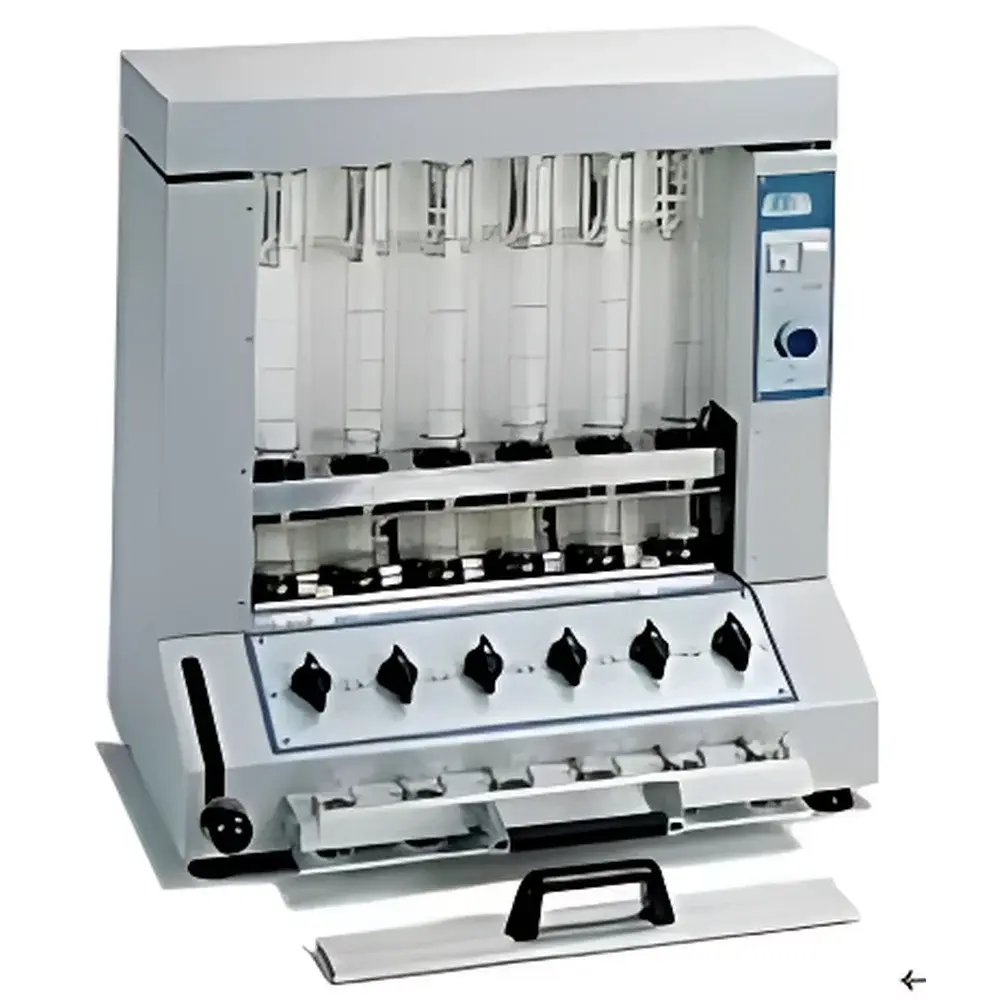
JP Dosi-fiber Fiber Analyzer
| Brand | JP |
|---|---|
| Origin | Spain |
| Model | Dosi-fiber |
| Sample Capacity | 6 positions |
| Throughput | up to 36 samples/day (Weende method) |
| Sample Mass Range | 0.5–3 g (typical 1 g) |
| Measurement Range | 0.1–100% |
| Repeatability | ±1% (for fiber content 1–30%) |
| Accuracy | ±0.1% |
| Cooling Water Consumption | 1 L/min |
| Heating System | Infrared elements |
| Housing | Rilsan-coated robust enclosure |
Overview
The JP Dosi-fiber Fiber Analyzer is a fully automated, gravimetric fiber extraction system engineered for precision and regulatory compliance in feed, food, and agricultural laboratories. Designed and manufactured in Spain, it implements standardized sequential solvent extraction protocols—including Weende, Van Soest (NDF, ADF), and AOAC-compliant dietary fiber methods—without reliance on aggressive acids such as acetic acid, trichloroacetic acid (TCA), or nitric acid. Its core operational principle centers on controlled thermal digestion followed by integrated vacuum-assisted filtration within disposable crucibles, ensuring complete mass balance throughout the analytical workflow. Unlike batch-style digesters requiring manual transfer between vessels, the Dosi-fiber maintains sample integrity by retaining the specimen within the same crucible—from initial weighing through digestion, rinsing, drying, and final ashing—minimizing handling-induced loss and operator variability. This architecture supports full traceability under GLP and GMP frameworks, and its design aligns with ISO 6865 (Animal feeding stuffs — Determination of crude fibre), AOAC 978.10 (Dietary Fiber in Foods), and ASTM D4194 (Standard Test Methods for Cellulose Content in Wood Pulp).
Key Features
- Robust Rilsan-coated steel housing for chemical resistance and long-term durability in high-throughput lab environments
- Independent infrared heating elements per digestion position, enabling uniform temperature control across all six sample stations
- Simultaneous processing of up to six samples with programmable, reproducible thermal profiles (digestion, rinsing, drying)
- Integrated extraction–filtration manifold eliminating manual transfers and associated mass loss risks
- Ceramic crucible support system with ergonomic positioning for rapid loading/unloading and consistent alignment during filtration
- Gravimetric flexibility: samples remain in the same crucible from tare to final ash weight, supporting multi-stage weighing (e.g., pre-digestion, post-NDF, post-ADF, residue ash)
- No solvent evaporation losses due to sealed condensation path and optimized reflux geometry
Sample Compatibility & Compliance
The Dosi-fiber accommodates heterogeneous solid matrices including animal feedstuffs (pellets, meal, silage), cereal grains, legumes, forage grasses, wood pulp, paper fibers, and textile cellulose derivatives. Its modular protocol configuration supports both traditional proximate analysis (crude fiber via Weende) and advanced fiber fractionation (neutral detergent fiber, acid detergent fiber, lignin, and residual ash). All wet chemistry steps comply with internationally recognized reference methods—specifically AOAC Official Methods 978.10, 962.09, and 991.43; ISO 5986, 6865, and 13906; and USP & EP monographs for dietary fiber quantification. The instrument’s closed-loop water cooling (1 L/min flow rate) ensures stable thermal management during extended operation, while its non-corrosive fluid pathways meet FDA 21 CFR Part 11 readiness requirements when paired with validated LIMS integration.
Software & Data Management
While the base Dosi-fiber operates via intuitive front-panel controls with preset method templates, optional PC-based software enables full method parameterization, real-time monitoring of temperature and cycle progression, electronic audit trails, and CSV/Excel export of raw mass data. All weight entries—including initial tare, post-digestion residue, dried NDF/ADF fractions, and ash weights—are timestamped and user-logged, satisfying ALCOA+ principles (Attributable, Legible, Contemporaneous, Original, Accurate, Complete, Consistent, Enduring, Available). Data files retain full metadata: operator ID, method version, calibration history, and environmental conditions (ambient temperature/humidity if logged externally), facilitating seamless integration into laboratory quality management systems compliant with ISO/IEC 17025.
Applications
- Quality control of compound feeds and raw materials in livestock nutrition laboratories
- Dietary fiber profiling for functional food labeling (EU Regulation No 1169/2011, FDA 21 CFR 101.9)
- Forage evaluation for dairy and beef rations using NDF digestibility modeling inputs
- Cellulose purity assessment in regenerated fiber production (e.g., lyocell, viscose)
- Wood pulp characterization in paper manufacturing QA/QC workflows
- Research-grade fiber partitioning in plant biochemistry and agronomy studies
FAQ
Does the Dosi-fiber require acid hydrolysis for ADF determination?
No. It performs acid detergent fiber analysis using sulfuric acid in detergent solution under controlled reflux—without requiring post-hydrolysis with strong mineral acids like nitric or perchloric acid.
Can the instrument be used for soluble fiber quantification?
Yes, when combined with enzymatic-gravimetric protocols (e.g., AOAC 991.43), the Dosi-fiber supports isolation of soluble dietary fiber fractions following enzymatic starch and protein removal.
Is calibration traceable to national standards?
All mass measurements rely on external analytical balances calibrated per ISO/IEC 17025; the Dosi-fiber itself does not incorporate internal mass standards but is designed to preserve balance accuracy throughout the workflow.
What maintenance is required for long-term reliability?
Routine cleaning of crucible holders and condenser paths is recommended after every 50 cycles; infrared element output is verified annually using NIST-traceable blackbody sources.
Is method validation documentation available?
JP provides IQ/OQ documentation packages and application notes aligned with AOAC and ISO method validation guidelines, including repeatability, intermediate precision, and ruggedness assessments.







