
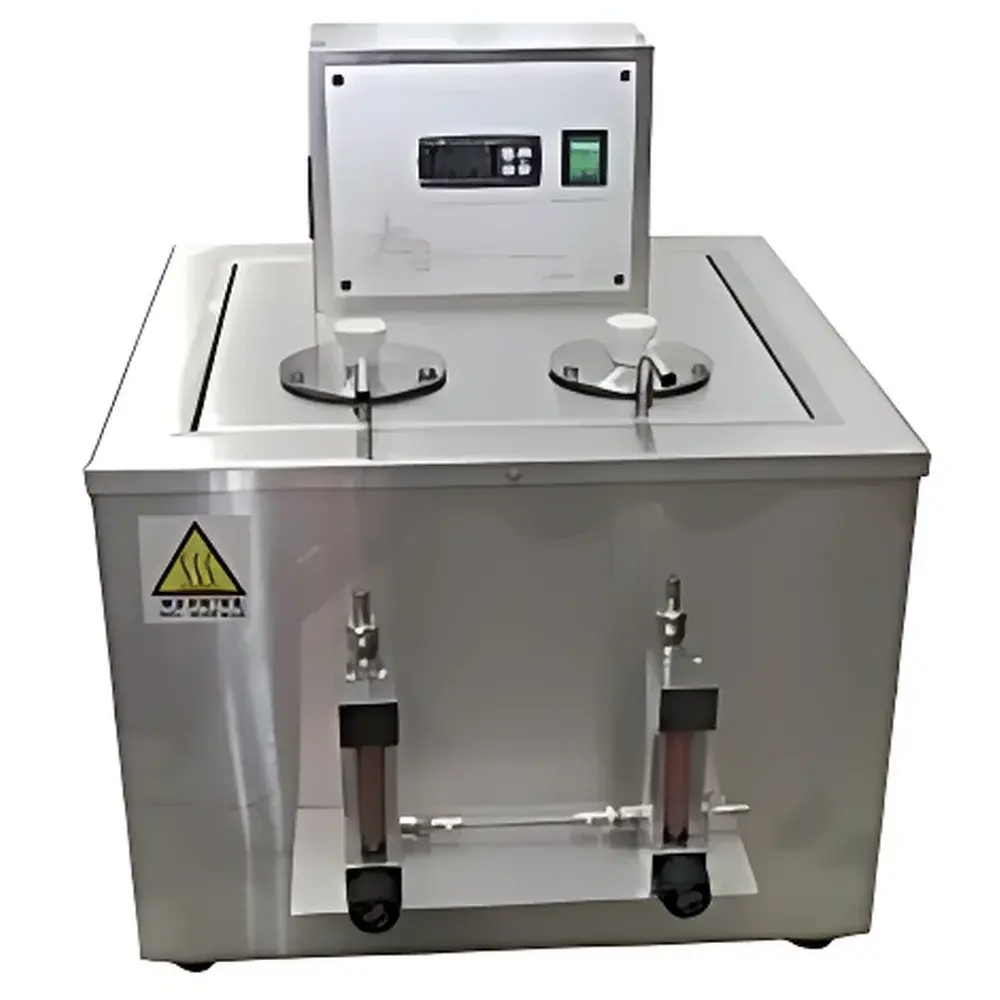
SDM 2050 Benchtop Lubricating Grease and Oil Evaporation Loss Tester
| Brand | SDM |
|---|---|
| Origin | Italy |
| Model | 2050 |
| Temperature Range | Ambient to 180 °C (±0.3 °C stability) |
| Power Supply | 220 V, 50/60 Hz |
| Heating Power | 3200 W |
| Dimensions | 58 × 46 × 54 cm |
| Weight | 27 kg |
| Compliance | ASTM D972, IP 183 |
| Bath Material | Stainless Steel |
| Control System | PID Digital Controller with PT100A Sensor |
| Safety Features | Overtemperature Alarm, Low-Level Liquid Warning Light |
| Stirring | Motorized Stainless Steel Agitator |
| Construction | Insulated Dual-Wall Bath with Stainless Steel Lid and Precision Flowmeter Mounting Ports |
Overview
The SDM 2050 Benchtop Lubricating Grease and Oil Evaporation Loss Tester is a precision-engineered instrument designed for quantitative determination of volatile loss in lubricating greases and mineral-based or synthetic lubricating oils under controlled thermal and airflow conditions. It operates on the principle of gravimetric mass loss measurement following standardized thermal exposure—specifically aligned with ASTM D972 (Standard Test Method for Evaporation Loss of Lubricating Greases) and IP 183 (Determination of Evaporation Loss of Lubricating Greases and Oils). The system maintains a thermally stable, convective air environment within a dual-wall insulated stainless steel bath, enabling reproducible evaporation kinetics assessment across extended test durations (typically 22 hours at 99 °C or 180 °C per specification requirements). Its benchtop footprint and integrated safety architecture—including independent overtemperature cutoff and real-time liquid-level monitoring—make it suitable for routine QC laboratories operating under ISO/IEC 17025-accredited environments.
Key Features
- Stainless steel dual-wall bath with high-efficiency thermal insulation to minimize ambient interference and ensure ±0.3 °C temperature stability across the full 25–180 °C operating range
- PID digital temperature controller with PT100A Class A platinum resistance sensor for closed-loop thermal regulation and programmable ramp profiles
- Motor-driven stainless steel agitator providing consistent, low-shear air circulation above the sample surface to emulate standardized airflow conditions
- Integrated flowmeter mounting interface on the stainless steel lid—compatible with calibrated glass or metal flowmeters per ASTM D972 Annex A1
- Dedicated low-level liquid warning indicator with visual LED alert, preventing heater dry-out and ensuring uninterrupted test integrity
- Overtemperature protection circuitry with independent thermal cutoff switch, compliant with IEC 61010-1 safety standards for laboratory electrical equipment
- Front-panel mounted stainless steel control module with intuitive push-button interface and real-time digital display of setpoint, actual temperature, and elapsed time
Sample Compatibility & Compliance
The SDM 2050 accommodates standard ASTM D972-compliant evaporation vessels (e.g., 50-mL glass crucibles or aluminum pans) and supports both grease and fluid oil samples without modification. Its design fulfills mandatory apparatus requirements specified in Clause 6 of ASTM D972 and Section 4 of IP 183—including bath geometry, air inlet/outlet configuration, and thermal uniformity criteria. The instrument is routinely deployed in petroleum product testing labs subject to API RP 2550, ISO 6743-9 (lubricant classification), and refinery QA/QC workflows requiring traceable, auditable test execution. While not inherently 21 CFR Part 11–compliant, its operational logs (when paired with external data acquisition systems) support GLP/GMP documentation practices through manual entry into validated LIMS platforms.
Software & Data Management
The SDM 2050 operates as a standalone hardware platform with no embedded software or network connectivity. All parameter settings—including target temperature, dwell time, and alarm thresholds—are configured via front-panel controls. Temperature history is not internally recorded; however, the unit features a 0–10 V analog output signal (optional accessory) compatible with third-party chart recorders or SCADA systems for continuous thermal profiling. Laboratories requiring electronic audit trails may integrate the instrument with external USB data loggers connected to the PT100A sensor output. Calibration certificates (traceable to NIST or EU-accredited NMIs) are provided with each unit, and annual verification protocols align with ISO/IEC 17025 clause 6.5.2 for measurement equipment validation.
Applications
- Quantification of evaporative volatility in automotive and industrial greases during formulation development and batch release testing
- Comparative evaluation of base oil volatility in synthetic vs. mineral lubricants under accelerated thermal stress
- Supporting OEM specifications such as GM 6277M, Ford WSK-M2C93.B, and VW TL 521 82 for long-life lubricant qualification
- Root-cause analysis of grease hardening or oil thinning observed in field service failures
- Regulatory submission testing for REACH SVHC screening where volatile organic content impacts classification
- Teaching laboratories demonstrating fundamental principles of vapor pressure, thermal degradation kinetics, and ASTM methodology adherence
FAQ
What standards does the SDM 2050 explicitly support?
ASTM D972 and IP 183 are fully implemented in its mechanical and thermal design; no adapter kits or firmware updates are required.
Can the instrument be used for non-petroleum-based lubricants (e.g., bio-lubricants)?
Yes—provided the sample remains thermally stable below 180 °C and does not corrode stainless steel components; method validation per ASTM D972 Annex B is recommended.
Is calibration documentation included upon delivery?
Each unit ships with a factory calibration report (including PT100A sensor verification at three points: 50 °C, 100 °C, and 150 °C) traceable to an ILAC-MRA signatory calibration laboratory.
Does the SDM 2050 require water cooling or external ventilation?
No—it relies solely on passive convection and internal thermal management; however, operation in a well-ventilated room is advised to dissipate ambient heat from the 3200 W heating element.
How is sample mass loss calculated?
Gravimetrically: users weigh the sample vessel before and after the prescribed test duration using an analytical balance (not supplied); the instrument itself performs no weighing or calculation.




