
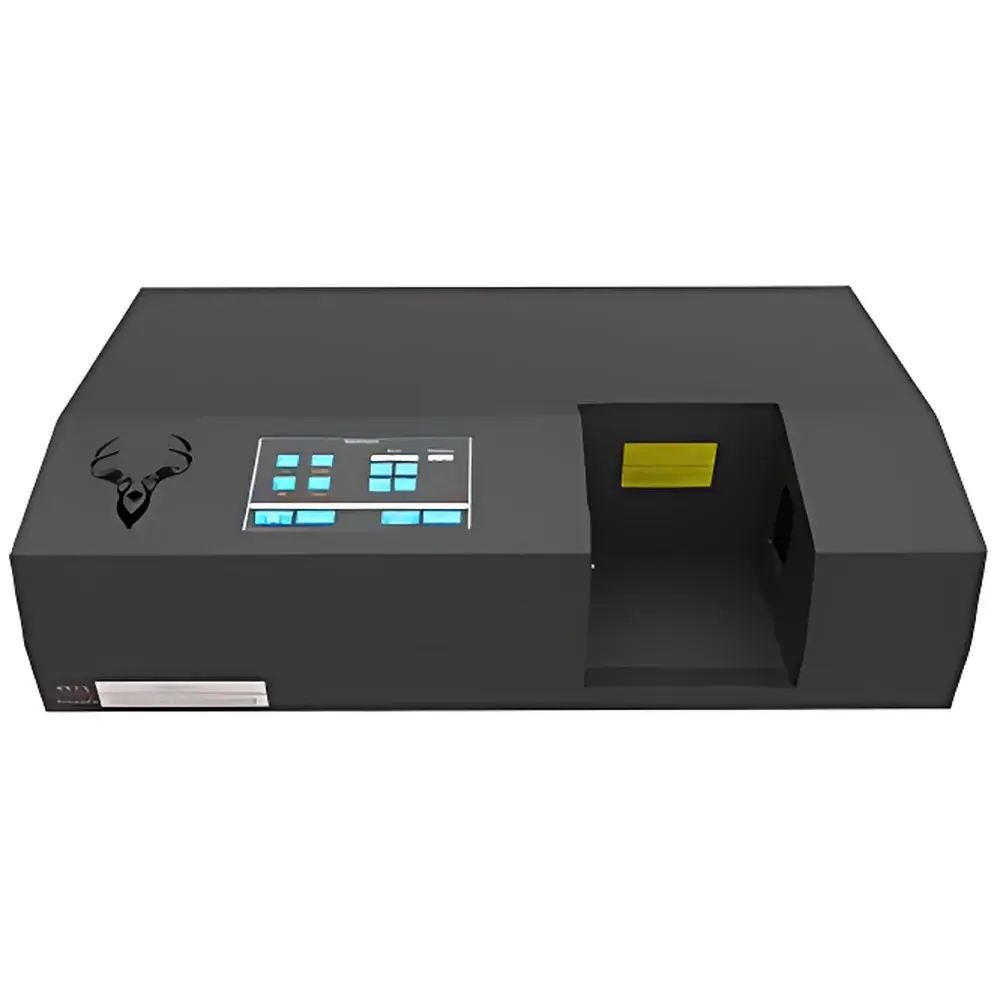
M530 Fourier Transform Infrared Spectrophotometer
| Origin | USA |
|---|---|
| Manufacturer Type | Authorized Distributor |
| Origin Category | Imported |
| Model | M530 |
| Price Range | USD 9,200 – 13,100 (est.) |
| Optical Design | Pseudo-Double-Beam |
| Detector | DLATGS (Deuterated L-Alanine doped Triglycine Sulfate) |
| Spectral Range | 4000 – 600 cm⁻¹ |
| Spectral Resolution | <3 cm⁻¹ (4000–2000 cm⁻¹), <2 cm⁻¹ (2000–600 cm⁻¹) |
| Wavelength Accuracy | ±0.1 cm⁻¹ |
| Spectral Bandwidth | 4 cm⁻¹ (nominal) |
| Stray Light | <0.01% T |
| Automation Level | Motorized Wavelength Calibration & Auto-Alignment |
| Display | Integrated 7-inch Capacitive Touchscreen |
| Interface | RS-232, USB 2.0 |
| Power Supply | 115/230 VAC, 50/60 Hz, 150 W |
| Dimensions (W×D×H) | 66.7 × 38.7 × 18.4 cm |
| Weight | 17.2 kg (38 lbs) |
| Sample Compartment | 150 mm² Clear Aperture |
| Source | Ceramic-encapsulated NiCr Wire (1250 K, 36 W) |
Overview
The M530 Fourier Transform Infrared (FTIR) Spectrophotometer is a benchtop mid-infrared analytical instrument engineered for precision, reliability, and operational simplicity in routine and research-grade molecular identification and quantification. Unlike dispersive IR instruments, the M530 employs interferometric detection based on the Michelson interferometer principle—capturing full-spectrum interferograms via rapid scanning of a moving mirror, followed by real-time Fast Fourier Transformation (FFT) to generate high-fidelity absorbance or transmittance spectra. Its spectral coverage spans 4000–600 cm⁻¹ (2.5–16.7 µm), fully encompassing fundamental vibrational modes of organic functional groups (e.g., C=O at ~1700 cm⁻¹, O–H at ~3300 cm⁻¹, C–H at ~2900 cm⁻¹) and enabling robust qualitative and semi-quantitative analysis across pharmaceuticals, polymers, forensics, and quality control laboratories. The system utilizes a thermoelectrically stabilized DLATGS detector, offering excellent signal-to-noise ratio (SNR) without liquid nitrogen cooling, and a high-output ceramic NiCr source optimized for thermal stability and long-term radiometric consistency.
Key Features
- Pseudo-double-beam optical architecture: Compensates for source drift and environmental fluctuations during acquisition, enhancing baseline stability and measurement reproducibility over extended scan sessions.
- Motorized, microprocessor-controlled alignment: Eliminates manual calibration; automatic mirror positioning ensures optimal interferogram symmetry and phase correction prior to each scan.
- Integrated 7-inch capacitive touchscreen interface: Provides full offline operation—no PC required for data acquisition, spectral preview, peak annotation, or report generation. All instrument parameters (scan number, resolution, aperture, gain) are adjustable directly from the GUI.
- Robust mechanical construction: Precision-machined aerospace-grade aluminum chassis with corrosion-resistant powder coating ensures dimensional stability under thermal cycling and mechanical stress, supporting deployment in non-climate-controlled environments.
- Low-maintenance optical train: Sealed interferometer with gold-coated mirrors and hardened beam splitter minimizes dust ingress and degradation; no user-serviceable optics beyond routine desiccant replacement.
- Real-time spectral visualization: Live interferogram and spectrum rendering during acquisition enables immediate assessment of sample adequacy, pathlength, and detector saturation—reducing rework and optimizing throughput.
Sample Compatibility & Compliance
The M530 accommodates standard FTIR sampling accessories—including KBr pellet holders, ATR (Attenuated Total Reflectance) plates with diamond or ZnSe crystals, transmission cells (0.1–10 mm pathlength), and gas cells (up to 10 cm). Its 150 mm² sample compartment supports both macro and micro sampling configurations. The instrument complies with key international standards for spectroscopic instrumentation: ASTM E1421–22 (Standard Practice for Describing and Measuring Performance of FTIR Spectrometers), ISO 17025:2017 (General Requirements for the Competence of Testing and Calibration Laboratories), and USP (Spectrophotometric Absorption Measurements). While not inherently 21 CFR Part 11 compliant, audit trail functionality and electronic signature support can be implemented via optional software modules validated for GLP/GMP environments.
Software & Data Management
Built-in firmware supports native export of spectra in JCAMP-DX (.dx) and ASCII formats, ensuring compatibility with third-party chemometric platforms (e.g., Unscrambler®, MATLAB®, Python SciPy libraries). Optional PC-based software provides advanced processing capabilities: baseline correction (Rubberband, Concave), spectral subtraction, derivative analysis, peak integration (Gaussian/Lorentzian fitting), and library searching against commercial databases (e.g., Sadtler, Hummel, Polymer). All data files include embedded metadata (date/time stamp, operator ID, instrument serial number, acquisition parameters), facilitating traceability and regulatory documentation. Firmware updates are delivered via USB drive and verified via SHA-256 checksum to maintain integrity.
Applications
- Pharmaceutical raw material identification per USP monographs and ICH Q5A guidelines
- Polymorph screening and crystallinity assessment in API development
- Contamination analysis in packaging materials (e.g., residual solvents, plasticizer migration)
- Failure analysis of polymer components (oxidation, hydrolysis, crosslinking)
- Forensic fiber and paint chip comparison using spectral correlation algorithms
- Educational labs requiring intuitive, maintenance-free FTIR instruction
FAQ
Does the M530 require purging with dry air or nitrogen to operate?
No. The sealed optical bench and thermoelectrically stabilized DLATGS detector eliminate the need for continuous purge gas, enabling rapid startup and field deployment.
Can the M530 perform quantitative analysis?
Yes—when used with calibrated standards and validated methods, it supports Beer-Lambert-based quantitation for known analytes, particularly in transmission or ATR mode with consistent contact pressure.
What is the typical measurement repeatability for wavenumber accuracy?
Under routine lab conditions, wavenumber reproducibility is ±0.05 cm⁻¹ (1σ) across repeated scans of polystyrene film reference standard (ASTM E1421 Annex A1).
Is preventive maintenance required?
Annual verification of interferometer alignment and detector responsivity is recommended; no optical realignment or lamp replacement is needed within the first 5 years of operation.
How does the M530 handle moisture and CO₂ interference in ambient air?
The firmware includes dynamic atmospheric compensation algorithms that subtract time-synchronized background spectra, effectively suppressing H₂O and CO₂ absorption bands without hardware desiccants or vacuum systems.
Related Products





