
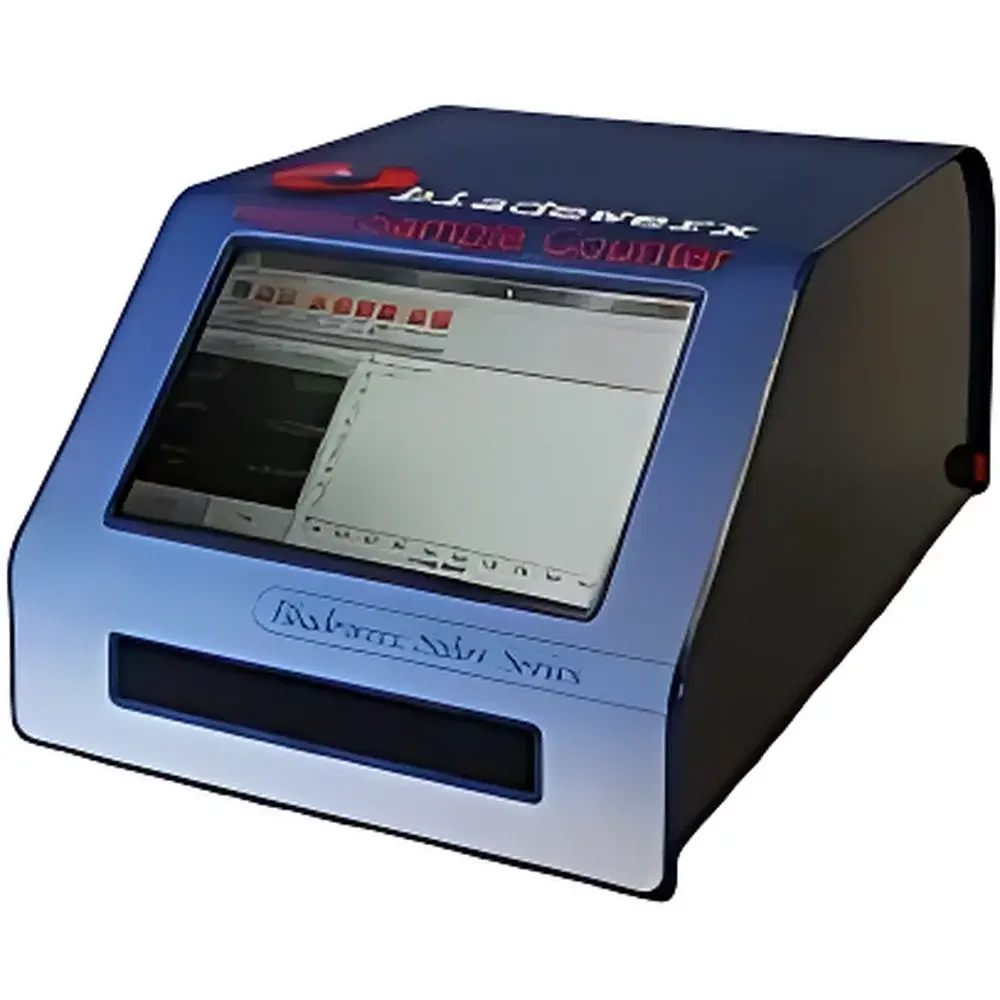
Bladewerx SabreISC Alpha/Beta Airborne Particle Counter
| Brand | Bladewerx |
|---|---|
| Origin | USA |
| Model | SabreISC |
| Instrument Type | Laboratory-grade Alpha/Beta Spectrometric Air Sampler |
| Flow Rate | Low-flow (6 L/min standard) |
| Flow Accuracy | < ±3% |
| Timing Accuracy | < ±1 s |
| Repeatability | < ±5% FS |
| Particle Size Distribution Error | Not applicable (energy-resolved spectrometry, not optical sizing) |
| Energy Response Accuracy | < ±10% FS (α), < ±10% FS (β) |
| Detector | Solid-state ion-implanted silicon, 1-in² (450 mm²) or 2-in² (2000 mm²) active area |
| Alpha Energy Range | 1.0–10.0 MeV |
| Beta Energy Range | 100 keV–4 MeV |
| Max Count Rate | 600,000 cpm (α + β combined) |
| Operating Temperature | −20 °C to +50 °C |
| Relative Humidity | 5–100% RH (non-condensing) |
| Power | 12 VDC @ 2.5 A (AC adapter included) |
| Dimensions | 21 × 16 × 30 cm |
| Weight | 2.9 kg (<7 lbs) |
| Battery Backup | Integrated 1-hr Li-ion UPS |
| Display | 7-inch LCD touchscreen (800 × 480) |
| Compliance | Designed for EPA Method 900, ASTM D6330, ISO 7503-1, and compatible with GLP/GMP data integrity requirements (audit trail, user access control, electronic signature support via RadNet software) |
Overview
The Bladewerx SabreISC Alpha/Beta Airborne Particle Counter is a laboratory-grade, energy-resolving spectrometric air sampler engineered for quantitative measurement of alpha- and beta-emitting radionuclides collected on filter media. Unlike optical particle counters that classify aerosols by physical size, the SabreISC employs solid-state ion-implanted silicon detector technology coupled with multi-channel pulse-height analysis to discriminate and quantify radionuclides based on their characteristic alpha and beta energy spectra. This enables direct, real-time quantification of isotopes such as 239Pu, 241Am, 210Po, 214Po, and 218Po—without requiring extended decay waiting periods for radon progeny equilibration. Its integrated α-peak shape fitting algorithm dynamically deconvolves overlapping spectral peaks using user-defined nuclide libraries, delivering isotopic specificity even in mixed-field environments where traditional gross-alpha/beta methods fail.
Key Features
- Solid-state ion-implanted silicon detector with selectable active areas (450 mm² or 2000 mm²) optimized for high-efficiency alpha spectroscopy and low-background beta detection.
- Real-time radon progeny compensation: automatic spectral subtraction of 214Po and 218Po contributions during acquisition, eliminating need for post-sampling decay delays.
- Dual-mode operation: configurable for simultaneous α/β counting or α-only mode—user-selectable via intuitive touchscreen interface or RadNet control software.
- Modular, field-serviceable sample chamber with interchangeable 2-inch filter holders accommodating standard 50.8-mm (2-in) PTFE or cellulose ester filters.
- Onboard Windows-based embedded PC with integrated MCA (1024-channel), preamplifier, HV supply, and spectral processing engine—no external computer required for basic operation.
- 7-inch resistive touchscreen (800 × 480) with glove-compatible interface; optional “Field Ready” configuration includes ergonomic handle and extended-life battery pack (6+ hr runtime).
- Active diagnostics and self-calibration routines—including source-response verification, energy calibration via drag-and-drop peak alignment, and live count-rate monitoring.
Sample Compatibility & Compliance
The SabreISC accepts standard 2-inch (50.8-mm) diameter air filters—including PTFE, polyvinyl chloride (PVC), and mixed-cellulose ester (MCE)—with no requirement for chemical etching or electrodeposition. Its 4π geometry yields typical alpha detection efficiency of 25% and beta efficiency of 16% (for 36Cl). The system meets design criteria referenced in EPA Method 900 (Radionuclide Air Emissions), ASTM D6330 (Standard Practice for Air Sampling of Radioactive Particulates), and ISO 7503-1 (Monitoring of Radioactive Contamination—Part 1: Airborne Particulates). When operated with RadNet software, it supports 21 CFR Part 11-compliant audit trails, role-based user authentication, and electronic signatures—ensuring full traceability for regulatory submissions under GLP or GMP frameworks.
Software & Data Management
Control and analysis are performed via Bladewerx RadNet—a Windows 7–10 compatible application providing instrument setup, spectral acquisition, energy calibration, nuclide library management, and report generation. The software implements proprietary α-peak shape fitting algorithms capable of resolving up to four co-located alpha emitters (e.g., 239Pu, 241Am, 210Po, 214Po) simultaneously. Net beta activity is calculated using either fixed-duration counting or adaptive auto-stop logic: acquisition terminates when statistical confidence exceeds user-defined thresholds (e.g., ≥95% confidence that net activity is above or below action levels). All raw spectra, processed results, metadata (flow rate, time stamps, environmental conditions), and operator logs are stored in encrypted SQLite databases with versioned backups.
Applications
- Environmental monitoring of nuclear facilities, uranium enrichment sites, and legacy waste handling operations.
- Decommissioning and decontamination (D&D) surveys requiring rapid isotopic identification of airborne alpha contamination.
- Health physics program support—routine workplace air sampling for plutonium, americium, and polonium isotopes.
- Emergency response screening for special nuclear materials (SNM) or radiological dispersal devices (RDDs).
- Method validation and inter-laboratory comparison studies under ISO/IEC 17025 accreditation.
- Research applications involving low-level alpha spectrometry of atmospheric aerosols, including volcanic ash or industrial process emissions.
FAQ
Does the SabreISC require external vacuum pumps or gas supplies?
No—the SabreISC is a self-contained sampling system with internal flow control and pressure regulation. It operates at a nominal flow rate of 6 L/min and maintains accuracy within ±3% across its specified temperature and humidity range.
Can the SabreISC distinguish between 239Pu and 240Pu?
Not directly—their alpha energies (5.156 MeV and 5.168 MeV) are too closely spaced for resolution with silicon detectors. However, it reliably separates 239Pu from 241Am (5.638 MeV) and 210Po (5.305 MeV) using its peak-fitting algorithm.
Is the detector replaceable in the field?
Yes—the detector module is designed for modular replacement without recalibration. Each unit ships with NIST-traceable energy and efficiency calibration certificates.
What data export formats does RadNet support?
CSV, XML, and PDF reports; spectral data (ASCII .spe format); and database dumps compatible with third-party gamma/alpha analysis platforms (e.g., Genie 2000, GammaVision, Alpha Analyst).
Does the SabreISC meet IEC 62327 requirements for portable radiation monitors?
While not certified as a personal radiation detector (PRD), its hardware architecture, electromagnetic compatibility (EMC), and environmental rating align with IEC 62327 Annex B guidance for laboratory-based spectrometric air samplers used in nuclear security contexts.







