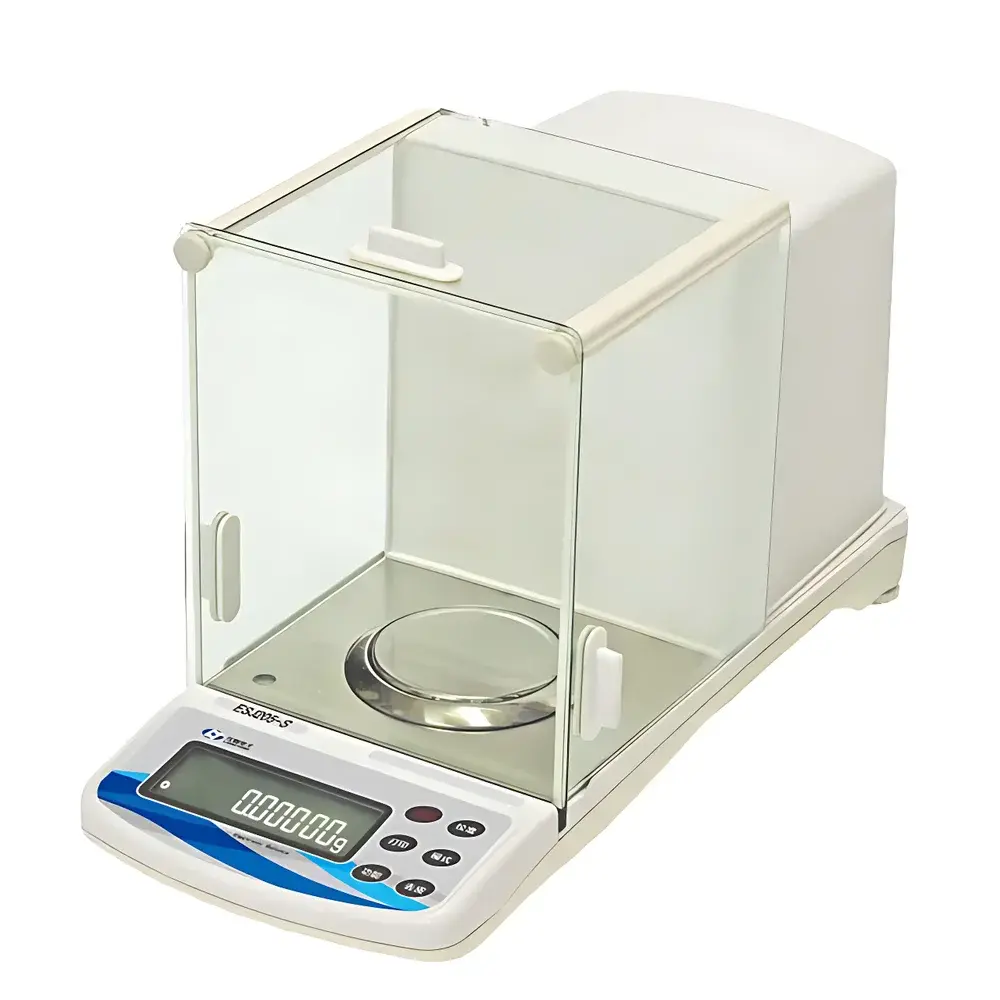
Longteng ESJ203-S Semi-Micro Analytical Balance (0.01 mg Readability, Dual-Range, Fully Automatic Internal Calibration)
| Brand | Longteng |
|---|---|
| Origin | Liaoning, China |
| Manufacturer Type | Authorized Distributor |
| Product Category | Domestic Instrument |
| Model | ESJ203-S |
| Instrument Type | Analytical Balance |
| Maximum Capacity | 200 g |
| Readability | 0.01 mg (100 g range) / 0.1 mg (200 g range) |
| Repeatability | ±0.03 mg (100 g range) / ±0.1 mg (200 g range) |
| Linearity Error | ±0.05 mg (100 g range) / ±0.1 mg (200 g range) |
| Pan Diameter | Φ90 mm |
| Weight | 9.1 kg |
| Dimensions (W×D×H) | 410 × 320 × 350 mm |
| Calibration | Fully Automatic Internal Calibration with Built-in Stainless Steel Weights |
| Display | Backlit LCD |
| Connectivity | RS232 Interface |
| Compliance | Designed to support GLP/GMP documentation workflows |
Overview
The Longteng ESJ203-S is a semi-micro analytical balance engineered for high-precision mass measurement in regulated laboratory environments. Operating on electromagnetic force compensation (EMFC) principle, it delivers metrological stability and long-term repeatability essential for quantitative analysis, formulation development, and reference standard preparation. The instrument features dual-range functionality—0.01 mg readability up to 100 g and 0.1 mg readability up to 200 g—enabling seamless transition between ultra-sensitive micro-weighing and broader capacity applications without manual range switching. Its rear-mounted EMFC sensor architecture minimizes mechanical hysteresis and thermal drift, while the triple-door draft shield ensures rapid stabilization and consistent performance across variable ambient conditions. Designed and assembled in Liaoning Province, China, the ESJ203-S meets international design conventions for analytical balances, including ISO 9001-compliant manufacturing processes and adherence to fundamental metrological principles outlined in OIML R76.
Key Features
- Rear-mounted high-stability electromagnetic force compensation sensor with optimized thermal mass distribution for reduced sensitivity to ambient temperature fluctuations.
- Triple-door acrylic draft shield with ergonomic access and large Φ90 mm stainless steel weighing pan—compatible with tall or wide sample containers and volumetric glassware.
- Fully automatic internal calibration system with built-in stainless steel reference weights; supports scheduled, temperature-triggered, and user-initiated recalibration to maintain traceable accuracy.
- Backlit LCD display with adjustable contrast—optimized for both low-light and high-glare environments, reducing visual fatigue during extended use sessions.
- Dual-range operation (100 g / 0.01 mg and 200 g / 0.1 mg) with intelligent auto-ranging logic that preserves resolution without operator intervention.
- Comprehensive error management: overload/underload detection, real-time temperature compensation, full-scale tare, accumulation/subtraction, and zero-tracking algorithms.
- RS232 serial interface compliant with standard ASCII protocol—enables direct integration with LIMS, ELN, and statistical process control (SPC) software.
Sample Compatibility & Compliance
The ESJ203-S accommodates diverse sample types—including powders, granules, liquids in vials or crucibles, and small solid components—within its spacious weighing chamber. Its robust mechanical design supports routine use in QC laboratories performing ASTM E899 (standard practice for calibration of analytical balances), USP <41> (balances), and ISO/IEC 17025-accredited testing workflows. While not certified to OIML Class I or II, the balance’s documented repeatability (±0.03 mg at 100 g), linearity (±0.05 mg), and internal calibration traceability align with intermediate-tier analytical requirements typical of pharmaceutical stability studies, catalyst loading verification, and raw material assay validation. Optional density determination kits (with sinker assembly and dedicated software module) extend functionality to solid and liquid density measurements per ISO 1183 and ASTM D792.
Software & Data Management
Data output follows standard RS232 framing (9600 baud, 8N1), supporting passive logging into spreadsheet applications or active ingestion by validated laboratory informatics systems. The balance generates timestamped, unit-tagged records—including gross/net/tare values, calibration status flags, and environmental metadata (if external sensor input is enabled). When integrated with compliant ELN platforms, the ESJ203-S supports audit-trail generation for critical weighings under FDA 21 CFR Part 11—provided the host system implements electronic signatures, data integrity controls, and immutable storage. All internal calibration events are logged with date/time stamps and deviation metrics, facilitating GLP audit readiness and preventive maintenance scheduling.
Applications
- Pharmaceutical: Active pharmaceutical ingredient (API) dispensing, reference standard weighing, dissolution tablet sampling, and excipient ratio verification.
- Materials Science: Catalyst dosage in heterogeneous reaction screening, nanomaterial mass quantification prior to dispersion, and thin-film coating weight gain analysis.
- Academic Research: Gravimetric titration endpoint determination, stoichiometric reagent preparation, and calibration of pipettes and burettes per ISO 8655.
- Food & Agriculture: Nutrient fortification verification, pesticide residue standard preparation, and moisture content determination via loss-on-drying protocols.
- Environmental Testing: Filter membrane weighing for particulate matter (PM2.5/PM10) analysis per EPA Method 201A and ISO 12103-1.
FAQ
What is the difference between the two readability ranges?
The ESJ203-S operates in two distinct modes: 0.01 mg resolution up to 100 g (semi-micro mode), and 0.1 mg resolution up to 200 g (analytical mode). The instrument automatically selects the appropriate range based on load magnitude and user-defined thresholds.
Does the balance meet ISO/IEC 17025 requirements for accredited labs?
While the ESJ203-S itself is not accredited, its documented repeatability, linearity, and internal calibration traceability enable laboratories to establish and validate their own measurement uncertainty budgets per ISO/IEC 17025 Clause 6.4.2.
Can the RS232 interface support bidirectional communication?
No—the interface is unidirectional (balance-to-host only) and transmits ASCII-formatted weighing data. Command reception (e.g., remote tare) is not supported.
Is external calibration required after internal calibration?
Internal calibration satisfies routine verification needs. External calibration using NIST-traceable weights is recommended annually—or after relocation, significant environmental change, or performance deviation—as part of a comprehensive quality assurance program.
What environmental conditions optimize performance?
Operate within 15–30 °C ambient temperature, ≤70% RH (non-condensing), and minimal air currents. Avoid placement near HVAC vents, centrifuges, or vibrating surfaces to preserve 0.01 mg repeatability.