
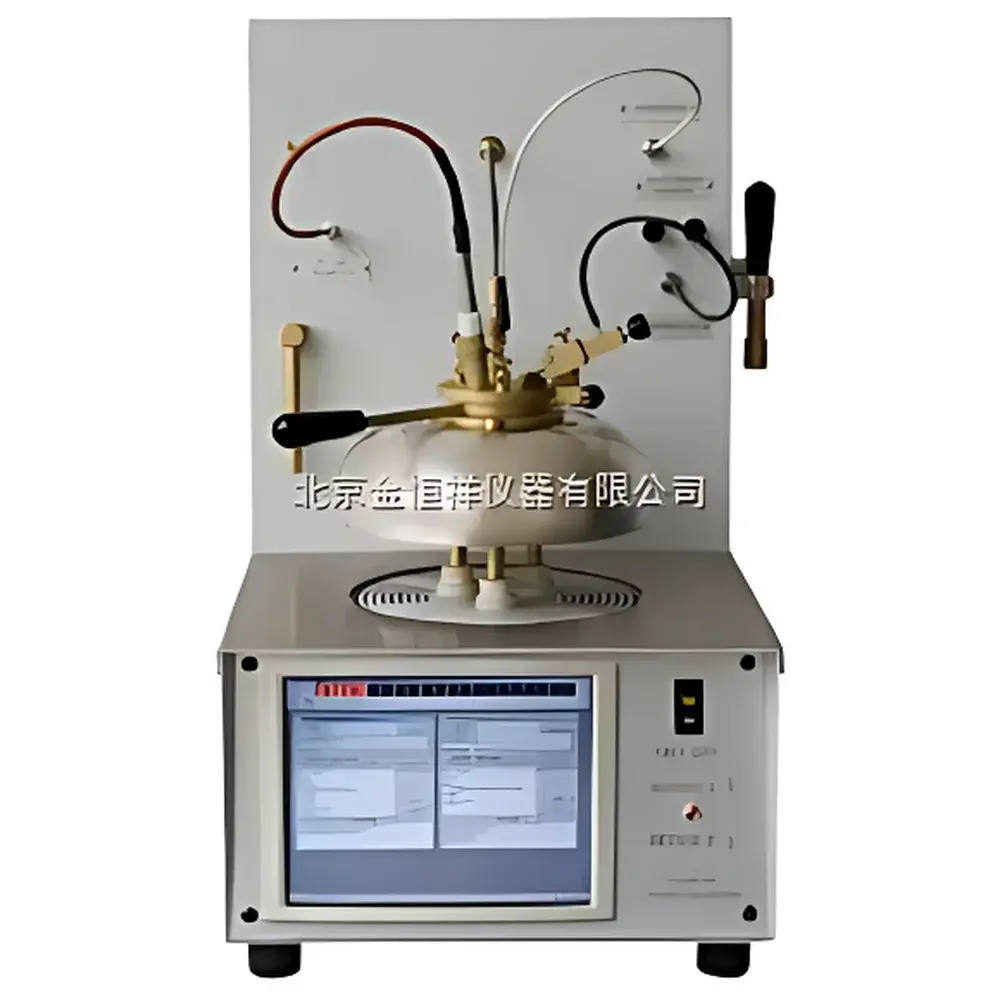
SDM 750AUT Pensky-Martens Closed-Cup Flash Point Analyzer
| Brand | SDM |
|---|---|
| Origin | Italy |
| Model | 750AUT |
| Detection Method | Closed-Cup (Pensky-Martens) |
| Temperature Range | +40 °C to +360 °C |
| Temperature Accuracy | ±0.1 °C |
| Temperature Sensor | PT100 |
| Cup Material | Copper |
| Heating System | Electronic with Over-Temperature Protection |
| Cooling System | Forced Air (Fan) |
| Stirring Mechanism | Motor-Driven Magnetic Stirrer (Compliant with ASTM D93 Methods A & B) |
| Ignition System | Dual Auto-Ignition (Pilot Flame & Electric Spark) |
| Detector Type | Ionization Detector |
| Display | 800×480 Touchscreen LCD |
| Power Supply | 220 V, 50 Hz |
| Dimensions | 33 × 46 × 57 cm |
| Weight | 26 kg |
| Compliance Standards | ASTM D93, D3941, E502 |
Overview
The SDM 750AUT Pensky-Martens Closed-Cup Flash Point Analyzer is an automated, standards-compliant instrument engineered for precise and repeatable flash point determination of petroleum-based and organic liquid samples using the classical Pensky-Martens closed-cup method. Based on the principle of controlled thermal ramping under inert vapor containment, the system heats a defined volume of sample in a standardized copper cup while periodically introducing an ignition source—either pilot flame or electric spark—at predetermined temperature intervals. Upon detection of transient vapor-phase combustion via ionization sensing, the instrument records the lowest temperature at which sustained ignition occurs—the flash point. This thermodynamic threshold serves as a critical safety parameter for storage, transport, handling, and regulatory classification of flammable liquids per OSHA, GHS, and CLP frameworks.
Key Features
- Fully automated Pensky-Martens test sequence—including heating, stirring, ignition triggering, ionization-based flame detection, and endpoint identification—minimizing operator intervention and human error.
- Dual ignition capability: configurable selection between pilot flame and electric spark ignition, ensuring compatibility with diverse sample volatility profiles and laboratory safety protocols.
- High-stability PT100 platinum resistance thermometer integrated directly into the test cup assembly, delivering real-time temperature measurement with ±0.1 °C accuracy across the full operational range (+40 °C to +360 °C).
- Copper test cup with heat-resistant handle, manufactured to exact dimensional and surface-finish tolerances specified in ASTM D93 and ISO 2719, ensuring consistent vapor space geometry and thermal mass behavior.
- Electronically regulated heating module with independent over-temperature cutoff and fail-safe shutdown logic, compliant with IEC 61010-1 safety requirements for laboratory equipment.
- Integrated forced-air cooling system enabling rapid post-test cooldown, reducing cycle time between consecutive analyses without compromising thermal stability.
- Motor-driven magnetic stirrer synchronized to ASTM D93 Method A (for viscous samples) and Method B (for low-viscosity distillates), maintaining uniform bulk temperature and vapor equilibrium.
Sample Compatibility & Compliance
The 750AUT supports flash point analysis of a broad spectrum of liquid matrices including gasoline, diesel fuel, kerosene, lubricating oils, biodiesel blends, solvents (e.g., toluene, xylene, acetone), and industrial waste streams. Its design adheres strictly to internationally recognized test standards: ASTM D93 (Standard Test Methods for Flash Point by Pensky-Martens Closed Cup Tester), ASTM D3941 (for aqueous solutions), ASTM E502 (for solvent mixtures), IP 34, ISO 2719, EN 22719, and DIN 51578. All hardware components—including cup geometry, lid sealing mechanism, stirrer clearance, and ignition source positioning—are validated against these normative specifications. The instrument meets GLP documentation requirements and supports audit-ready operation when paired with secure user access controls and electronic record retention.
Software & Data Management
The embedded Windows-based control software (compatible with Windows 2000 through Windows Vista) provides intuitive graphical navigation via an 800×480 touchscreen interface. Core modules include Analysis Setup (method configuration, temperature ramp profiles, ignition timing), Diagnostics (real-time sensor status, heater calibration logs, ignition verification), Calibration (multi-point PT100 validation, cup offset correction), and Data Processing (statistical summary, trend plotting, export to CSV/Excel). All analytical events—including temperature readings, ignition attempts, flame detection signals, and fault codes—are timestamped and stored locally with optional network backup. The system supports customizable report templates, on-screen pass/fail indicators, audible alerts for endpoint detection or system anomalies, and full traceability per FDA 21 CFR Part 11 when deployed in regulated environments with appropriate IT governance.
Applications
This analyzer is routinely deployed in petroleum refineries, lubricant manufacturing QC labs, chemical formulation centers, environmental testing facilities, and third-party certification laboratories. Typical use cases include batch release testing of finished fuels per API RP 2542, stability assessment of reformulated gasoline during oxidation studies, flash point verification of used oil re-refining feedstocks, compliance screening of solvent-based coatings under REACH Annex XVII, and forensic analysis of ignitable liquid residues in fire investigation laboratories. Its robust architecture ensures long-term reproducibility across shifts and operators—critical for inter-laboratory comparison studies referenced in ASTM D613 and ISO 3679 round-robin protocols.
FAQ
What standards does the 750AUT fully comply with?
ASTM D93 (Methods A and B), ASTM D3941, ASTM E502, IP 34, ISO 2719, EN 22719, and DIN 51578.
Can the instrument test aqueous or high-water-content samples?
Yes—when configured per ASTM D3941, it accommodates water-miscible solvents and emulsified hydrocarbons using modified cup pre-conditioning and extended dwell times.
Is external calibration required before first use?
No—factory calibration with NIST-traceable reference oils is provided; users may perform routine verification using certified flash point standards (e.g., SRM 2722, 2723).
Does the system support remote monitoring or integration with LIMS?
Data export via USB or RS232 enables manual LIMS ingestion; native Ethernet or OPC UA integration requires optional firmware upgrade and middleware configuration.
How is safety ensured during repeated ignition cycles?
Ignition energy is limited to <10 mJ per event, vapor space remains sealed throughout testing, and automatic flame suppression activates if abnormal combustion duration is detected.





