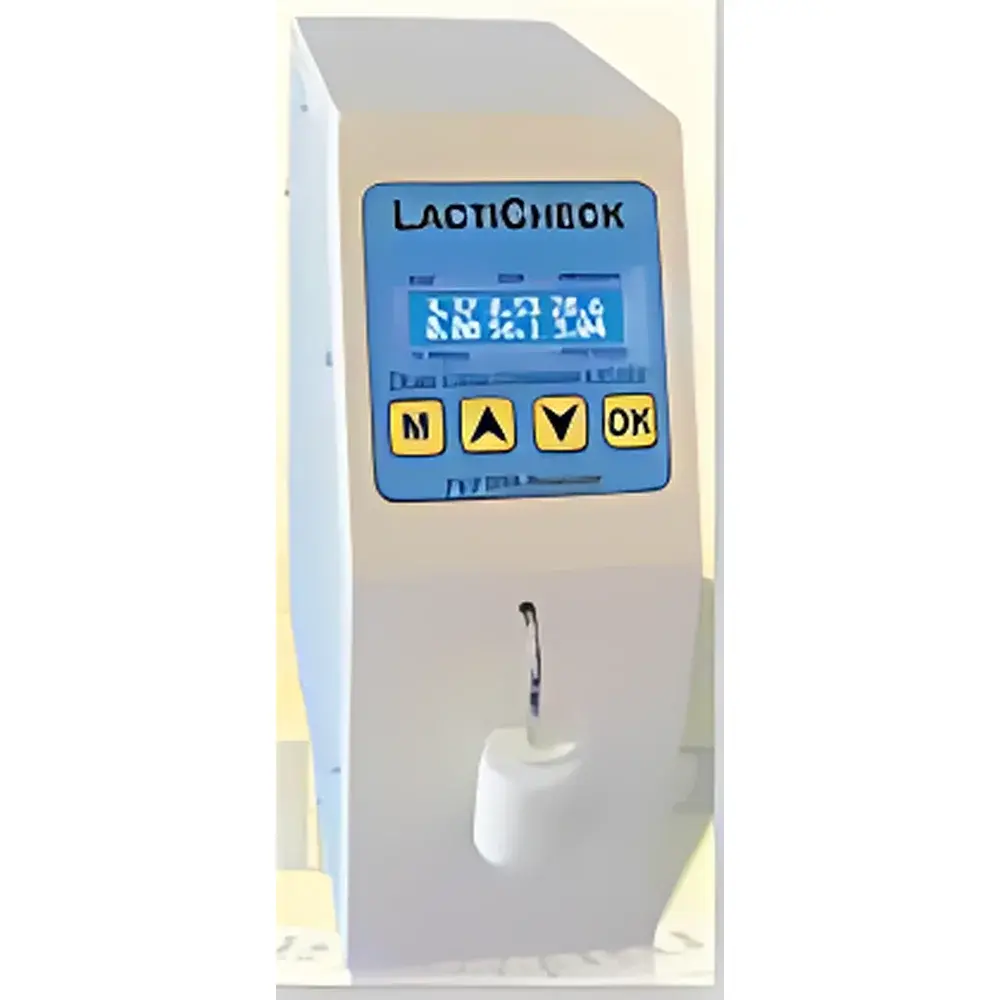
PP LactiCheck-RR02 Dairy Analyzer
| Brand | PP |
|---|---|
| Origin | USA |
| Model | RR02 |
| Automation | Fully Automatic |
| Analysis Time | 40 s |
| Fat Range | 0.3–9% (±0.06% repeatability, ±0.2% accuracy) |
| Protein Range | 2–5% |
| SNF Range | 2–12% |
| Density Range | 1.0260–1.0330 g/cm³ (±0.0005 g/cm³) |
| Lactose Range | 3–7% (±0.1%) |
| Water Adulteration Detection | 2–60% (±2%) |
| Sample Volume | 20.0 mL |
| Dimensions (W×D×H) | 95 × 230 × 250 mm |
| Net Weight | 3.3 kg |
| Power Supply | AC 110/220 V ±10/−15%, DC 12–14.2 V |
| Max Power Consumption | 30 W |
| Data Interface | RS-232 (USB optional) |
Overview
The PP LactiCheck-RR02 Dairy Analyzer is a compact, fully automated ultrasonic spectroscopy-based instrument engineered for rapid, non-destructive quantification of key compositional parameters in raw and processed bovine, caprine, and ovine milk. Unlike traditional wet-chemistry or infrared methods, the RR02 employs high-frequency acoustic wave propagation through the sample—measuring both sound velocity and attenuation across a broadband ultrasonic spectrum. These physical responses correlate directly with molecular-level interactions among fat globules, casein micelles, lactose crystals, and serum proteins, enabling first-principles derivation of fat, protein, non-fat solids (SNF), lactose, density, and water adulteration without calibration against reference chemical assays at every run. Designed for routine quality control in dairy collection centers, processing plants, and regulatory laboratories, the RR02 delivers traceable, operator-independent results in under 40 seconds per 20 mL sample—minimizing downtime and eliminating solvent use, reagent costs, or hazardous waste generation.
Key Features
- Fully automated workflow: Single-button operation initiates sample aspiration, temperature equilibration, ultrasonic interrogation, data processing, and result display.
- Ultrasonic spectroscopy platform: Measures acoustic velocity (m/s) and attenuation coefficient (dB/cm/MHz) to derive composition via physics-based models—not empirical correlations—ensuring robustness across milk types and thermal histories.
- Multi-species compatibility: Factory-calibrated for bovine, caprine, and ovine milk matrices; includes dual-channel fat calibration for full-fat and low-fat formulations.
- High reproducibility: ±0.06% RSD for fat measurement across repeated analyses under controlled temperature (±0.1 °C).
- Integrated thermal stabilization: Peltier-controlled sample chamber maintains 40 °C ± 0.3 °C during analysis, critical for consistent fat globule dispersion and acoustic signal fidelity.
- Compact footprint (95 × 230 × 250 mm) and low power draw (<30 W) enable deployment in mobile labs, farm-side stations, or ISO-classified QC environments.
Sample Compatibility & Compliance
The RR02 accepts homogenized or unprocessed whole, skim, standardized, or fortified milk—including heat-treated, pasteurized, and UHT samples—as well as goat and sheep milk with minimal pre-treatment (no filtration or centrifugation required). It complies with foundational principles outlined in ISO 9622:2013 (milk fat and protein determination by mid-infrared spectrometry) and ASTM D8295-22 (standard guide for ultrasonic characterization of food emulsions), though its ultrasonic methodology provides orthogonal verification where IR may suffer from spectral overlap or water vapor interference. While not FDA 21 CFR Part 11–certified out-of-the-box, the instrument’s audit-ready output logs (timestamped, user-ID tagged, and immutable when exported via RS-232) support GLP/GMP-aligned documentation practices when integrated into validated laboratory information management systems (LIMS).
Software & Data Management
Instrument control and data handling are managed via embedded firmware with a monochrome LCD interface and tactile keypad—designed for glove-compatible operation in cold or humid environments. All measurements are stored locally with date/time stamps, operator ID fields, and raw acoustic spectra (upon request). Data export is supported via RS-232 serial protocol (standard) or optional USB-to-serial adapter, enabling direct ingestion into Excel, LabVIEW, or enterprise LIMS platforms. Calibration verification reports include slope/intercept diagnostics, drift monitoring over 30-day intervals, and outlier detection based on Mahalanobis distance in multivariate acoustic space—facilitating preventive maintenance scheduling and method transfer between instruments.
Applications
- Dairy intake grading at collection hubs: Real-time fat/protein classification for fair pricing and supplier accountability.
- Process line monitoring: In-line verification of standardization, homogenization efficacy, and thermal treatment consistency.
- Adulteration screening: Quantitative detection of water dilution (2–60% range) with ±2% uncertainty—critical for fraud prevention per Codex Alimentarius Standard 206-1999.
- Research & development: Rapid screening of novel feed formulations’ impact on milk composition across lactation cycles.
- Regulatory compliance testing: Supporting national dairy standards (e.g., USDA Grade A, EU Regulation No. 1308/2013) through documented, repeatable physical measurement.
FAQ
What sample preparation is required prior to analysis?
No centrifugation, filtration, or chemical reagents are needed. Samples must be homogenized (manually or via vortex) and brought to ambient temperature (15–25 °C) before loading; the instrument thermally equilibrates to 40 °C internally.
Can the RR02 analyze frozen or fermented milk products?
Frozen samples must be fully thawed and gently mixed to re-suspend fat; fermented products (e.g., yogurt, kefir) are outside validated scope due to viscosity-induced acoustic scattering and phase separation.
How often does the system require recalibration?
Factory calibrations remain stable for ≥6 months under daily use; quarterly verification using certified reference milk standards (CRM-MILK series) is recommended per ISO/IEC 17025 guidelines.
Is remote diagnostics or firmware update capability available?
Firmware updates require local connection via RS-232 and proprietary configuration utility; remote access is not supported to maintain data integrity and cybersecurity compliance in regulated environments.
Does the instrument meet electrical safety standards for international deployment?
Yes—certified to IEC 61010-1:2010 (Measurement, Control, and Laboratory Equipment Safety) and EMC Directive 2014/30/EU, with dual-voltage AC input (110/220 V) and CE marking.