
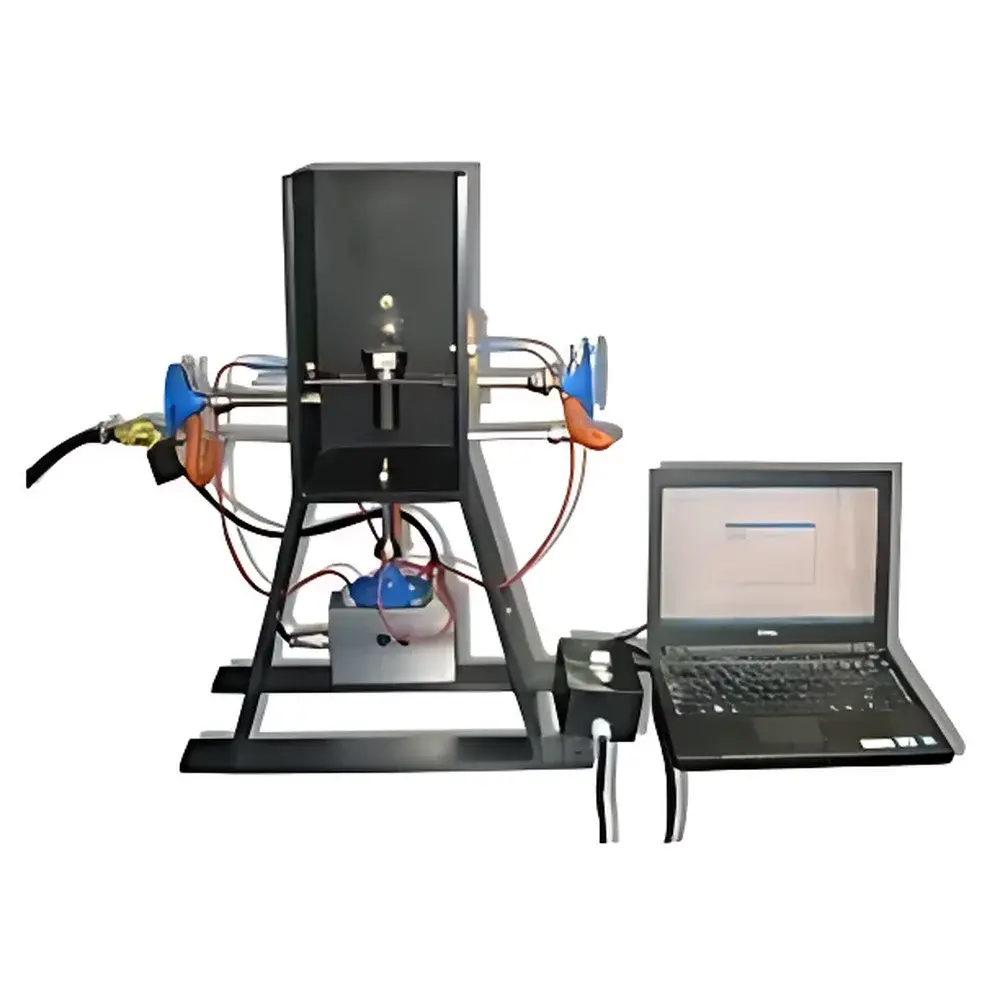
Koenen Test Apparatus by SMS
| Brand | SMS |
|---|---|
| Origin | USA |
| Manufacturer Type | Authorized Distributor |
| Origin Category | Imported |
| Model | Koenen |
| Price Range | USD 14,000 – 70,000 |
| Instrument Type | Multi-Functional Tribological Tester |
| Max Friction Force | 20 N |
| Friction Force Resolution | 4 mN |
| Max Operating Temperature | 400 °C |
Overview
The Koenen Test Apparatus, manufactured by SMS (USA), is a standardized thermal sensitivity assessment system designed in strict accordance with UN Manual of Tests and Criteria, Part I, Section 15.3 (Koenen Test) and ASTM E681–22. It is not a conventional tribometer but a regulated safety testing device engineered to evaluate the thermal instability and deflagration potential of solid, liquid, or pasty substances under controlled, highly confined heating conditions. The apparatus subjects a precisely loaded sample—encapsulated in a standardized steel tube capped with a calibrated orifice plate—to rapid, uniform external heating via four synchronized propane burners. Thermal response is quantified by physical deformation (bulging, bursting, or rupture) of the tube, which serves as a deterministic indicator of hazard classification for transport under UN Recommendations on the Transport of Dangerous Goods (UN TDG) and ADR/RID/IMDG Code requirements.
Key Features
- Four independently regulated propane burners delivering a certified heating rate of 3.3 ± 0.3 K/s, traceable to NIST-calibrated thermocouple arrays and digital pyrometry;
- Standardized sample tube fabricated from cold-drawn low-carbon steel: 75 mm length, 25 mm outer diameter, mass 25.5 ± 1.0 g, with flanged open end for secure clamping;
- Matching counterbalance tube (stainless steel, identical dimensions) enabling symmetrical thermal load distribution and mechanical stability during high-temperature exposure;
- Heat-resistant chromium alloy orifice plates with nine precision-machined apertures (1.0, 1.5, 2.0, 2.5, 3.0, 5.0, 8.0, 12.0, and 20.0 mm diameter), each certified per ISO 2768-mK tolerances;
- Dedicated sample compaction tool applying a repeatable 80 N axial force to ensure consistent sample density and interfacial contact geometry;
- Integrated electronic ignition controller with remote activation and fail-safe flame monitoring—eliminating manual ignition and minimizing operator proximity during test initiation;
- Modular gas delivery subsystem: industrial propane cylinder (500 mbar regulator), digital flowmeter, stainless steel manifold, and redundant pressure relief valves compliant with ANSI Z21.11.2;
- Electrical compatibility with dual-voltage operation (110 V / 60 Hz or 220 V / 50 Hz), including EMI-filtered power supply and grounded chassis per UL 61010-1.
Sample Compatibility & Compliance
The Koenen Apparatus accommodates solids (crystalline, granular, powdered), liquids (viscous or volatile), and semi-solids (gels, pastes, slurries) within the defined mass and volume constraints of the standard tube geometry. Sample preparation follows UN-recommended protocols, including moisture content verification (per ISO 11358-1) and homogeneity assessment prior to loading. All test procedures, result interpretation criteria (e.g., burst threshold classification), and reporting formats align with UN ST/SG/AC.10/11/Rev.6, EC Directive 2008/43/EC, and CLP Regulation (EC) No 1272/2008 Annex I, Section 2.1. The apparatus itself meets CE marking requirements for Category 1 equipment under the Pressure Equipment Directive (PED 2014/68/EU) for auxiliary components and complies with OSHA 1910.119 process safety management standards when integrated into a qualified hazardous materials laboratory.
Software & Data Management
While the core Koenen test is inherently analog and pass/fail based on physical tube deformation, optional digital instrumentation packages include high-speed thermal imaging (FLIR A655sc, 640 × 480 resolution, 50 Hz frame rate), real-time surface temperature mapping (Type K thermocouples with 0.1 °C resolution), and automated video capture synchronized to burner ignition. All acquired data are timestamped, stored in vendor-neutral .csv and .tiff formats, and support audit trails compliant with FDA 21 CFR Part 11 (when paired with validated LIMS integration). Calibration records—including burner heat flux validation, orifice plate dimensional certification, and force transducer traceability to NIST SRM 2059—are maintained in accordance with ISO/IEC 17025:2017 Clause 6.5.
Applications
- Hazard classification of energetic materials (e.g., propellants, initiators, pyrotechnic compositions) for UN Class 1 transport approval;
- Regulatory submission support for REACH registration dossiers requiring thermal stability data (Annex VII, Section 7.11);
- Pre-formulation screening of pharmaceutical intermediates exhibiting exothermic decomposition risks;
- Quality control of industrial explosives and blasting agents against batch-to-batch thermal consistency;
- Research into confinement effects on combustion propagation kinetics in porous media;
- Validation of computational thermal runaway models (e.g., TSS, AKTS Thermokinetics) using empirical burst onset temperatures.
FAQ
Is the Koenen Test Apparatus suitable for routine QC testing in GMP environments?
Yes—when operated under documented SOPs, calibrated annually per ISO/IEC 17025, and integrated with electronic record systems supporting ALCOA+ principles, it fulfills ICH Q5C and Q9 requirements for stability-indicating methods.
Can custom orifice plates be used beyond the standard set?
No—only the nine certified orifices listed in UN Manual Section 15.3 are accepted for regulatory submissions; deviations invalidate test compliance.
What ventilation specifications are required for safe installation?
A dedicated fume hood or room-exhaust system must maintain ≥12 air changes per hour and capture >99.9% of post-test effluents (CO, NOx, HCl, particulates) per EN 14175-3 and NFPA 45 standards.
Does SMS provide method validation documentation?
Yes—each shipped unit includes a Factory Acceptance Test (FAT) report, NIST-traceable calibration certificates, and a full UN Method Verification Package aligned with ISO 17025 Clause 7.2.2.
Is remote operation supported for unattended testing?
Remote ignition and burner sequencing are standard; however, visual inspection of tube deformation requires immediate post-test observation—fully unattended operation is prohibited under UN test protocol.



