
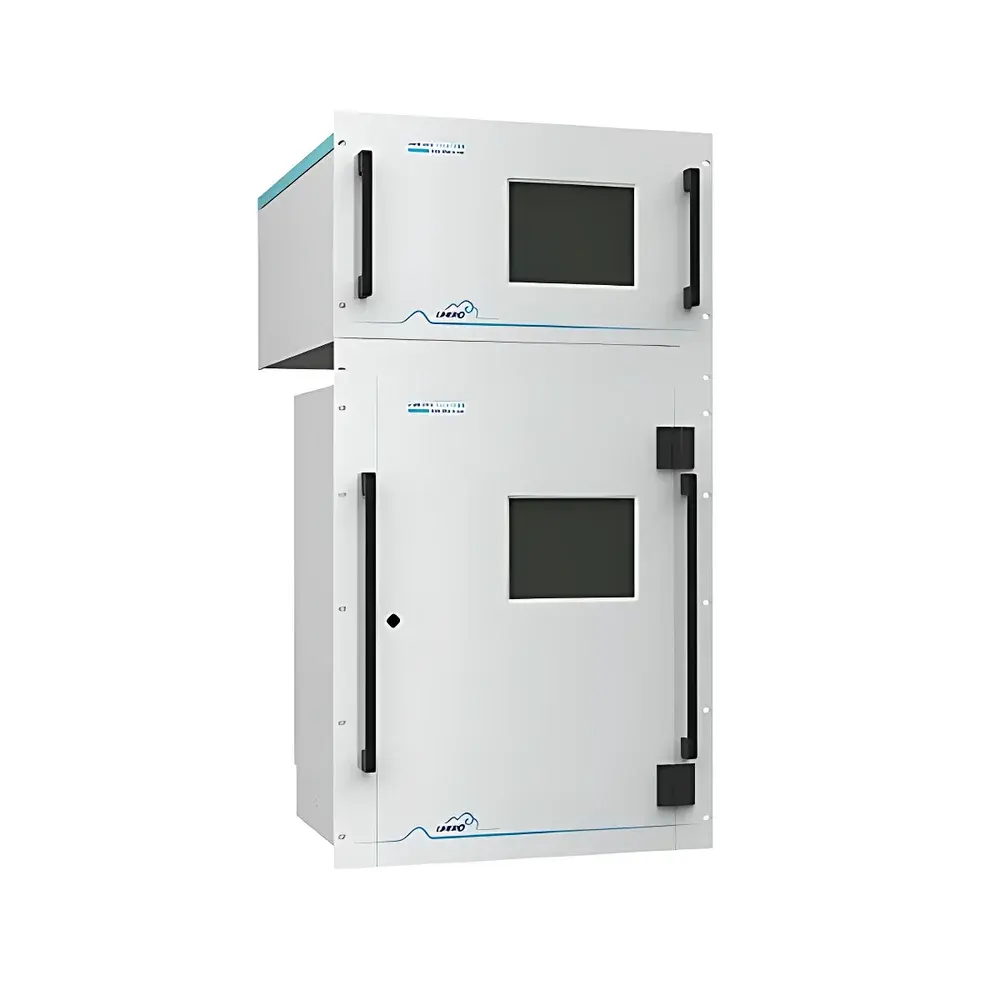
Lihero LFAMS-2010 Online Ambient Air Particulate Water-Soluble Ionic Species Monitoring System
| Brand | Lihero |
|---|---|
| Model | LFAMS-2010 |
| Origin | Hunan, China |
| Instrument Type | Online Aerosol Ion Analyzer |
| Sampling Modes | TSP, PM₁₀, PM₂.₅, PM₁ |
| Minimum Time Resolution | 1 hour |
| Anion Targets | SO₄²⁻, NO₃⁻, NO₂⁻, F⁻, Cl⁻ (expandable) |
| Cation Targets | Na⁺, NH₄⁺, K⁺, Mg²⁺, Ca²⁺ (expandable) |
| Absorption Efficiency | ≥99% |
| Detection Principle | Online Steam-Jet Impaction + Liquid Phase Ion Chromatography (IC) |
Overview
The Lihero LFAMS-2010 Online Ambient Air Particulate Water-Soluble Ionic Species Monitoring System is an integrated analytical platform engineered for continuous, unattended quantification of water-soluble inorganic ions in atmospheric aerosols. It combines real-time aerosol sampling via steam-jet impaction with on-line liquid-phase ion chromatography (IC) to deliver time-resolved chemical speciation data without manual sample handling. The system operates on the principle of thermophoretic vapor condensation followed by inertial impaction into a recirculating absorption loop, ensuring quantitative transfer of soluble ionic fractions from collected particulate matter into aqueous phase. This enables direct coupling to high-resolution ion chromatographic separation and suppressed conductivity detection—fully compliant with standardized methodologies including EPA Method IO-3.3 (for ambient aerosol anions) and ISO 10108 (for cationic species in airborne particulates). Designed for fixed-site air quality monitoring stations, research observatories, and regulatory compliance laboratories, the LFAMS-2010 supports long-term trend analysis, source apportionment studies, and secondary aerosol formation modeling.
Key Features
- Automated, continuous aerosol sampling with programmable time resolution down to 1 hour per analysis cycle
- Multi-stage size-selective inlet configurable for TSP, PM₁₀, PM₂.₅, or PM₁ fractionation in accordance with ISO 25241 and EN 12341
- High-efficiency steam-jet impaction module achieving ≥99% collection efficiency for water-soluble ionic components across the targeted size range
- Integrated micro-bore ion chromatograph with gradient elution capability and dual-column switching for simultaneous anion/cation analysis
- On-board reagent preparation and waste management system minimizing operator intervention and consumables handling
- Ruggedized enclosure rated IP54 for outdoor deployment with temperature-controlled internal environment (15–30 °C operational range)
Sample Compatibility & Compliance
The LFAMS-2010 is validated for ambient air matrices under typical urban, rural, and coastal conditions. It accommodates variable humidity (20–90% RH) and temperature ranges (−10 °C to 45 °C) through active thermal stabilization of the sampling line and absorption chamber. All wet chemistry modules comply with ISO/IEC 17025:2017 requirements for analytical competence. Data output formats conform to AQMS (Air Quality Management System) standards and support direct ingestion into national reporting platforms such as China’s CNEMC AQS and international frameworks including EEA AirBase. The system meets essential electromagnetic compatibility (EMC) and safety criteria per IEC 61326-1 and IEC 61000-6-2, and its software architecture supports audit-trail functionality aligned with GLP principles.
Software & Data Management
The embedded control and analysis software provides remote configuration, real-time status visualization, and automated QC flagging based on retention time stability, peak symmetry, and calibration drift thresholds. Raw chromatograms and processed ion concentration time series are stored in vendor-neutral HDF5 format with embedded metadata (sampling duration, flow rate, temperature, pressure, filter ID). Export options include CSV, NetCDF, and XML for integration with third-party data assimilation tools (e.g., CAMx, WRF-Chem). Software validation documentation includes IQ/OQ protocols and complies with FDA 21 CFR Part 11 requirements for electronic records and signatures where enabled via optional secure authentication module.
Applications
- Long-term monitoring of secondary inorganic aerosol (SIA) precursors—including sulfate, nitrate, and ammonium—in support of PM₂.₅ regulatory compliance (e.g., WHO Air Quality Guidelines, EU Directive 2008/50/EC)
- Source identification and receptor modeling using ion ratio diagnostics (e.g., NO₃⁻/SO₄²⁻, Ca²⁺/Mg²⁺, Na⁺/Cl⁻)
- Process evaluation of desulfurization efficiency at coal-fired power plants via stack plume characterization
- Field validation of satellite-based aerosol optical depth (AOD) retrievals through ground-truthed ionic mass closure
- Indoor air quality assessment in sensitive environments (e.g., cleanrooms, museums, hospitals) where chloride or ammonium ingress indicates ventilation failure or material off-gassing
FAQ
What is the minimum detectable concentration for sulfate (SO₄²⁻) under standard operating conditions?
The system achieves a method detection limit (MDL) of 0.08 µg/m³ for SO₄²⁻ when sampling at 16.7 L/min over a 1-hour cycle, based on EPA IO-3.3 validation protocols.
Can the LFAMS-2010 be configured for semi-volatile organic acids alongside inorganic ions?
No—the current architecture is optimized exclusively for inorganic water-soluble ions. Organic acid analysis requires derivatization and alternative detection modes not supported by the integrated IC module.
Is remote firmware update capability available?
Yes, secure OTA (over-the-air) updates are supported via TLS 1.2-encrypted HTTPS connection, with version rollback and integrity checksum verification.
Does the system meet U.S. EPA equivalency requirements for regulatory monitoring?
While not yet listed on the EPA’s EQOA (Equivalent Methods) database, the LFAMS-2010 adheres to all technical specifications outlined in EPA Method IO-3.3 and has undergone intercomparison testing at certified reference laboratories per ISO 5725-2.
How is calibration traceability maintained across extended deployments?
Calibration standards are traceable to NIST SRM 2783 (Air Particulate Matter) and NIST SRM 3182 (Anion Calibration Solution), with automated multi-point calibration performed every 24 hours and documented in the audit log.







