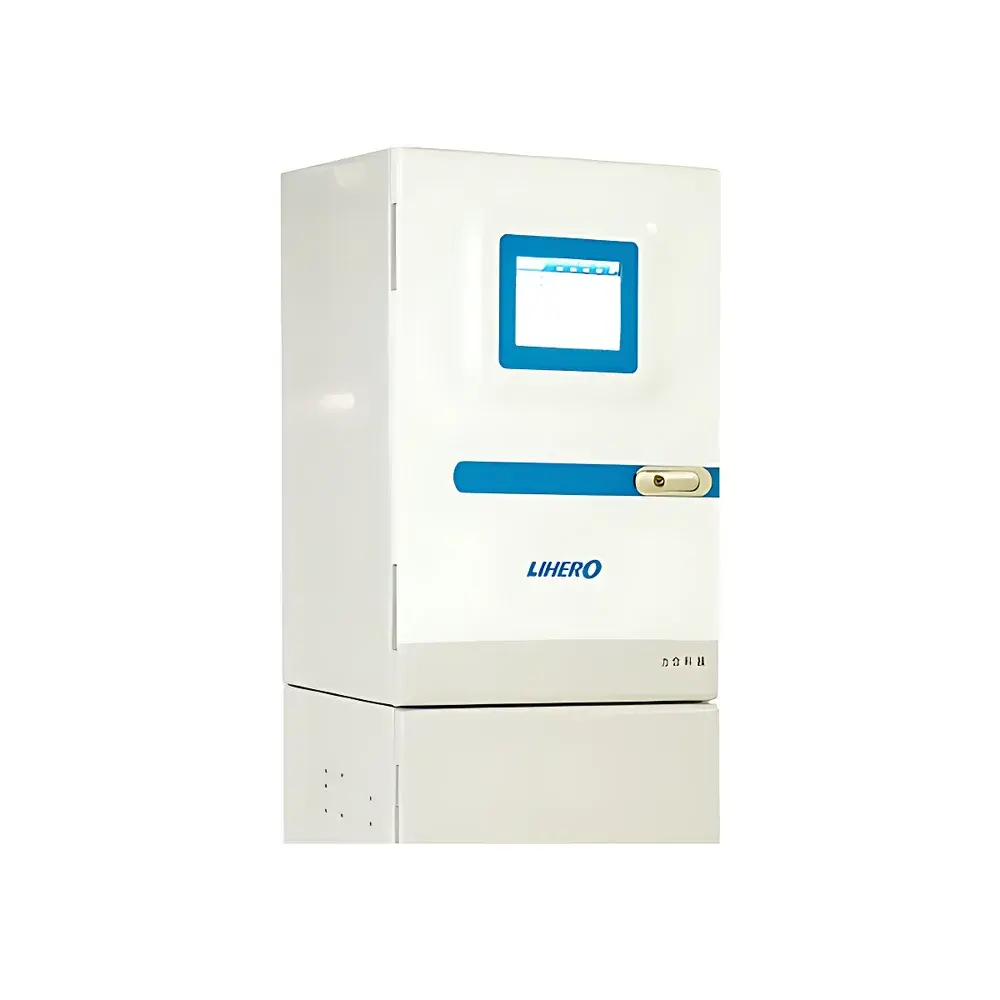
Lihero LIS-2013 Series Online Water Quality Analyzer
| Brand | Lihero |
|---|---|
| Model | LIS-2013 Series |
| Application Domain | Industrial Process Water Monitoring |
| Measurement Parameters | pH, Conductivity, Dissolved Oxygen (DO), Turbidity, Sodium (Na⁺), Silicate (SiO₃²⁻), Phosphate (PO₄³⁻), Hydrazine (N₂H₄), Total Hardness, Total Alkalinity, Residual Chlorine, Iron (Fe²⁺/Fe³⁺) |
| Operating Environment | Continuous online operation in power plants, steel mills, petrochemical refineries, pharmaceutical manufacturing water systems, and high-purity water loops |
| Compliance Framework | Designed for integration into ISO 9001-certified QA/QC workflows and compatible with GLP/GMP data integrity requirements |
| Data Storage | ≥2 years of timestamped measurement records with audit-trail-capable event logging |
| Maintenance Interval | Up to 30 days between reagent refills under typical industrial operating conditions |
| Display Interface | Embedded Linux OS with 7-inch capacitive touchscreen, full Chinese HMI |
| Sample Handling | Multi-channel auto-sampling with flow interruption detection and self-cleaning fluidic path |
Overview
The Lihero LIS-2013 Series Online Water Quality Analyzer is an integrated, multi-parameter process analytical instrument engineered for continuous, real-time monitoring of critical water quality indicators in demanding industrial environments. It operates on a modular architecture combining electrochemical sensors (pH, DO, residual chlorine), optical absorption cells (silicate, phosphate, hydrazine), turbidimetric detection (ISO 7027-compliant), and ion-selective electrode (ISE) modules (sodium, iron). Unlike laboratory-based analyzers requiring manual sampling and batch analysis, the LIS-2013 employs a precisely controlled peristaltic pumping system with programmable sample dilution, temperature-compensated measurements, and automated calibration validation cycles. Its design targets uninterrupted operation in power plant boiler feedwater loops, refinery cooling towers, pharmaceutical purified water (PW) and water-for-injection (WFI) distribution systems, and semiconductor ultrapure water (UPW) recirculation lines—where deviations in sodium, silica, or hydrazine concentration can trigger corrosion, scaling, or end-product contamination.
Key Features
- Modular sensor architecture enables field-replaceable measurement modules without system shutdown—supporting phased upgrades and technology refreshes.
- Embedded Linux-based controller with deterministic real-time task scheduling ensures consistent measurement timing and synchronization across all channels.
- Self-cleaning fluidic pathway utilizes timed air purging and reverse-flow rinsing to minimize biofilm accumulation and particulate fouling in turbidity and ISE cells.
- Sealed, pressurized reagent reservoirs with RFID-tagged consumables provide traceable reagent lot tracking and automatic expiration alerts aligned with ISO 8573-1 air purity class requirements.
- Multi-channel sampling manifold supports up to six independent inlet streams with programmable dwell time, flow verification, and dry-run protection.
- Onboard diagnostic engine performs daily functional checks—including electrode impedance monitoring, photometric zero drift assessment, and pump stroke accuracy validation—reporting results via standardized MODBUS TCP diagnostics registers.
Sample Compatibility & Compliance
The LIS-2013 is validated for aqueous matrices ranging from raw intake water (turbidity ≤ 100 NTU) to high-purity steam condensate (conductivity < 0.1 µS/cm). All wetted materials comply with ASTM F2623 (USP Class VI elastomers) and ASME BPE-2022 surface finish standards (Ra ≤ 0.4 µm for stainless steel manifolds). Measurement protocols align with ASTM D1125 (pH), ASTM D511 (calcium/magnesium hardness), ASTM D3370 (residual chlorine), and ISO 5667-3 (sampling preservation). Data integrity features include time-stamped audit trails, write-once-read-many (WORM) storage partitioning, and optional 21 CFR Part 11-compliant electronic signature support via external authentication servers.
Software & Data Management
The analyzer ships with Lihero ProcessLink™ v4.2 firmware, supporting OPC UA server configuration for seamless integration into DeltaV, Emerson DeltaV DCS, Siemens PCS7, and Honeywell Experion PKS environments. Local data retention includes 2+ years of 1-minute interval measurements stored in SQLite3 databases with SHA-256 hash-verified log rotation. Remote access is enabled via TLS 1.2-secured web interface or encrypted MQTT publishing to cloud historian platforms (e.g., OSIsoft PI System, AVEVA PI). All configuration changes, calibration events, and alarm triggers generate immutable entries containing operator ID, timestamp, and pre/post-change parameter values—fully auditable during FDA or EMA inspection readiness reviews.
Applications
- Boiler feedwater monitoring in thermal power stations: real-time sodium and silica detection below 1 ppb detection thresholds to prevent turbine blade deposition.
- Cooling water chemistry control in petrochemical complexes: simultaneous phosphate dosing feedback and corrosion inhibitor residual tracking.
- Pharmaceutical water system validation: continuous compliance verification against USP and EU Annex 1 requirements for PW/WFI conductivity and TOC surrogate parameters.
- Steel mill desalination plant effluent monitoring: hardness and alkalinity trending for lime softening process optimization.
- Nuclear power plant secondary loop hydrazine monitoring: ensuring oxygen scavenging efficacy while avoiding excess N₂H₄ decomposition byproducts.
FAQ
What is the minimum detectable concentration for sodium ions in high-purity water applications?
The LIS-2013 sodium module achieves a practical limit of quantitation (LOQ) of 0.1 µg/L (pptr) in deionized water matrices at 25 °C, verified per ICH Q2(R2) methodology.
Does the system support remote calibration verification without on-site technician intervention?
Yes—automated standard addition tests and zero-point validation using certified reference materials (CRMs) can be triggered via SCADA command or scheduled calendar-based routines.
How does the analyzer handle sample carryover between high-concentration and low-concentration streams?
The fluidic architecture incorporates dedicated rinse cycles with ultra-low-volume dead-leg minimization (< 50 µL), validated per ASTM D8084 for cross-contamination risk assessment.
Is the data storage compliant with 21 CFR Part 11 for regulated pharmaceutical use?
Out-of-the-box compliance requires configuration of external identity management (e.g., Active Directory integration) and enabling digital signature modules—both supported via optional firmware license keys.
Can the LIS-2013 integrate with existing DCS historian systems using legacy protocols?
In addition to native OPC UA, it provides backward-compatible MODBUS RTU/ASCII over RS-485 and analog 4–20 mA output cards for legacy DCS interfaces.