
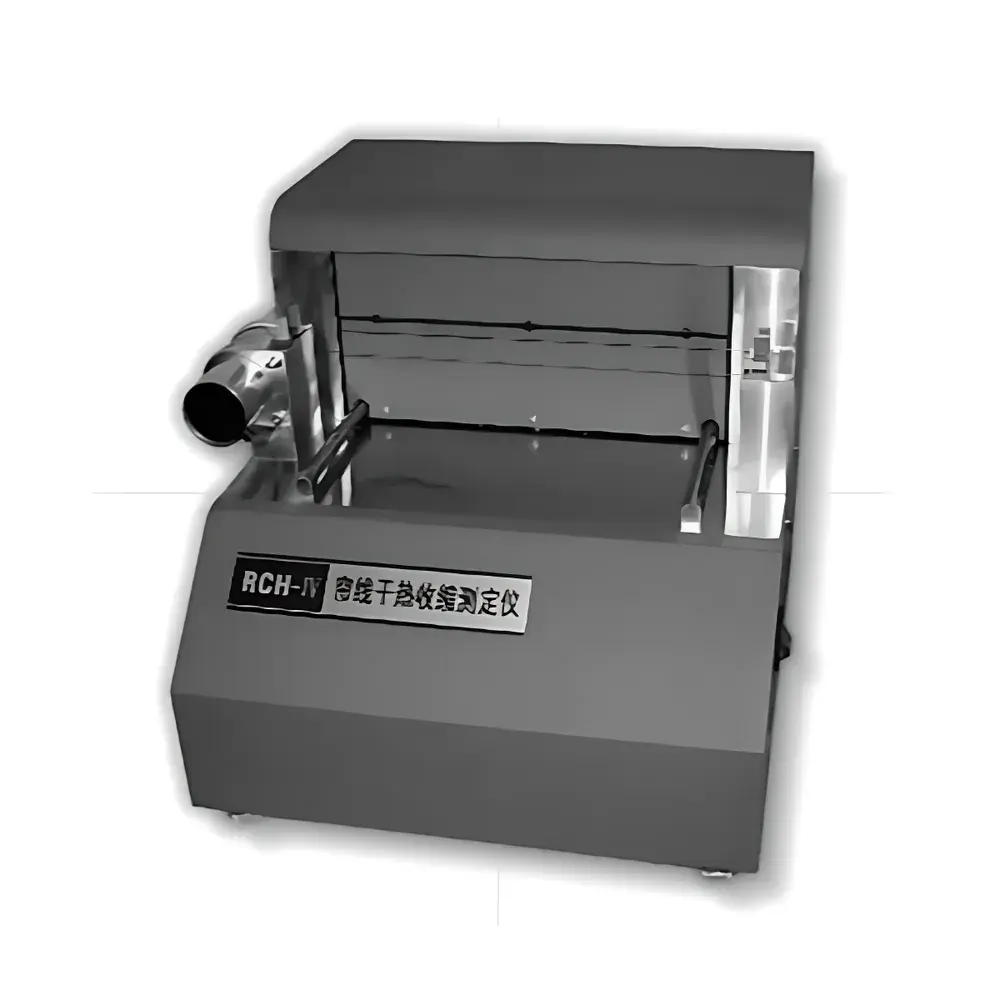
Rigaku RCH-IV Dry Heat Shrinkage Tester for Tire Cord
| Brand | Rigaku |
|---|---|
| Origin | USA |
| Model | RCH-IV |
| Temperature Range | Ambient to 250 °C |
| Shrinkage Measurement Range | −5% to +40% |
| Shrinkage Force Range | 0–25 N |
| Test Positions | 3 (Shrinkage ×2, Force ×1) |
| Compliance | GB/T 9101–2002, GB/T 9102–2003, GB/T 19390–2003, ASTM D4974 |
| Power Supply | 220 V / 50 Hz |
Overview
The Rigaku RCH-IV Dry Heat Shrinkage Tester is a precision-engineered instrument designed for the quantitative evaluation of thermal dimensional stability in high-performance tire cord materials—including nylon, polyester, aramid, and hybrid multifilament yarns. It operates on the principle of controlled dry-heat exposure under defined mechanical constraint, measuring both dimensional change (shrinkage strain) and internal tensile response (shrinkage force) as functions of temperature and time. The system adheres to standardized thermal conditioning protocols specified in GB/T 9101–2002 (determination of hot-air shrinkage), GB/T 9102–2003 (residual shrinkage after cooling), and GB/T 19390–2003 (shrinkage force measurement), with full technical alignment to ASTM D4974 for textile cord thermal behavior assessment. Unlike ambient-condition tensile testers, the RCH-IV integrates thermostatically regulated convection heating, real-time load-cell transduction, and synchronized linear displacement sensing—enabling simultaneous acquisition of strain and stress kinetics during exposure to dry air at temperatures up to 250 °C.
Key Features
- Triple-test configuration: two independent shrinkage measurement stations and one dedicated shrinkage force station—enabling parallel evaluation of dimensional and mechanical responses under identical thermal conditions.
- Precisely regulated dry-air heating chamber with PID-controlled temperature uniformity ±1.5 °C across the test zone, validated per IEC 60068-2-2 requirements for thermal testing environments.
- High-resolution digital load cell (0–25 N, resolution ≤0.02 N) and optical encoder-based displacement sensor (±0.01 mm accuracy) ensure traceable, repeatable quantification of force and length change.
- Microprocessor-based control interface with pre-programmable test parameters—including target temperature, dwell time (standardized at 120 s per GB/T 9101), tension preload, and data sampling interval (10–500 ms).
- Real-time graphical display of shrinkage % vs. time and shrinkage force (N) vs. time curves during active heating; automatic endpoint detection based on stabilized readings or user-defined duration.
- Integrated data logging architecture compliant with GLP documentation standards: timestamped raw data files (.csv), annotated test reports (.pdf), and audit-ready metadata (operator ID, calibration status, environmental logs).
Sample Compatibility & Compliance
The RCH-IV accommodates standard tire cord specimens per ISO 2078 and ASTM D2256—typically 500 mm gauge length, preconditioned per ISO 139 (23 °C / 50% RH, ≥4 h). It supports single-filament, twisted, and cabled structures with diameters ranging from 0.2 mm to 1.8 mm. All test routines are fully traceable to national and international regulatory frameworks: GB/T series standards for Chinese automotive component certification, ASTM D4974 for U.S. OEM qualification, and ISO 18064 (textile cord thermal behavior) where applicable. Instrument calibration certificates include NIST-traceable references for temperature (PT100 probe), force (deadweight verification), and displacement (laser interferometer validation).
Software & Data Management
The embedded Windows-based software suite provides full lifecycle data governance—from method setup and instrument diagnostics to statistical reporting and electronic signature support. Raw datasets retain native timestamping, sensor channel synchronization, and metadata tagging (e.g., sample ID, lot number, operator, ambient humidity/temperature). Export options include CSV for third-party statistical analysis (JMP, Minitab), PDF reports with embedded curves and pass/fail annotations against specification limits, and SQL-compatible database archives. Audit trail functionality satisfies FDA 21 CFR Part 11 requirements, including immutable records of parameter changes, result modifications, and user login/logout events—essential for GMP-regulated quality control laboratories.
Applications
- Quality assurance of industrial tire cord prior to rubber compound adhesion processing.
- R&D evaluation of heat-setting efficacy in textured polyester and nylon filaments.
- Comparative thermal stability screening of bio-based and recycled polymer cords.
- Process validation for continuous heat-treatment lines in synthetic fiber manufacturing.
- Root-cause analysis of belt ply delamination in radial tire failure investigations.
- Supporting ISO/TS 16949 and IATF 16949 compliance through documented, reproducible shrinkage metrics.
FAQ
What standards does the RCH-IV comply with?
GB/T 9101–2002, GB/T 9102–2003, GB/T 19390–2003, and ASTM D4974.
Can the instrument measure both shrinkage and shrinkage force simultaneously?
No—shrinkage and shrinkage force are measured in separate stations; however, identical thermal profiles can be applied concurrently across all three positions.
Is temperature calibration traceable to national standards?
Yes—temperature sensors are calibrated using NIST-traceable reference thermometers and verified per ISO/IEC 17025-accredited procedures.
What is the minimum specimen length required?
500 mm gauge length is standard; shorter specimens may be accommodated with custom fixtures subject to metrological validation.
Does the software support multi-user access with role-based permissions?
Yes—administrator, analyst, and reviewer roles are configurable with password protection and electronic signature enforcement.





