
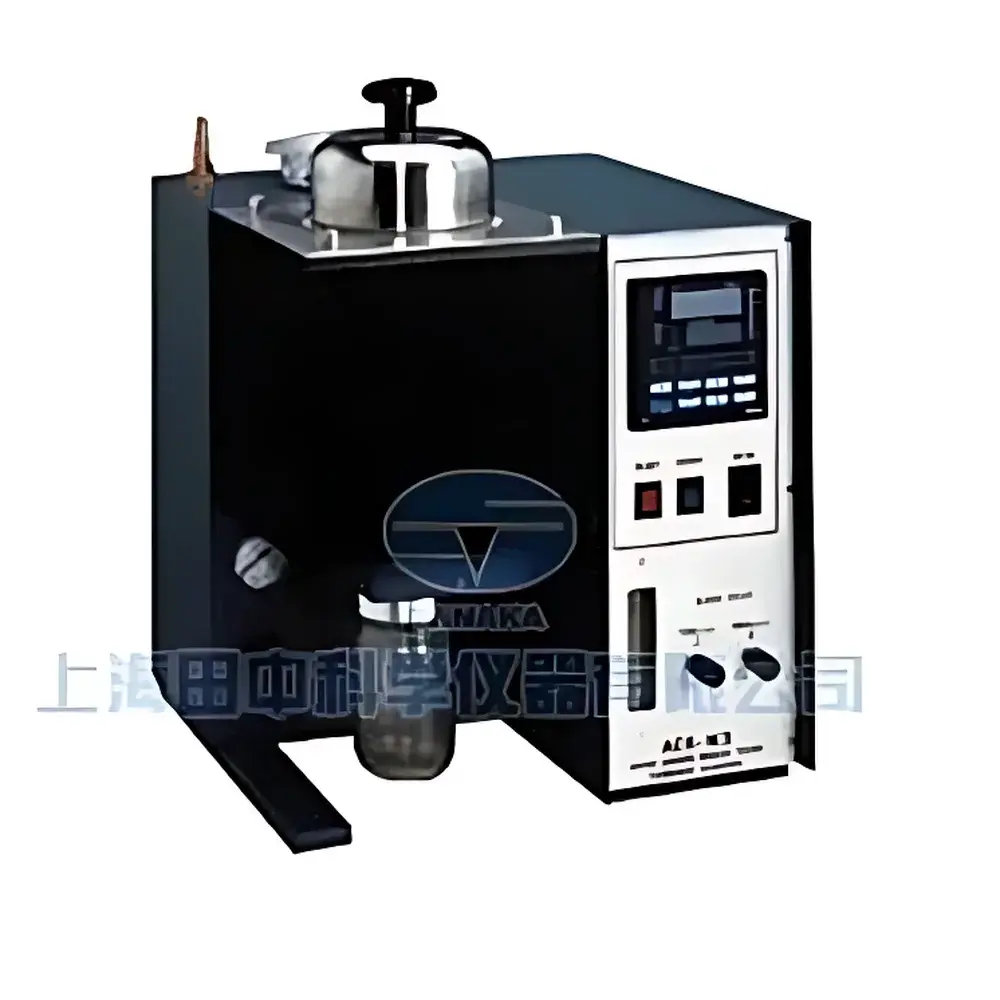
Tanaka ACR-M3 Automated Micro Carbon Residue Tester (ASTM D4530 / GB/T 17144 Compliant)
| Brand | Tanaka |
|---|---|
| Origin | Japan |
| Model | ACR-M3 |
| Standard Compliance | ASTM D4530, GB/T 17144 |
| Heating Range | Ambient to 600 °C |
| Furnace Type | Double-walled stainless steel cylindrical furnace (600 mL capacity) |
| Power Supply | AC 220 V, 50 Hz, 6 A |
| Max. Dual Heater Power | 2 × 500 W |
| Temperature Control | Digital programmable controller (0–500 °C range) |
| Thermocouple | JIS J-type |
| Nitrogen Supply | Primary pressure ≤2058 kPa (21 kgf/cm²), secondary pressure adjustable up to 686 kPa (7 kgf/cm²) |
| N₂ Flow Control | Dual-range automatic switching between 150 mL/min and 600 mL/min via two needle valves + solenoid valve |
| Condensate Collection | Threaded 200 mL borosilicate glass bottle |
| Exhaust | φ12.7 mm stainless steel duct mounted on rear panel |
| Cooling | Axial fan for control unit and furnace lid |
| Dimensions (W×D×H) | 360 × 330 × 350 mm |
| Weight | ~20 kg |
| Sample Throughput | 6 samples (large crucibles) or 12 samples (small crucibles) per run |
| Sample Mass Range | 0.15 ± 0.05 g (for >5% CR), 0.5 ± 0.1 g (for 1–5% CR), 5.0 ± 0.5 g (for <1% CR) |
Overview
The Tanaka ACR-M3 Automated Micro Carbon Residue Tester is an engineered solution for precise, repeatable determination of carbon residue in petroleum products according to the micro-method principle defined in ASTM D4530 and GB/T 17144. Unlike traditional Conradson carbon residue (CCR) apparatuses, the ACR-M3 employs controlled pyrolysis under inert nitrogen atmosphere—eliminating oxidative interference and enabling quantitative thermal decomposition in a sealed, reproducible environment. The instrument operates by heating weighed samples in standardized crucibles within a double-walled stainless steel furnace, where temperature ramping, dwell time, and gas flow are fully automated and traceable. This method yields residual carbon mass as a percentage of the original sample weight, serving as a critical indicator of coke-forming tendency in fuels, lubricants, and heavy distillates—directly informing refining process control, blending optimization, and product specification compliance.
Key Features
- Automated dual-range nitrogen flow control (150 mL/min and 600 mL/min) via precision needle valves and a solenoid valve—ensuring optimal purge conditions across volatile and non-volatile fractions.
- Dual crucible configuration support: accommodates either six large crucibles (for low-residue samples) or twelve small crucibles (for high-residue materials), maximizing lab throughput without manual intervention.
- Integrated safety architecture: real-time furnace temperature monitoring with automatic power cutoff and audible alarm upon over-temperature detection (>600 °C threshold).
- Pressure-regulated nitrogen supply system featuring primary/secondary stage regulation, calibrated pressure gauges (0–500 kPa), and fail-safe low-pressure shutoff (<78 kPa) to prevent incomplete inerting.
- Modular condensate collection using a threaded 200 mL borosilicate glass bottle—designed for rapid detachment, cleaning, and residue quantification without tooling.
- Front-panel digital controller with programmable ramp-hold profiles, J-type thermocouple feedback, and intuitive start/reset interface—requiring only a single “Start” command to initiate full ASTM-compliant sequence.
- Axial fan cooling system actively dissipates heat from both the control electronics and furnace lid—maintaining stable ambient operation during extended batch runs.
Sample Compatibility & Compliance
The ACR-M3 is validated for use with a broad spectrum of petroleum-derived materials including diesel fuel, residual fuel oil, cracked stocks, lubricating base oils, and vacuum residua. Its micro-method approach eliminates the need for open-flame heating and reduces operator exposure to fumes and hot surfaces. All operational parameters—including temperature profile, nitrogen flow timing, and hold duration—are aligned with the procedural requirements of ASTM D4530 and GB/T 17144. The instrument’s design supports GLP-aligned workflows: electronic start logging, auditable temperature history (via controller memory), and consistent crucible geometry ensure inter-laboratory reproducibility. While not inherently 21 CFR Part 11 compliant, its programmable controller output can be interfaced with validated LIMS or ELN systems supporting electronic record retention and audit trails.
Software & Data Management
The ACR-M3 operates without proprietary software—the digital program controller stores up to 10 user-defined test protocols and logs timestamped start/stop events and peak temperature readings internally. For integration into modern QA/QC environments, optional RS-232 or USB-to-serial adapters enable export of temperature vs. time data to spreadsheet or laboratory information management systems (LIMS). No embedded database or cloud connectivity is present; all data handling remains under local user control—consistent with secure industrial network policies. Calibration records, maintenance logs, and operator training documentation are maintained externally per ISO/IEC 17025 requirements.
Applications
- Refinery QC labs assessing carbon residue in atmospheric and vacuum residues prior to coker feed scheduling.
- Fuel formulation teams evaluating thermal stability of middle distillates and marine fuels against IMO Annex VI specifications.
- Lubricant manufacturers verifying base oil purity and additive package compatibility through residue profiling.
- Independent testing laboratories performing contract analysis for API, ISO 8217, or EN 590 compliance reporting.
- Research institutions studying coke formation kinetics under controlled inert pyrolysis conditions.
FAQ
What standards does the ACR-M3 comply with?
ASTM D4530 and GB/T 17144 are fully supported through hardware configuration, thermal profile accuracy, and nitrogen flow control logic.
Is the instrument suitable for routine high-volume testing?
Yes—batch capacity of up to 12 samples per run, combined with fully automated sequence execution and rapid cool-down, enables efficient daily throughput in production QC environments.
How is safety ensured during high-temperature operation?
The system features redundant thermal protection: independent over-temperature cutoff circuitry, low-nitrogen-pressure interlock, and front-panel emergency power switch—all meeting IEC 61010-1 requirements for laboratory electrical equipment.
Can test data be exported for regulatory submission?
Raw temperature/time logs and protocol metadata may be retrieved via serial interface and formatted for inclusion in FDA, EPA, or CNAS audit packages when paired with validated data acquisition software.
What maintenance is required for long-term reliability?
Routine tasks include periodic verification of thermocouple calibration, inspection of nitrogen regulator seals, cleaning of exhaust ducts and condensate traps, and replacement of furnace insulation after ~5,000 cycles—per Tanaka’s documented service schedule.
Related Products





