
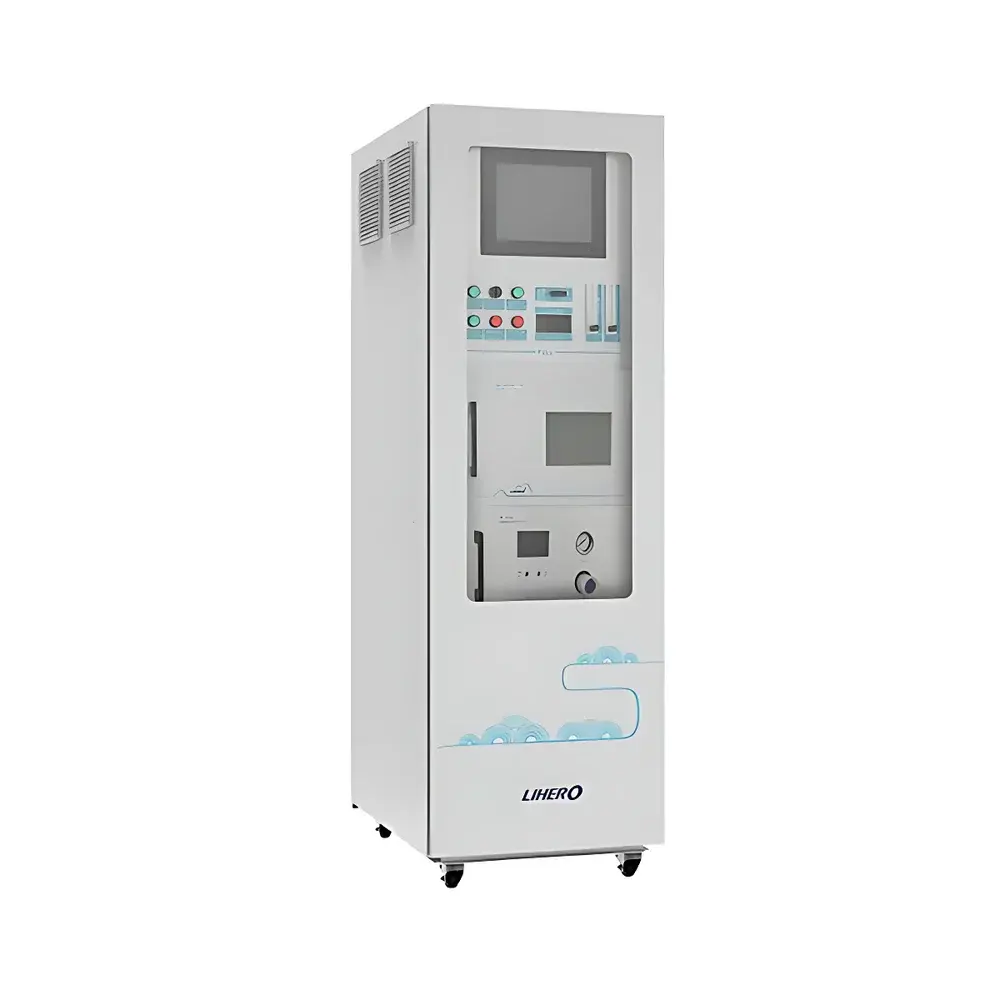
Lihero NMHC-CEMS Fixed Source Emission Continuous Monitoring System
| Brand | Lihero |
|---|---|
| Origin | Hunan, China |
| Manufacturer Type | Authorized Distributor |
| Country of Origin | China |
| Model | NMHC-CEMS |
| Pricing | Available Upon Request |
Overview
The Lihero NMHC-CEMS Fixed Source Emission Continuous Monitoring System is an integrated analytical platform engineered for real-time, regulatory-compliant quantification of non-methane hydrocarbons (NMHC) and volatile organic compounds (VOCs) — including benzene, toluene, ethylbenzene, and xylene (BTEX) — in flue gas streams from stationary industrial sources. Based on flame ionization detection (FID) coupled with gas chromatography (GC), the system adheres to core principles defined in EPA Method 25A, HJ 38–2017 (China’s standard for NMHC determination), and ISO 11843-2 for detection limit validation. It delivers continuous, unattended operation across stack temperatures up to 200 °C and dew points below −10 °C, supporting compliance reporting for environmental authorities under China’s Standard for Emission of Air Pollutants from Industrial Furnaces and Kilns (GB 9078–1996) and the Comprehensive Emission Standard of Air Pollutants (GB 16297–1996). The system integrates heated sample extraction, catalytic methanizer-based NMHC separation, GC-FID analysis, and dual-path calibration gas management to ensure trace-level accuracy and long-term measurement integrity.
Key Features
- Modular configuration supporting simultaneous NMHC, BTEX, and extended VOC speciation (C2–C12 aliphatics/aromatics) within a single chassis — compatible with existing CEMS infrastructure via 4–20 mA and Modbus RTU interfaces;
- FID detector with linear dynamic range of 106, certified detection limit ≤0.1 ppm (as propane equivalent), with user-selectable full-scale ranges from 0.2 ppm to 10,000 ppm;
- Automated backflush GC column architecture reducing cycle time to ≤120 s per analysis while extending column service life beyond 18 months under continuous operation;
- Precision temperature control (±0.1 °C) for oven, detector, and methanizer zones; mass flow controllers (MFCs) with ±0.5% full-scale accuracy for carrier, makeup, and hydrogen gases;
- Fail-safe ignition management: automatic flame-out detection, purge sequence, and re-ignition within 90 s — validated per IEC 61508 SIL 2 functional safety requirements;
- Embedded data logger storing ≥12 months of operational metadata, including FID baseline drift, column head pressure, calibration event timestamps, and alarm history;
- Integrated catalytic tail-gas oxidizer converting residual hydrocarbons to CO2/H2O prior to venting — meeting OSHA PEL and local indoor air quality guidelines;
- Web-enabled HMI with real-time chromatogram display, peak integration overlays, and intuitive workflow navigation — no proprietary software installation required.
Sample Compatibility & Compliance
The system accepts raw flue gas samples at temperatures up to 200 °C and particulate loadings ≤50 mg/m³ (post-ceramic filter). Integrated heated sampling line (180 °C), Teflon-lined probe, and particle filtration meet EN 15267–3 and HJ 75–2017 certification prerequisites. All measurement protocols align with national verification procedures outlined in HJ 1013–2018 (Performance Testing Specifications for NMHC CEMS) and support audit-ready documentation for provincial ecological environment bureaus. Data transmission complies with HJ 212–2017 communication protocol for environmental monitoring systems, enabling seamless integration into China’s National Environmental Monitoring Network (NEMN).
Software & Data Management
Firmware v3.2 includes embedded Linux-based controller with TLS 1.2 encrypted data transmission, configurable report generation (hourly/daily/monthly), and role-based access control (operator, technician, administrator). Raw chromatographic data (ASCII .csv), processed concentration values, and QC flags are stored locally on industrial-grade SSD and mirrored to external FTP/SFTP servers. Audit trail functionality records all parameter changes, calibration actions, and user logins — satisfying GLP-aligned record retention requirements per HJ 76–2017. Remote diagnostics and firmware updates are supported via secure SSH tunneling without exposing the device to public IP networks.
Applications
- Continuous emission monitoring for thermal power plants, cement kilns, and steel sintering facilities subject to GB 13223–2011 and GB 4915–2013;
- VOC abatement efficiency verification at RTO/RCO units and activated carbon adsorption systems;
- Process optimization support in petrochemical refineries and fine chemical synthesis lines where NMHC emissions correlate with reactor conversion rates;
- Stack testing validation during environmental impact assessments (EIAs) and post-construction acceptance inspections;
- Long-term trend analysis for facility-wide carbon intensity benchmarking and ESG reporting frameworks.
FAQ
Does the system comply with China’s mandatory CEMS certification requirements?
Yes — it has undergone type approval testing per HJ 76–2017 and HJ 1013–2018, and holds registration in the Ministry of Ecology and Environment’s Certified CEMS Product Catalog.
Can the system operate without on-site IT infrastructure?
Yes — it functions autonomously with internal data storage, local HMI, and optional 4G/LTE cellular backup for data transmission when LAN connectivity is unavailable.
What maintenance intervals are recommended for GC columns and FID components?
Column replacement is recommended every 18–24 months depending on matrix complexity; FID jet cleaning and electrode inspection are scheduled quarterly, with full detector recalibration annually.
Is third-party data validation supported?
Yes — the system exports timestamped, digitally signed .csv files compatible with independent QA/QC software such as EnviroData and QI Analyst for cross-platform reconciliation.
How is zero/span drift monitored and corrected?
Automated daily zero/span checks using certified N2 and CH4/air standards; drift compensation algorithms adjust integration parameters in real time and flag excursions exceeding ±5% of full scale.







