
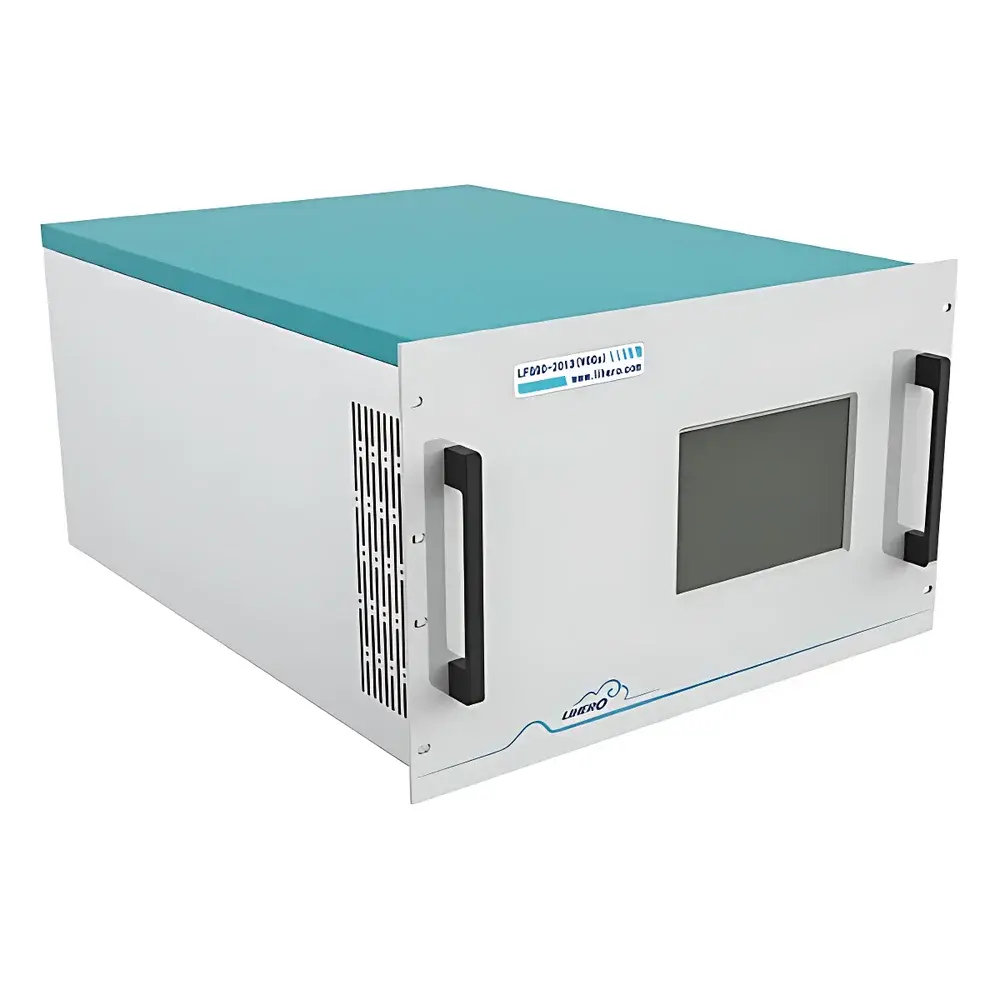
Lihero LFGGC-2013 NMHC Online Methane and Non-Methane Hydrocarbons Analyzer
| Brand | Lihero |
|---|---|
| Model | LFGGC-2013 (NMHC) |
| Instrument Type | Online Gas Chromatograph |
| Detection Principle | Gas Chromatography with Flame Ionization Detection (GC-FID) |
| Sample Handling | Heated Sampling Line (up to 180 °C), Integrated High-Temperature Filter |
| Column Configuration | Dual-Path Separation — Methane-Specific Capillary Column + Custom C₂⁺ Adsorption/Desorption Trap |
| Detector | Imported FID with Auto-Ignition and Flame-Out Recovery |
| Temperature Control Accuracy | ±0.1 °C |
| Pressure Control Resolution | 0.01 psi |
| Response Time | ≤40 s |
| Warm-up Time | ≤30 min |
| Detection Range | Dual-Range (Low/High, Auto-Switching) |
| Carrier Gas | High-Purity Hydrogen (Onboard PEM Electrolytic Generator, Deionized Water Feed) and Zero Air (Integrated Onboard Generator) |
| Display | 5.7″ Capacitive Touchscreen |
| Connectivity | USB 2.0, 10/100 Mbps Ethernet |
| Compliance | Designed for Continuous Emission Monitoring (CEM) in compliance with EPA Method 25A, ISO 10156, and EN 15467 principles |
| Origin | Hunan, China |
| Manufacturer Status | Authorized Distributor |
Overview
The Lihero LFGGC-2013 NMHC Online Methane and Non-Methane Hydrocarbons Analyzer is a dedicated gas chromatographic system engineered for continuous, unattended measurement of methane (CH₄) and total non-methane hydrocarbons (NMHC) in ambient air, industrial stack emissions, biogas streams, and landfill off-gas applications. It operates on the principle of dual-path gas chromatography coupled with flame ionization detection (GC-FID), a reference method recognized under EPA Method 25A and aligned with performance criteria in ISO 10156 and EN 15467. Methane is resolved using a high-selectivity capillary column under isothermal or temperature-programmed conditions, while NMHC quantification relies on cryogenic adsorption of C₂–C₁₀ hydrocarbons onto a proprietary sorbent trap, followed by rapid thermal desorption into the FID. This architecture eliminates interference from methane in NMHC reporting and ensures stoichiometrically accurate carbon-equivalent concentration output.
Key Features
- Dual-range auto-switching detection architecture supports wide dynamic coverage—from sub-ppm to 10,000 ppm C₁–C₁₀ hydrocarbons—without manual range adjustment or calibration interruption.
- Full-path heated sampling train (up to 180 °C) with integrated ceramic high-temperature particulate filter prevents condensation, adsorption loss, and catalytic degradation of reactive VOCs during transport.
- Imported low-dead-volume rotary diaphragm valves enable precise, repeatable flow routing between sample loop, trap, column, and detector—critical for retention time stability and peak shape fidelity.
- Onboard hydrogen generator utilizes proton exchange membrane (PEM) electrolysis of deionized water, delivering ultra-high-purity H₂ (99.999%) on demand; zero air is generated via catalytic purification of compressed ambient air.
- Microprocessor-controlled oven maintains column and detector zones within ±0.1 °C, while digital pressure control (0.01 psi resolution) ensures reproducible carrier gas linear velocity—key parameters governing GC separation efficiency and quantitative precision.
- Auto-ignition sequence with real-time flame monitoring detects flame extinction and re-ignites the FID within seconds, minimizing downtime and preserving data continuity during power fluctuations or transient gas composition shifts.
- Reverse-flush capability shortens cycle time by purging late-eluting heavy hydrocarbons from the analytical column, extending column lifetime beyond 24 months under typical CEM duty cycles.
Sample Compatibility & Compliance
The LFGGC-2013 accepts gaseous samples at pressures between 0.5–2.0 bar(g) and temperatures up to 60 °C at the inlet. It is validated for use with ambient air, flue gas (with optional dilution module), biogas (up to 40% CO₂), and landfill extraction gas containing H₂S ≤5 ppm (requires optional sulfur scrubber). The system meets fundamental design requirements for regulatory-grade CEM systems: traceable calibration protocols, audit-ready event logging, and hardware-level fault diagnostics. While not certified as a Type-Approved CEMS per EU Directive 2010/75/EU or U.S. EPA Performance Specification 8, its operational methodology aligns with the scientific basis of Method 25A and supports data quality objectives required for Title V reporting, LDAR verification, and GHG inventory compliance under IPCC Tier 2/3 frameworks.
Software & Data Management
Embedded firmware provides real-time chromatogram visualization, baseline correction, peak integration (using valley-to-valley and tangent skim algorithms), and automatic retention time alignment. All raw chromatographic data, instrument status logs (oven temp, pressure, valve positions, FID current), and user actions are timestamped and stored internally (≥30 days) and exportable via USB or Ethernet to external SCADA or LIMS platforms. Data files conform to ASTM E1792-18-compliant CSV structure, including metadata headers for traceability. Remote configuration and diagnostic access are supported over secure HTTP/S with role-based authentication (admin/operator), satisfying foundational elements of FDA 21 CFR Part 11 for electronic records when deployed in GLP environments.
Applications
- Continuous monitoring of methane slip in natural gas-fired combustion turbines and reciprocating engines.
- Real-time NMHC emission tracking from chemical manufacturing exhaust stacks per EPA 40 CFR Part 60 Subpart J.
- Biogas upgrading process control—quantifying residual hydrocarbons pre- and post-membrane separation.
- Landfill gas collection system optimization through spatially distributed CH₄/NMHC ratio trending.
- Urban air quality networks requiring speciated hydrocarbon data for ozone precursor analysis.
- Research laboratories conducting atmospheric chemistry studies involving hydrocarbon photooxidation kinetics.
FAQ
What carrier gases does the LFGGC-2013 require?
It uses high-purity hydrogen (generated onboard from deionized water) as both fuel for the FID and carrier gas for the methane channel; zero air (catalytically purified) serves as makeup and combustion air.
Can the analyzer distinguish individual NMHC compounds?
No—it reports total NMHC as propane-equivalent carbon (C₃H₈) concentration per EPA Method 25A conventions. Compound-specific analysis requires a full-spectrum GC-MS configuration.
Is external calibration gas required for routine operation?
Yes—daily or per-shift span checks using certified CH₄-in-air and NMHC-in-air standards (e.g., propane or toluene blends) are necessary to maintain accuracy and meet QA/QC protocols.
Does the system support Modbus TCP or OPC UA communication?
Native protocol support includes HTTP RESTful API and ASCII-over-TCP; Modbus TCP and OPC UA gateways can be implemented via third-party edge devices connected to the Ethernet port.
What maintenance intervals are recommended?
FID nozzle cleaning every 90 days, trap regeneration every 6 months, and column replacement every 24 months—assuming average particulate load and <5 ppm H₂S exposure.







