
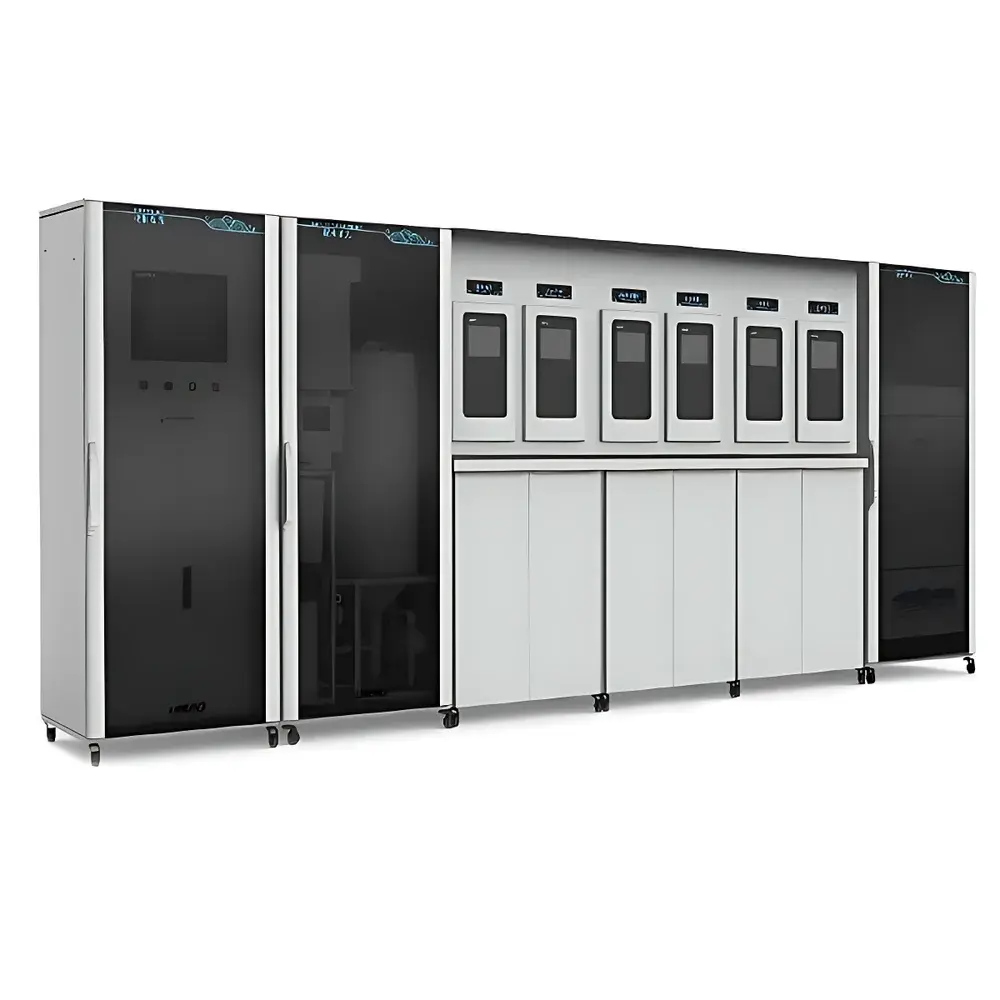
Lihero LFWAMS-2010 Fixed-Station Water Quality Automatic Monitoring System
| Brand | Lihero |
|---|---|
| Origin | Hunan, China |
| Manufacturer Type | Authorized Distributor |
| Country of Manufacture | China |
| Model | LFWAMS-2010 |
| Pricing | Available Upon Request |
Overview
The Lihero LFWAMS-2010 Fixed-Station Water Quality Automatic Monitoring System is an integrated, industrial-grade environmental monitoring platform engineered for continuous, unattended operation in surface water, reservoirs, drinking water intakes, and wastewater discharge points. Built upon a modular architecture centered on certified online analytical instruments, the system employs multi-sensor fusion, programmable logic control (PLC), and IoT-enabled telemetry to deliver real-time, high-frequency measurement of over 100 physicochemical and biological parameters—including nutrients (NH₄⁺, NO₃⁻, TN, TP), heavy metals (Cd, Pb, As, Hg via ICP-MS or anodic stripping voltammetry modules), organic pollutants (CODMn, TOC, UV₂₅₄), chlorophyll-a, turbidity, dissolved oxygen, pH, conductivity, and temperature. Its core operational principle relies on standardized wet-chemistry analysis (e.g., colorimetry, ion-selective electrode detection, electrochemical sensing) coupled with automated sample pretreatment (filtration, digestion, dilution) and calibration verification cycles. Designed for regulatory compliance and long-term stability, the LFWAMS-2010 supports 7×24 operation under ambient outdoor conditions (IP65-rated enclosure, -10°C to 50°C operating range) and integrates seamlessly into national and provincial water quality surveillance networks.
Key Features
- Modular sensor and analyzer bay architecture—enables rapid reconfiguration of parameter sets via software-defined control logic or physical module swapping, supporting field adaptation without hardware redesign.
- Automated quality assurance/quality control (QA/QC) protocols including scheduled multi-point calibration, blank/spike recovery checks, drift monitoring, and internal standard validation—fully documented in audit trails per ISO/IEC 17025 and China’s HJ 915-2017 technical specifications for automatic water quality monitoring stations.
- Embedded industrial PLC with dual-redundant communication interfaces (4G LTE + Ethernet + optional LoRaWAN) ensures reliable data transmission even during network outages; local edge storage retains ≥30 days of raw sensor output and diagnostic logs.
- Adaptive sampling logic—supports event-triggered sampling (e.g., sudden DO drop or turbidity spike), scheduled high-frequency acquisition (1–60 min intervals), and low-power sleep modes during baseline conditions to extend maintenance intervals.
- Self-diagnostic firmware continuously monitors critical subsystems (pump performance, reagent level, temperature stability, optical path cleanliness) and generates actionable maintenance alerts with root-cause classification.
Sample Compatibility & Compliance
The LFWAMS-2010 accepts raw water samples from natural and anthropogenic sources without pre-filtration (0.45 µm inline filter standard). It accommodates variable flow rates (1–5 L/min), suspended solids content (<100 mg/L), and salinity up to 10 g/L. All wetted components comply with NSF/ANSI 61 for potable water contact. Analytical modules meet applicable Chinese Environmental Protection Standards (HJ series), and optional configurations support EPA Method 200.7 (ICP-OES), EPA 300.0 (ion chromatography), and ISO 15839 for online water quality sensors. The system architecture supports GLP-aligned data integrity requirements, including electronic signatures, time-stamped audit logs, and immutable data archiving compliant with China’s GB/T 32960.3-2016 for environmental monitoring data management.
Software & Data Management
The system operates with Lihero WQMS v4.2—a web-based, role-secured monitoring platform supporting SCADA-style visualization, GIS-integrated spatial mapping, and configurable alarm thresholds (e.g., WHO guideline values, Class III surface water standards per GB 3838-2002). Raw and processed data are stored in a PostgreSQL database with built-in encryption-at-rest and TLS 1.2+ encrypted transmission. The platform provides RESTful API access for integration with provincial environmental information systems (e.g., China’s National Surface Water Quality Monitoring Platform) and supports automated report generation (daily/weekly/monthly PDF/Excel exports) aligned with HJ 915-2017 reporting templates. Full 21 CFR Part 11 compliance is available via optional validated software package, including electronic signature workflows, user access tiering, and change-controlled configuration management.
Applications
- Real-time early warning of eutrophication events in lakes and reservoirs through synchronized NH₄⁺, PO₄³⁻, Chl-a, and DO trend analysis.
- Regulatory compliance monitoring at municipal drinking water source intakes per GB 5749-2022, with automatic alerting on exceedances of arsenic, fluoride, or nitrate limits.
- Industrial effluent discharge tracking at chemical parks and wastewater treatment plants, enabling dynamic load balancing and pollution source attribution.
- Support for scientific research campaigns requiring high-temporal-resolution datasets (e.g., diel dissolved oxygen cycling, stormwater runoff contaminant pulses).
- Integration into smart watershed management platforms for predictive modeling of pollutant transport using historical LFWAMS-2010 time-series as training inputs.
FAQ
What certifications does the LFWAMS-2010 hold for environmental monitoring use in China?
It complies with HJ 915-2017, HJ 353-2019 (technical specifications for water quality automatic monitoring stations), and GB/T 32960.3-2016. Optional modules carry CMA accreditation for specific parameters.
Can the system operate in remote, off-grid locations?
Yes—configured with solar power kits (12 V DC input support) and battery backup (72 h autonomy), it maintains full functionality without mains electricity.
How is data security ensured during transmission and storage?
All communications use TLS 1.2+, data-at-rest encryption (AES-256), and RBAC (role-based access control); audit logs record every login, configuration change, and data export event.
Is remote firmware update supported?
Yes—over-the-air (OTA) updates are performed via signed, version-controlled packages with rollback capability and pre-deployment validation checks.
What maintenance interval is recommended for routine service?
Standard preventive maintenance is scheduled every 90 days, including reagent replacement, tubing inspection, optical window cleaning, and QA/QC verification—reduced to 180 days with optional ultrasonic anti-fouling modules.
Related Products







