
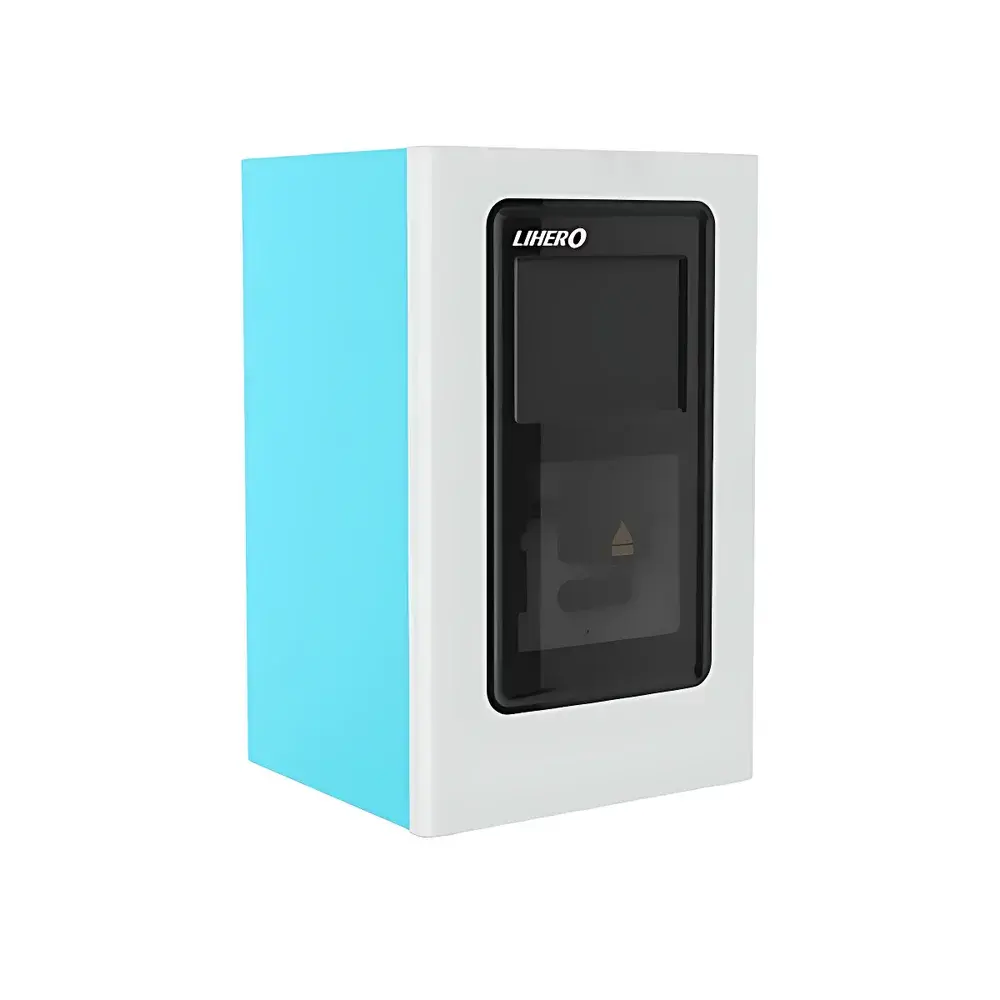
Lihero LFS-2002 Permanganate Index (CODMn) Online Analyzer
| Brand | Lihero |
|---|---|
| Model | LFS-2002 (CODMn) |
| Type | Online Analyzer |
| Detection Principle | Potassium Permanganate Oxidation Titration (Acidic & Alkaline Methods) |
| Endpoint Detection | Photometric & Potentiometric Titration |
| Chloride Interference Compensation | Automatic Method Switching (Acidic vs. Alkaline) |
| Self-Diagnosis | Integrated Sensor Health Monitoring, Optical Path Auto-Balancing, Reagent Level & Sample Flow Monitoring |
| Calibration & QA/QC | Automated Zero/Span/Standard Verification, Curve Auto-Calibration, Spike Recovery Test |
| Compliance Support | Designed for ISO 8467, ASTM D1253, and GB/T 5750.7–2006 alignment |
| Remote Operation | Modbus TCP, RS485, and Optional OPC UA Integration |
| Operating System | Embedded Real-Time OS |
Overview
The Lihero LFS-2002 Permanganate Index (CODMn) Online Analyzer is an industrial-grade, fully automated system engineered for continuous, unattended measurement of the permanganate index—a critical surrogate parameter for organic pollution load in surface water, drinking water sources, and treated effluents. Based on the standardized potassium permanganate oxidation titration method, the analyzer implements a two-step redox reaction sequence under precisely controlled thermal and pH conditions: first, oxidation of reducible substances by excess KMnO₄ in either acidic or alkaline medium; second, back-titration of residual oxalate with standardized KMnO₄. Endpoint detection is achieved via dual-mode sensing—either photometric absorbance at 525 nm (for low-turbidity, low-color samples) or potentiometric monitoring of the MnO₄⁻/Mn²⁺ redox couple (for high-turbidity, colored, or chloride-rich matrices). This dual-endpoint architecture ensures robust performance across heterogeneous water matrices without manual intervention.
Key Features
- Automated dual-method operation: seamless switching between acidic (ISO 8467 Clause 6.1) and alkaline (ISO 8467 Clause 6.2) digestion protocols based on real-time chloride concentration input or pre-configured threshold logic—effectively eliminating chloride interference up to 300 mg/L Cl⁻.
- Integrated sensor diagnostics: optical path auto-balancing compensates for lamp aging, cuvette fouling, and ambient light drift; electrochemical sensor self-check verifies reference electrode stability and junction potential integrity prior to each titration cycle.
- Comprehensive QA/QC automation: scheduled zero-point verification (using deionized water), span validation (with certified KMnO₄ standard), multi-point curve calibration, and automatic spike recovery assessment per batch—fully traceable with timestamped audit logs.
- Modular reagent management: independent reservoirs for KMnO₄, Na₂C₂O₄, H₂SO₄, and NaOH solutions, each monitored via capacitive level sensors; low-reagent alerts trigger event logging and optional SCADA notification.
- Embedded deterministic real-time OS: ensures sub-second response to flow anomalies, temperature deviations, or endpoint overshoot—critical for maintaining <±2% RSD repeatability across 72-hour unattended operation.
- Fault-resilient architecture: hardware-level watchdog timers, redundant power supervision, and non-volatile error register storage enable full diagnostic traceability during power interruption or communication loss.
Sample Compatibility & Compliance
The LFS-2002 accepts raw or pre-filtered (≤80 µm) influent water with turbidity ≤400 NTU and suspended solids ≤150 mg/L. It complies with the analytical framework of ISO 8467:2021 (Water quality — Determination of permanganate index), ASTM D1253-20 (Standard Test Method for Determining Permanganate Number of Water), and China’s GB/T 5750.7–2006 (Standard Examination Methods for Drinking Water – Organic Indexes). Its alkaline method implementation satisfies EPA Method 410.2 adaptation requirements for chloride-rich groundwater and estuarine monitoring. Instrument design incorporates GLP-aligned data integrity safeguards—including electronic signature-capable audit trails, immutable event logs, and time-stamped calibration records—supporting regulatory readiness for ISO/IEC 17025-accredited laboratories and municipal water utilities subject to national discharge permit reporting.
Software & Data Management
The analyzer operates via a web-accessible embedded HMI (HTML5-based), supporting local touchscreen control and remote configuration through HTTPS-secured connections. All measurement data—including raw absorbance/potential traces, titrant consumption volumes, calculated CODMn values (mg O₂/L), QA/QC status flags, and diagnostic codes—are stored in SQLite databases with configurable retention (default: 90 days). Data export adheres to EPA SW-846-compliant CSV schema and supports direct ingestion into LIMS platforms via FTPS or MQTT. Firmware updates are validated via SHA-256 checksum and applied atomically to prevent partial corruption. Audit trail entries comply with FDA 21 CFR Part 11 requirements for electronic records and signatures when deployed in regulated environments.
Applications
- Real-time monitoring of source water quality at intake structures of drinking water treatment plants.
- Effluent compliance tracking for municipal wastewater treatment facilities discharging to sensitive aquatic ecosystems.
- Long-term trend analysis in river basin management programs where organic loading correlates with eutrophication risk.
- Validation of pretreatment efficiency in industrial parks with mixed wastewater streams containing chlorinated organics.
- Research-grade longitudinal studies requiring high-frequency CODMn data synchronized with dissolved oxygen, conductivity, and temperature profiles.
FAQ
What is the typical measurement range for the LFS-2002?
The instrument is configured for a standard range of 0.5–10.0 mg O₂/L, extendable to 20.0 mg O₂/L via dilution module integration—calibrated per ISO 8467 Annex B.
How does the system handle high-chloride samples?
It automatically selects the alkaline digestion protocol when chloride exceeds 100 mg/L (configurable threshold), suppressing Cl⁻ oxidation side reactions and ensuring stoichiometric accuracy.
Is the analyzer compatible with existing SCADA infrastructure?
Yes—native Modbus TCP and RS485 (ASCII/RTU) protocols are supported; optional OPC UA server module enables seamless integration with Siemens Desigo, Schneider EcoStruxure, or Honeywell Experion DCS.
Can calibration be performed remotely?
All calibration routines—including zero, span, multi-point curve, and spike recovery—can be initiated, monitored, and verified via the web interface or programmatically through RESTful API endpoints.
What maintenance intervals are recommended?
Optical cell cleaning every 7 days (automated ultrasonic rinse optional), reagent replacement every 30 days (based on 4-sample/hour duty cycle), and full system verification quarterly per ISO/IEC 17025 internal audit schedule.







