
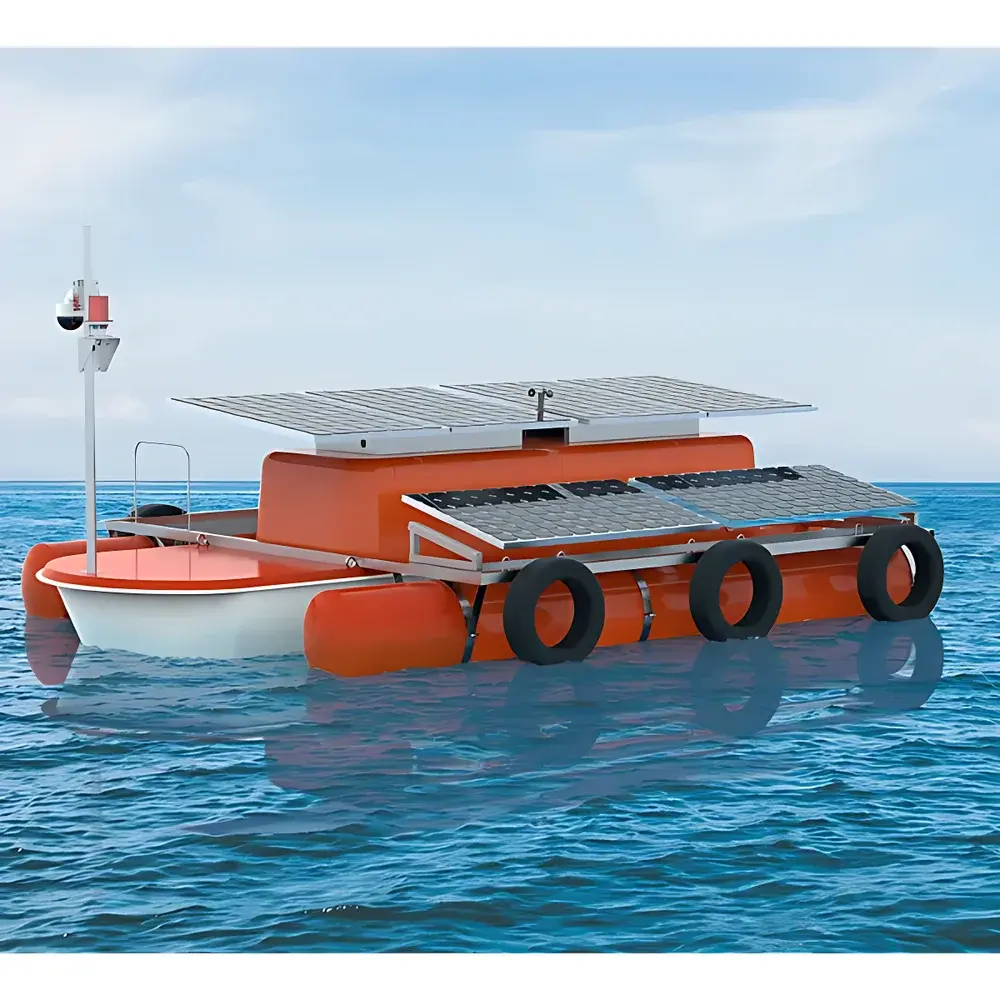
Lihero LFJCC-2010 Floating Platform-Based Water Quality Auto-Monitoring System
| Brand | Lihero |
|---|---|
| Origin | Hunan, China |
| Manufacturer Type | Authorized Distributor |
| Country of Origin | China |
| Model | LFJCC-2010 |
| Power Supply | Dual-mode solar/battery hybrid (24 V DC) |
| Operating Temperature | −10 °C to +50 °C |
| IP Rating | IP68 (submersible enclosure) |
| Communication | 4G LTE + GPS + SMS alert |
| Data Transmission | MQTT/HTTP over cellular network |
| Modular Sensor Capacity | Up to 12 configurable analytical modules |
| Compliance | GB/T 35273–2020 (China National Standard for Environmental Monitoring Equipment), ISO 5667-16:2009 (Water quality — Sampling — Part 16: Guidance on biologically sensitive sampling) |
Overview
The Lihero LFJCC-2010 Floating Platform-Based Water Quality Auto-Monitoring System is an integrated, solar-powered, in-situ environmental monitoring solution engineered for long-term deployment in rivers, lakes, reservoirs, and estuarine environments. Unlike fixed-station or bank-mounted systems, the LFJCC-2010 utilizes a buoyant, marine-grade stainless steel and HDPE floating platform that remains dynamically stable under variable water levels and moderate wave conditions (up to Sea State 3). Its core measurement architecture follows the principle of continuous-flow, multi-parameter sensor immersion—where water is drawn via a submersible pump into a conditioned flow cell or directly measured by calibrated in-situ probes. The system implements real-time electrochemical, optical, and physical sensing modalities—including conductivity, pH, dissolved oxygen (optical luminescence), turbidity (nephelometric, 90° scatter), and temperature—collectively constituting the standard five-parameter suite mandated by national surface water monitoring protocols. All analog and digital sensor outputs are digitized at source using 24-bit ADCs and timestamped with GPS-synchronized UTC time stamps, ensuring metrological traceability per ISO/IEC 17025-aligned data acquisition practices.
Key Features
- Fully autonomous operation enabled by dual-mode power management: high-efficiency monocrystalline solar panels (≥80 W peak) coupled with deep-cycle lithium iron phosphate (LiFePO₄) batteries (24 V / 100 Ah), supporting ≥14 days of continuous operation during low-irradiance periods.
- Integrated GPS-based geofencing and anti-theft verification: platform position is logged every 15 minutes; unauthorized displacement >50 m triggers immediate SMS and platform-level alarm escalation.
- Intelligent power-aware firmware: dynamic sensor activation scheduling reduces average system power draw to <3.2 W in standby mode and <8.7 W during active measurement cycles.
- Modular analytical architecture: standardized DIN-rail mounting and CAN bus interconnect allow hot-swapping of sensor modules (e.g., NH₃-N, NO₃⁻, COD UV254, chlorophyll-a fluorescence) without firmware recompilation—configuration managed via onboard web interface or remote OTA update.
- Embedded data integrity engine: automatic zero/span drift correction using internal reference buffers, redundant sensor cross-validation, and checksum-verified data packets prior to transmission.
- Robust mechanical design: platform buoyancy reserve ≥200% of total wet weight; corrosion-resistant hardware compliant with ISO 9223 C5-M marine exposure class.
Sample Compatibility & Compliance
The LFJCC-2010 is validated for use in freshwater and brackish water matrices with salinity up to 15 ppt. It accommodates suspended solids concentrations ≤100 mg/L without clogging, thanks to self-cleaning intake filters and pulse-flush routines executed every 6 hours. All wetted materials—including titanium alloy sensor housings, EPDM gaskets, and PTFE-coated flow cells—meet US EPA Method 1600 series material compatibility requirements for environmental water analysis. The system adheres to GB/T 35273–2020 for data security and encryption (AES-128), and its calibration traceability chain aligns with CNAS-CL01:2018 (equivalent to ISO/IEC 17025). Remote audit logs record all configuration changes, calibration events, and alarm states with immutable timestamps—supporting GLP-compliant field deployments.
Software & Data Management
Data acquisition and telemetry are managed by Lihero’s proprietary EdgeMonitor™ firmware (v4.2+), which supports dual communication paths: primary 4G LTE (CAT-M1/NB-IoT fallback) and secondary LoRaWAN gateway relay. Raw sensor data, diagnostic codes, battery voltage, solar input, and GPS coordinates are packaged into compact JSON payloads and transmitted at user-defined intervals (1 min to 24 h). The cloud-based Lihero AquaCloud™ platform provides role-based access control, automated QA/QC flagging (based on USGS QAPP criteria), and export-ready CSV/NetCDF files. Audit trails include full metadata: sensor serial numbers, calibration dates, operator IDs, and firmware version hashes—enabling full 21 CFR Part 11–compliant electronic records when deployed in regulatory monitoring programs.
Applications
- Real-time eutrophication tracking in drinking water source reservoirs
- Regulatory compliance monitoring for municipal wastewater discharge points
- Early warning detection of accidental chemical spills in navigable rivers
- Long-term trend analysis of climate-sensitive parameters (e.g., DO saturation deficit, thermal stratification onset)
- Supporting ISO 5667-16–aligned sampling campaign planning via spatial-temporal anomaly mapping
- Integration into provincial ecological monitoring networks (e.g., China’s National Surface Water Quality Assessment Program)
FAQ
What is the maximum deployment depth for the LFJCC-2010 platform?
The platform is rated for surface deployment only; submerged sensor extensions (e.g., for bottom-water profiling) require optional weighted tether kits—maximum operational draft is 1.2 m.
Does the system support third-party sensor integration?
Yes—via Modbus RTU (RS-485) or analog 4–20 mA inputs; technical documentation and pinout schematics are provided under NDA for OEM integration.
How frequently does the system perform automatic calibration checks?
Zero-point verification occurs hourly using deionized water flush; span validation is scheduled weekly using certified reference standards (traceable to NIM, China).
Is remote firmware update capability available?
Yes—over-the-air (OTA) updates are supported via signed binary packages with SHA-256 signature verification and rollback-safe dual-bank flash architecture.
Can historical data be retrieved if cellular connectivity is temporarily lost?
Yes—the onboard SD card (32 GB industrial grade) stores ≥90 days of raw sensor data with cyclic overwrite protection; data syncs automatically upon connection restoration.
Related Products







