
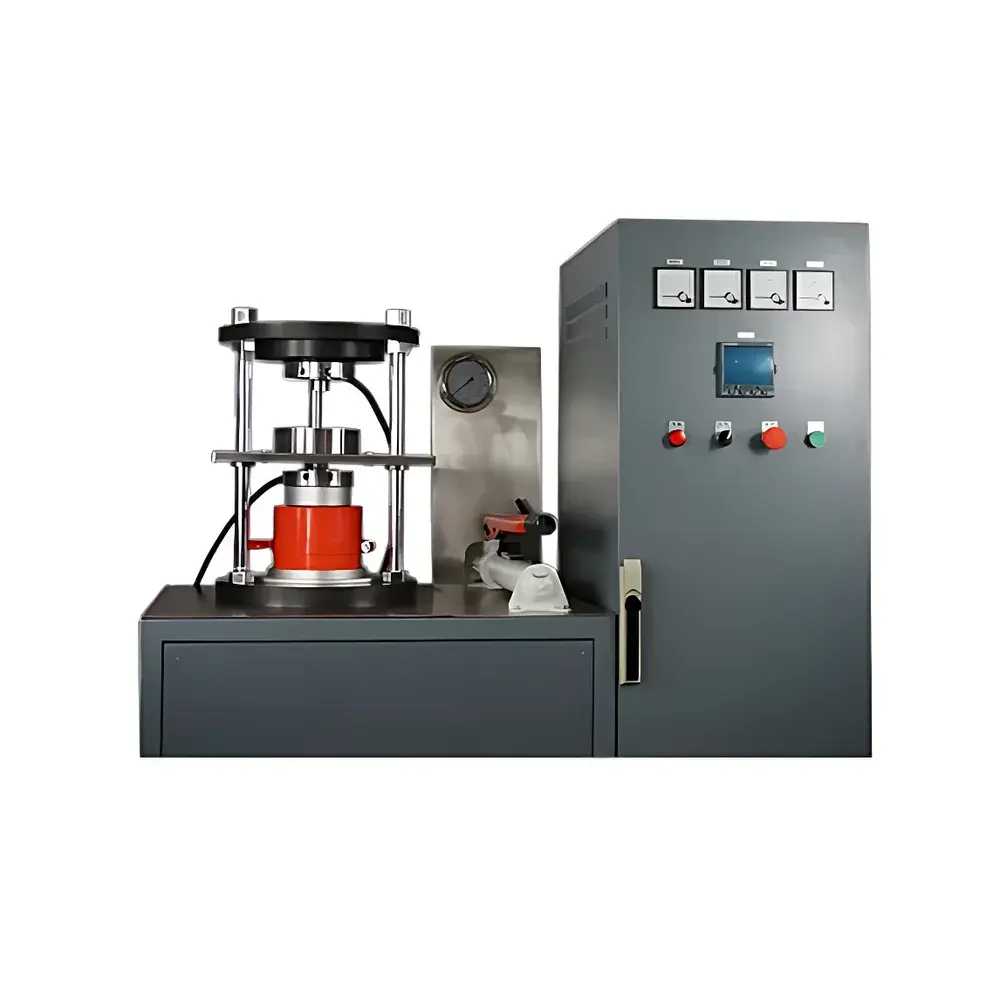
Rocktek RTK04 Two-Anvil Press for High-Pressure High-Temperature (HPHT) Research
| Brand | Rocktek |
|---|---|
| Origin | Hubei, China |
| Manufacturer Type | Authorized Distributor |
| Country of Origin | China |
| Model | RTK04 |
| Pricing | Upon Request |
| Pressure Range | 0–4 GPa |
| Temperature Range | 25–1800 °C |
| Sample Chamber Diameter Options | 10 mm / 13 mm / 19 mm |
| Continuous Operation Duration | Hours to Multiple Days |
Overview
The Rocktek RTK04 Two-Anvil Press is a statically loaded, large-volume high-pressure high-temperature (HPHT) apparatus engineered for reproducible generation of controlled thermodynamic conditions in solid-state and geophysical research. It operates on the principle of uniaxial force transmission through two opposing tungsten carbide or sintered diamond anvils, compressing a cylindrical sample assembly housed within a refractory pressure medium (e.g., NaCl, MgO, or borosilicate glass). This configuration enables uniform radial confinement and axial thermal symmetry—critical for minimizing stress gradients and ensuring homogeneity across the sample volume. Unlike multi-anvil devices, the RTK04’s two-anvil architecture delivers simplified mechanical alignment, reduced parasitic friction losses, and direct access to the sample region for in situ diagnostics (e.g., resistivity probes, thermocouple leads, or optical windows when integrated with optional viewports). Designed for static compression rather than dynamic shock loading, it supports quasi-static equilibrium studies where thermodynamic state variables—pressure (P), temperature (T), and time (t)—must be precisely stabilized and independently varied over extended durations.
Key Features
- Statically rated pressure capacity up to 4 GPa, verified via calibrated ruby fluorescence shift (R1-line) and/or molybdenum X-ray diffraction standards;
- Continuous temperature control from ambient (25 °C) to 1800 °C using graphite or Mo-based resistive heaters, with dual-zone thermal profiling to minimize axial temperature gradients;
- Modular sample chamber design supporting three standard inner diameters: 10 mm, 13 mm, and 19 mm—enabling flexibility between high-pressure resolution (smaller cavity) and bulk synthesis yield (larger cavity);
- Integrated programmable heating/cooling ramp rates (0.1–50 °C/min), configurable via front-panel interface or remote RS-485/Ethernet protocol;
- Robust structural frame with pre-stressed steel columns and hydraulic or servo-mechanical loading system, ensuring long-term dimensional stability under cyclic load;
- Optional automatic pressure maintenance module (RTK-APM) provides closed-loop feedback control using piezoresistive transducers and real-time PID compensation—essential for multi-day creep or phase-transition kinetics experiments.
Sample Compatibility & Compliance
The RTK04 accommodates diverse sample geometries and containment strategies, including sealed metal capsules (Ni, Fe, Pt), ceramic crucibles (Al2O3, ZrO2), and layered gasket assemblies for differential thermal analysis. Its design conforms to common laboratory safety standards for HPHT equipment, including ISO 12100 (risk assessment), EN 61000-6-4 (EMC emissions), and local electrical installation codes (IEC 60204-1). While not certified to ASME BPVC Section VIII Division 2, all pressure-bearing components undergo non-destructive ultrasonic testing (UT) and hydrostatic proof testing at 1.5× maximum operating pressure prior to shipment. The system supports GLP-compliant data logging when paired with Rocktek’s validated acquisition firmware (v3.2+), enabling audit-ready timestamped records of P–T–t trajectories for regulatory submissions.
Software & Data Management
Control and monitoring are executed via Rocktek’s proprietary WinPress™ software suite (Windows 10/11 compatible), featuring intuitive graphical workflow configuration, real-time P–T trajectory visualization, and automated sequence scripting. All operational parameters—including heater voltage, current, thermocouple voltages (Type C or S), and load cell outputs—are sampled at ≥10 Hz and stored in HDF5 format for post-processing interoperability with Python (h5py), MATLAB, or OriginLab. Export options include CSV, XML, and PDF reports compliant with internal lab SOPs. Optional 21 CFR Part 11 add-on provides electronic signature capability, audit trail logging, and user role-based access control—meeting requirements for materials qualification in aerospace or pharmaceutical development contexts.
Applications
The RTK04 serves as a foundational platform for experimental petrology (e.g., mantle mineral phase equilibria, magma crystallization paths), synthesis of ultra-hard phases (c-BN, w-BN, rhenium diboride), high-Tc superconductor fabrication (e.g., iron-based or hydride systems), ferroelectric domain engineering, and pressure-induced polymerization of carbon allotropes. In planetary science, it replicates core–mantle boundary conditions (360 GPa / 6000 K extrapolated) at accessible scale for equation-of-state calibration. Materials scientists employ it for grain growth kinetics under constrained diffusion, while chemists utilize its inert atmosphere compatibility (Ar, N2, vacuum) for metastable oxide synthesis. Its desktop footprint (W × D × H: 650 × 720 × 1100 mm) enables deployment in shared instrumentation facilities without dedicated vault infrastructure.
FAQ
What pressure calibration methods are supported?
Ruby fluorescence (R1-line shift), Sm:YAG luminescence, and energy-dispersive X-ray diffraction (EDXRD) with internal standards such as Au or Re.
Can the RTK04 be integrated with synchrotron beamlines?
Yes—standard flange interfaces (CF-63 or KF-50) allow vacuum-compatible mounting; optional beryllium or diamond windows enable X-ray transmission measurements.
Is third-party software control possible?
Yes—open TCP/IP command set and LabVIEW/VISA drivers are provided upon request for custom automation integration.
What maintenance intervals are recommended?
Anvil inspection every 50 operational cycles; gasket replacement after each run; annual recalibration of thermocouples and load cells per ISO/IEC 17025 guidelines.
Does Rocktek provide application support for first-time HPHT users?
Yes—comprehensive onboarding includes remote setup assistance, sample assembly training, and interpretation of P–T–V phase diagrams for target material systems.



