
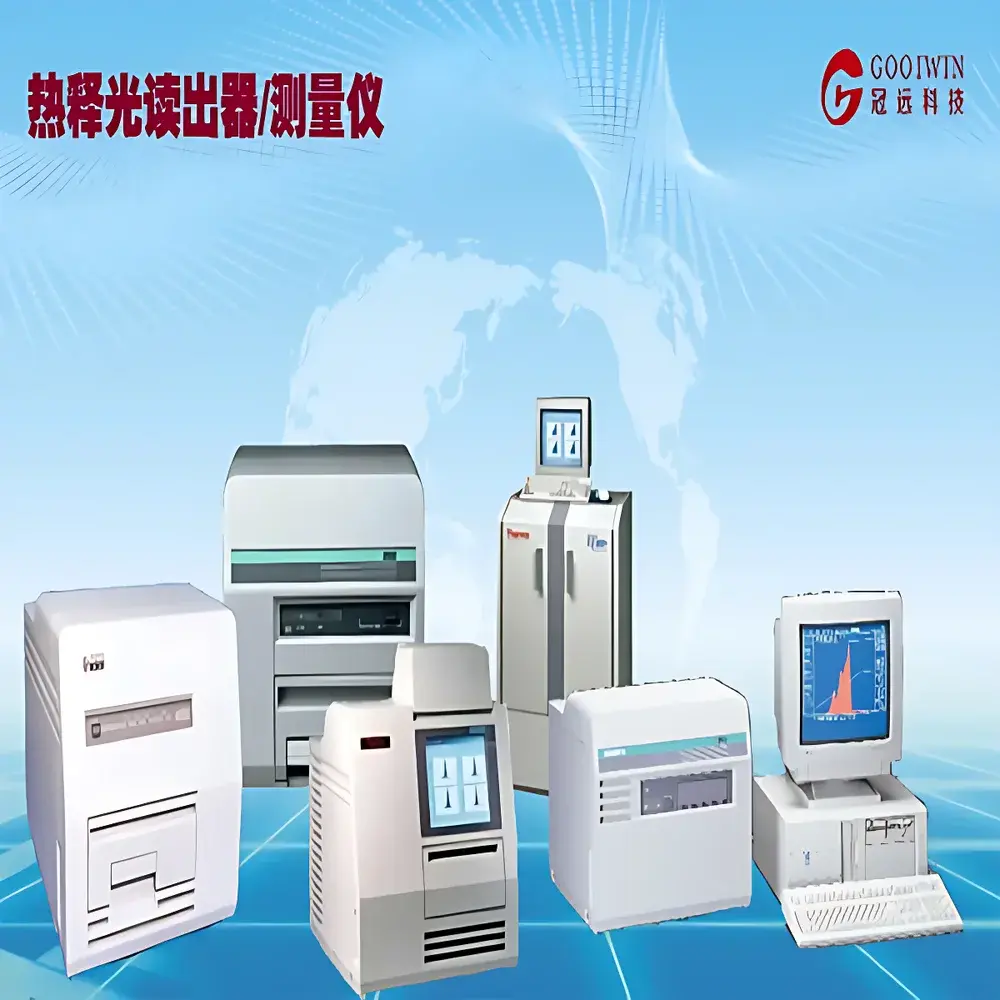
UNION TLD Series Automated Thermoluminescent Dosimeter Readers (TLD 3500 / 4500 / 5500 / 6600 / 8800)
| Brand | UNION |
|---|---|
| Origin | Germany |
| Product Type | Imported Industrial Thermoluminescent Dosimetry Reader |
| Model Range | TLD 3500, TLD 4500, TLD 5500, TLD 6600, TLD 8800 |
| Compliance | IEC 62387, ISO/IEC 17025, ANSI N13.11, DOELAP, NVLAP Accredited |
| Operating Temperature | 0–40 °C |
| Storage Temperature | −10–60 °C |
| Radiation Types | Photons (>1 keV), Beta (>70 keV), Thermal to 100 MeV Neutrons |
Overview
The UNION TLD Series Automated Thermoluminescent Dosimeter Readers are precision-engineered instruments designed for quantitative measurement of ionizing radiation dose via thermoluminescence (TL) emission. Based on the fundamental principle that certain crystalline materials (e.g., LiF:Mg,Ti, CaF2:Dy, or Al2O3:C) store energy from incident radiation and release it as visible light upon controlled thermal stimulation, these readers provide traceable, high-reproducibility dose assessment across clinical, environmental, industrial, and research applications. Each model in the TLD series—3500, 4500, 5500, 6600, and 8800—is purpose-built to meet specific operational throughput, automation, and regulatory requirements while maintaining strict adherence to international dosimetry standards including IEC 62387 (Radiation protection — Measurement of personal dose equivalents), ANSI N13.11 (Performance Criteria for Thermoluminescence Dosimetry Systems), and ISO/IEC 17025 for accredited testing laboratories.
Key Features
- Multi-model scalability: From benchtop manual operation (TLD 3500) to fully automated high-throughput processing (TLD 8800, up to 140 elements/hour).
- Programmable heating profiles: Linear ramping, pre-heat, readout, and post-annealing cycles ensure consistent TL signal liberation and reproducible glow curve analysis.
- Dual-channel photomultiplier tube (PMT) detection (TLD 4500 & TLD 8800) enables simultaneous parallel reading of two sample positions with integrated PMT cooling for reduced dark current and enhanced signal-to-noise ratio.
- Automated sample handling: TLD 6600 and TLD 8800 feature robotic loading/unloading mechanisms supporting up to 1400 four-element cards per batch, eliminating manual intervention and reducing operator-induced variability.
- Integrated calibration sources: TLD 8800 includes a built-in 90Sr/90Y beta source for routine response verification and element-specific correction factor (ECC) validation.
- Comprehensive quality assurance: Onboard QC routines include automatic background subtraction, linearity verification (<1% deviation), stability monitoring (<0.5% short-term variation over 10 consecutive readings), and drift compensation algorithms.
- Regulatory-ready architecture: Firmware supports audit trails, user access control, electronic signatures, and data integrity features aligned with FDA 21 CFR Part 11 and GLP/GMP documentation requirements.
Sample Compatibility & Compliance
The UNION TLD Series accommodates a broad range of commercially available thermoluminescent dosimeters—including Harshaw TLD-100 (LiF:Mg,Ti), TLD-700H, TLD-200, CaF2:Dy chips, Al2O3:C microcubes, and custom-formatted ring, wrist, extremity (EXT-RAD), and whole-body (DXT-RAD) cards. All models comply with international performance criteria defined in ANSI N13.11 and IEC 62387, and have undergone formal accreditation testing by DOELAP (Department of Energy Laboratory Accreditation Program) and NVLAP (National Voluntary Laboratory Accreditation Program). The TLD 6600 and TLD 8800 further satisfy ISO 4037 (X- and gamma-reference radiations) and IEC 61000-4-3 (EMC immunity) for deployment in regulated nuclear medicine, radiotherapy QA, and environmental monitoring facilities.
Software & Data Management
Each reader ships with UNION DOSIS™ v5.x software—a validated, Windows-based platform supporting full instrument control, real-time glow curve visualization, peak deconvolution, dose calculation using manufacturer-supplied or user-defined calibration curves, and automated report generation. Data export conforms to ASTM E2873 (Standard Guide for Digital Data Exchange in Radiation Protection) and is compatible with LIMS integration via HL7 or CSV/XML protocols. Audit logs record all critical events—including parameter changes, calibration actions, user logins, and measurement results—with time stamps and digital signatures. Software validation packages (IQ/OQ/PQ documentation) and 21 CFR Part 11 compliance modules are available as optional add-ons for pharmaceutical and clinical trial applications.
Applications
- Personal dosimetry in nuclear power plants, radiopharmaceutical manufacturing, and hospital radiotherapy departments.
- Environmental radiation monitoring: air, soil, and water sample analysis following accidental or routine releases.
- Food irradiation process validation and post-treatment dose mapping per ISO/ASTM 51275 and Codex Alimentarius standards.
- Radiotherapy quality assurance: output factor verification, beam profile checks, and patient-specific IMRT/VMAT plan validation.
- Archaeological and geological dating (TL dating) requiring precise low-dose sensitivity and long-term signal stability.
- High-dose testing of electronic components and aerospace materials under gamma, neutron, or mixed-field irradiation.
- Diagnostic imaging dose audits—including CT, fluoroscopy, and mammography—per AAPM TG-180 and IAEA TRS-457 guidelines.
FAQ
What types of radiation can the UNION TLD readers measure?
Photons (≥1 keV), beta particles (≥70 keV), and neutrons (thermal to 100 MeV), depending on dosimeter material selection and reader configuration.
Do these instruments support GLP or GMP-compliant workflows?
Yes—UNION DOSIS™ software includes configurable audit trails, role-based access control, electronic signatures, and data integrity safeguards aligned with FDA 21 CFR Part 11 and ISO/IEC 17025 requirements.
Is calibration traceable to national standards?
All models are supplied with calibration certificates traceable to PTB (Physikalisch-Technische Bundesanstalt) or NIST reference standards; periodic recalibration services are available through UNION’s ISO/IEC 17025-accredited service centers.
Can the TLD 8800 integrate with existing laboratory information systems?
Yes—via standardized APIs, HL7 messaging, or direct database synchronization using ODBC-compatible drivers; custom middleware integration support is provided upon request.
What maintenance intervals are recommended for optimal performance?
Preventive maintenance is advised every 12 months, including PMT gain verification, heater temperature calibration, optical path cleaning, and firmware update validation; full service logs are automatically archived within the software.




