
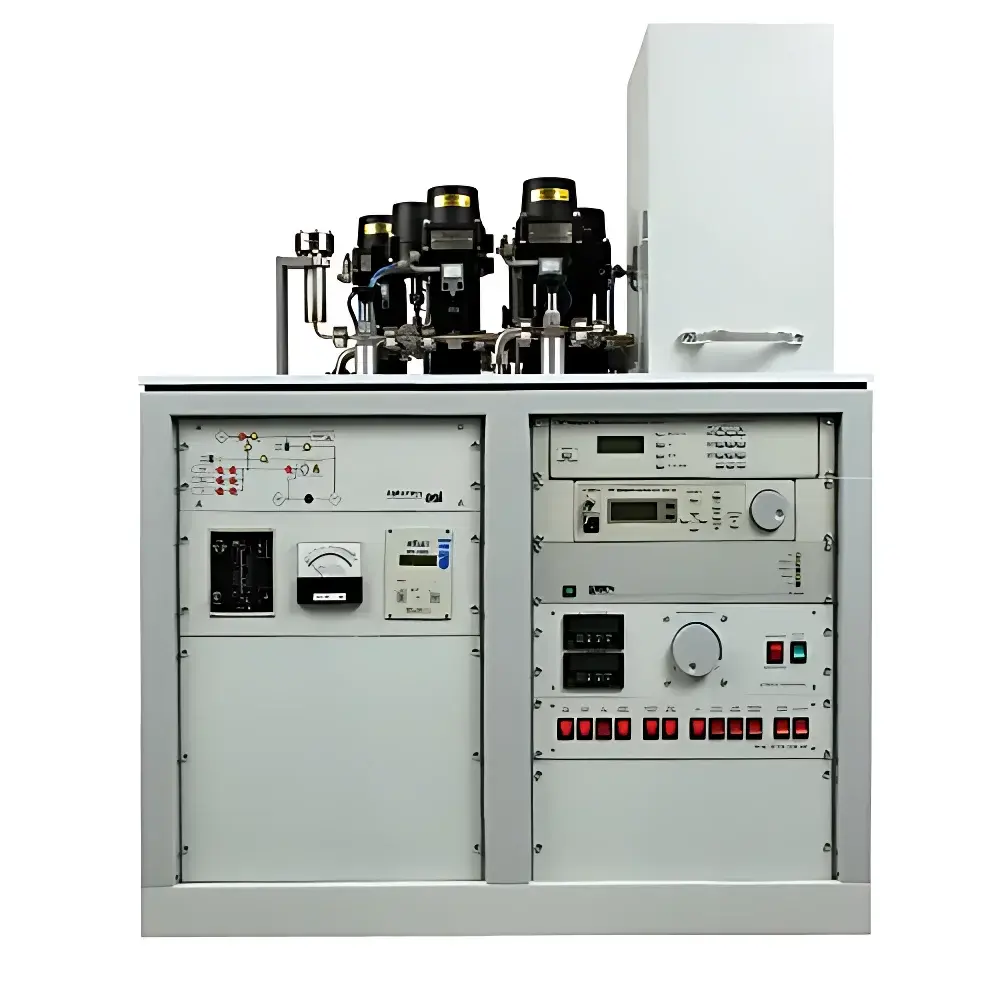
Alphachron He Automated In-Situ Helium Extraction and Analysis System
| Brand | ASI |
|---|---|
| Origin | USA |
| Manufacturer Type | Authorized Distributor |
| Origin Category | Imported |
| Model | Alphachron He |
| Pricing | Available Upon Request |
Overview
The Alphachron He Automated In-Situ Helium Extraction and Analysis System is a purpose-built, high-vacuum mass spectrometry platform engineered for geochronological and thermochronological research. It enables fully automated, in-situ ⁴He quantification from mineral separates—primarily apatite and zircon—via laser-driven noble gas release under ultra-high vacuum (UHV) conditions. The system operates on the principle of step-heating combined with static noble gas mass spectrometry: a focused 915 nm diode laser heats individual mineral grains to predetermined temperatures (e.g., ~1000 °C for apatite, ~1250 °C for zircon) in sequence, releasing radiogenic ⁴He accumulated over geological time. Released gases are cryogenically purified, introduced into a high-sensitivity quadrupole or magnetic sector mass spectrometer (configured per user specification), and quantified against calibrated ³He spike and ⁴He reference standards. This methodology supports (U–Th)/He dating, thermal history reconstruction, and crustal cooling rate modeling—key requirements in tectonic, basin, and metamorphic studies.
Key Features
- Automated XY laser positioning stage integrated with machine vision for precise grain targeting and real-time focus validation
- 25-position stainless-steel laser chamber with sapphire viewport windows, enabling sequential, unattended analysis of mineral mounts
- UHV gas handling line constructed from electropolished 316L stainless steel, featuring motorized and manual leak-tight valves compliant with ASTM E2914 and ISO 20483 for inert gas purity control
- 915 nm high-power diode laser subsystem with collimated beam delivery, adjustable power regulation (0–100 W), and interlocked safety enclosure meeting IEC 60825-1 Class 4 requirements
- Dual installed SAES non-evaporable getter (NEG) pumps with dedicated activation power supply; one spare NEG cartridge included for extended operational uptime
- Triple 3.3 L stainless-steel calibration gas reservoirs: one pre-loaded with ³He spike, one with certified ⁴He analytical standard (NIST-traceable), and one with ⁴He reference standard for daily instrument normalization
- Optional diffusion cell module (operating up to 600 °C) for low-temperature helium diffusivity experiments, fully synchronized with the main automation sequence
- Multi-stage vacuum architecture: dry diaphragm roughing pump, hybrid turbo-molecular pump with active speed control, and ion pump for base pressure <5×10⁻¹⁰ mbar—ensuring minimal background interference during low-abundance ⁴He detection
Sample Compatibility & Compliance
The Alphachron He accommodates standard 25-mm aluminum or copper sample holders with embedded mineral grains mounted in epoxy or indium. Compatible mineral phases include apatite, zircon, titanite, and muscovite—provided grain size exceeds 60 µm and surface contamination is minimized via HF etching and ultrasonic cleaning per USP and ASTM D7212 protocols. All vacuum components meet ASME BPE-2021 surface finish specifications (Ra ≤ 0.4 µm). System operation complies with GLP data integrity requirements: full electronic audit trail, user-access logging, and password-protected method editing. Optional 21 CFR Part 11 compliance package available for regulated laboratories conducting contractual geochemical services.
Software & Data Management
Control and data acquisition are managed through Alphachron Control Suite v4.x—a Windows-based application supporting script-driven experimental definition via plain-text configuration files (.cfg). Each sample position may be assigned unique heating duration, laser power ramp profile, and gas transfer timing. Real-time pressure, temperature, and mass spectrometer ion current signals are logged at 10 Hz resolution. Raw data exports to ASCII or NetCDF format; post-processing includes blank subtraction, spike dilution correction, atmospheric ⁴He correction (using measured ²⁰Ne/²²Ne ratios), and (U–Th)/He age calculation per Farley et al. (1996) and McInnes et al. (2021). Software architecture supports networked deployment and integration with LIMS via OPC UA interface.
Applications
- (U–Th)/He thermochronology for reconstructing exhumation histories across mountain belts and sedimentary basins
- Diffusion kinetics studies of helium in accessory minerals to constrain closure temperatures and cooling rates
- High-throughput screening of detrital zircon populations for provenance analysis and paleo-elevation modeling
- Calibration of helium retention models used in basin modeling software (e.g., PetroMod, BasinMod)
- Interlaboratory comparison studies requiring traceable, reproducible ⁴He measurement protocols aligned with IUGS GeoAnalytical Certification Guidelines
FAQ
What vacuum level is achieved during analysis, and how is it monitored?
Base pressure is continuously monitored via Bayard–Alpert and cold cathode gauges, with typical operating pressure below 1×10⁻⁹ mbar during gas introduction and measurement.
Can the system be upgraded to support ³He/⁴He ratio measurements for mantle-derived samples?
Yes—when configured with a multi-collector magnetic sector mass spectrometer and optional ³He/⁴He calibration gas manifold, the platform supports high-precision isotopic ratio analysis per ASTM D7827.
Is remote operation supported for unattended overnight runs?
Fully supported via secure RDP or VNC connection; all critical alarms trigger email/SMS alerts through integrated notification service.
How is laser alignment verified prior to each run?
Machine vision subsystem performs automated centroid detection and focal plane optimization using reflected NIR imaging before initiating any heating step.
What maintenance intervals are recommended for the vacuum system?
Ion pump regeneration every 18 months; turbo pump bearing inspection every 12,000 hours; SAES getter replacement every 24 months or after 5000 laser shots—whichever occurs first.





