
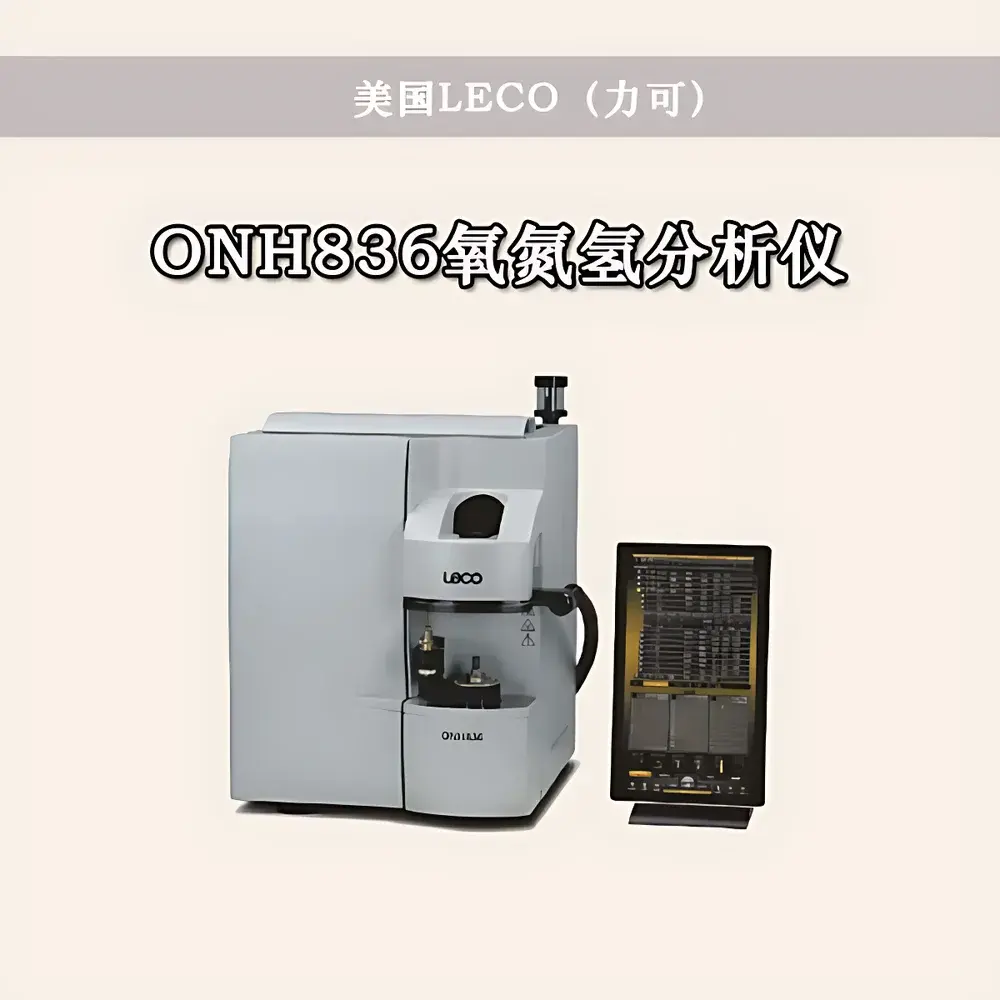
Leco ONH836 Oxygen-Nitrogen-Hydrogen Analyzer
| Origin | USA |
|---|---|
| Manufacturer Type | Authorized Distributor |
| Origin Category | Imported |
| Model | ONH836 |
| Instrument Type | Oxygen-Nitrogen-Hydrogen Elemental Analyzer |
| Software Interface | MS Windows®-based, Touchscreen-Optimized |
| Optional Features | Cornerstone® Mobile Remote Access, SmartLine® Remote Diagnostics, 20-Position Autosampler, Electrode Auto-Cleaning System, Rotatable Six-Axis Touchscreen, DFC Dynamic Flow Compensation, OMI-2 Bypassable Gas Filtration, NDIR & TCD Detectors with Thermal Stabilization |
Overview
The Leco ONH836 Oxygen-Nitrogen-Hydrogen Analyzer is a high-performance inert gas fusion elemental analyzer engineered for the simultaneous quantitative determination of oxygen (O), nitrogen (N), and hydrogen (H) in solid inorganic materials. It employs high-frequency induction heating under ultra-pure helium or argon atmosphere to fully melt samples—typically metals, alloys, ceramics, refractory compounds, hardmetals, and non-ferrous materials—releasing interstitial and lattice-bound gases. Released O₂, N₂, and H₂ are quantified via dual detection principles: non-dispersive infrared (NDIR) absorption for oxygen (measured as CO and CO₂ after conversion in a copper oxide furnace), and thermal conductivity detection (TCD) for nitrogen and hydrogen. This fundamental architecture ensures trace-level sensitivity, wide dynamic range coverage, and metrological robustness required in metallurgical QC, R&D laboratories, and advanced materials certification.
Key Features
- Stable, vibration-damped furnace head design with fully sealed sample loading—prevents atmospheric contamination during insertion and ensures reproducible combustion conditions.
- Three independent NDIR detectors optimized for CO, CO₂, and total carbon oxides; integrated catalytic converter ensures complete oxidation of CO to CO₂ prior to final measurement—enabling accurate oxygen quantification across ultra-trace (<0.1 ppm) to high-concentration (≥1000 ppm) ranges.
- Thermally stabilized TCD cells with active temperature control and pressure-compensated gas flow path—minimizes baseline drift and improves long-term signal fidelity for N and H analysis.
- Dynamic Flow Compensation (DFC) system—patented Leco technology that continuously monitors and adjusts carrier gas flow rate in real time, maintaining constant volumetric throughput through the entire analytical train; critical for precision nitrogen measurement in low-permeability matrices.
- OMI-2 bypassable gas purification module—removes moisture, hydrocarbons, and particulates upstream of detectors without interrupting analysis, enhancing detector longevity and data consistency.
- Touchscreen-optimized Windows® software with intuitive workflow navigation, instrument diagnostics, method storage, and GLP-compliant audit trail generation.
Sample Compatibility & Compliance
The ONH836 accommodates diverse solid sample forms including chips, turnings, powders, and pre-weighed pellets (typically 0.1–1.0 g). It supports standardized test methods aligned with ASTM E1019, ISO 14284, ISO 22377-1, and JIS G 1211. All hardware and firmware comply with IEC 61000-4 electromagnetic compatibility requirements and meet CE marking directives. Data integrity features—including electronic signatures, user access levels, and 21 CFR Part 11–ready audit logs—are embedded within the software architecture to support regulated environments operating under GMP/GLP frameworks.
Software & Data Management
Control and data acquisition are managed through Leco’s proprietary Windows®-based software suite, designed specifically for industrial touchscreen interfaces. The interface provides real-time gas chromatogram visualization, automatic peak integration, calibration curve management, and customizable reporting templates. Optional Cornerstone® Mobile extends functionality to iOS and Android devices, enabling remote monitoring of instrument status, live analysis curves, historical data retrieval, and alarm notifications. SmartLine® Remote Diagnostics allows authorized service engineers secure, encrypted access for predictive maintenance and troubleshooting—reducing instrument downtime and supporting continuous operational readiness.
Applications
The ONH836 serves critical quality assurance functions across multiple sectors: incoming raw material verification in steelmaking; hydrogen-induced cracking (HIC) risk assessment in pipeline steels and aerospace alloys; oxygen content validation in titanium and zirconium sponge production; nitrogen specification compliance in stainless steels and superalloys; and purity certification of sintered ceramics and refractory metal powders. Its ability to resolve sub-ppm hydrogen in niobium or oxygen in silicon carbide makes it indispensable in semiconductor substrate development and nuclear-grade material qualification.
FAQ
What sample types are compatible with the ONH836?
Solid conductive or semi-conductive inorganic materials—including ferrous and non-ferrous metals, carbides, nitrides, borides, oxides, and ceramic composites—are routinely analyzed. Non-conductive samples may require graphite or tungsten co-fusion additives.
Does the ONH836 comply with regulatory data integrity standards?
Yes—the software includes role-based user authentication, electronic signatures, immutable audit trails, and exportable raw data files compliant with FDA 21 CFR Part 11 and EU Annex 11 requirements.
How does the DFC system improve nitrogen analysis accuracy?
By actively correcting for pressure fluctuations and column backpressure variations, DFC maintains constant carrier gas linear velocity—essential for consistent N₂ peak shape, retention time stability, and stoichiometric equivalence between evolved gas volume and detector response.
Is routine maintenance minimized compared to legacy fusion analyzers?
Yes—the sealed furnace head, absence of moving optical components in NDIR cells, and modular OMI-2 filtration reduce scheduled servicing intervals; electrode auto-cleaning and autosampler options further decrease operator intervention.
Can the ONH836 be integrated into a laboratory information management system (LIMS)?
Yes—it supports ASTM E1382-compliant data export (CSV, XML), OPC UA connectivity, and configurable API endpoints for bidirectional LIMS synchronization.






