
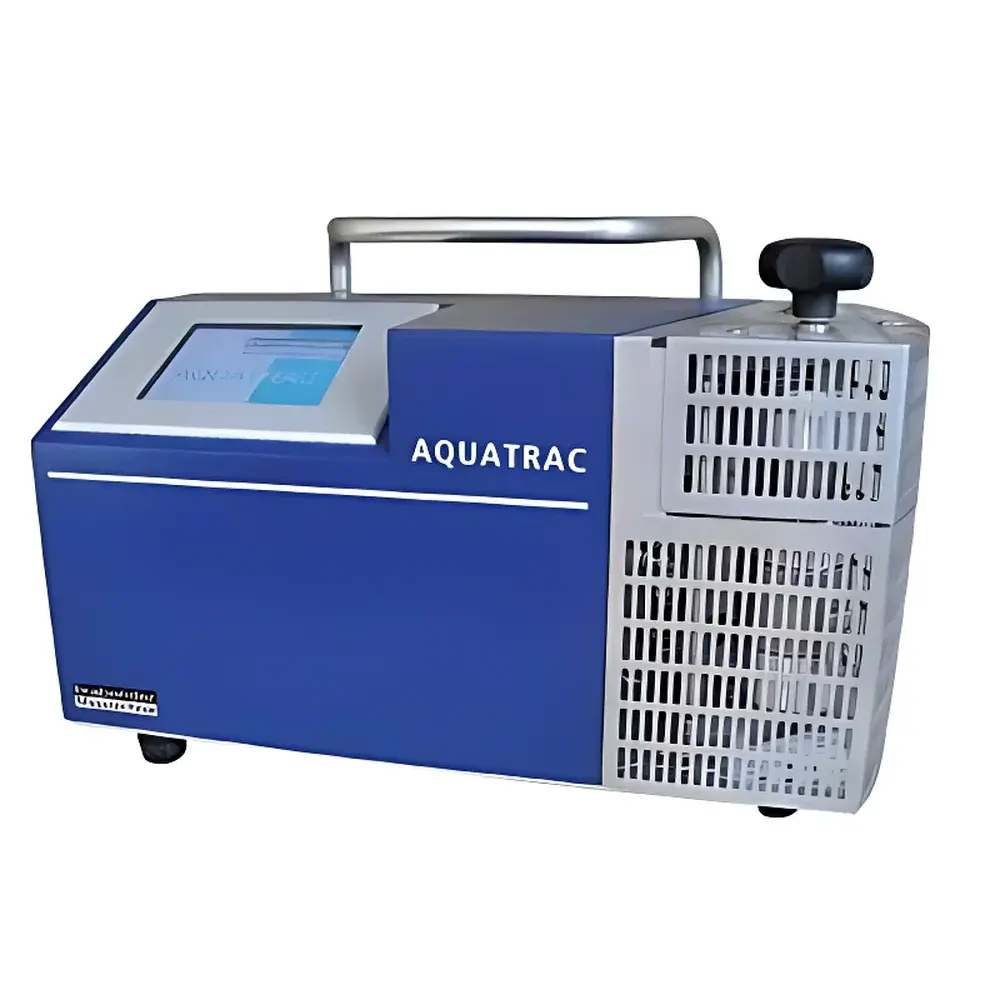
Brabender AQUATRAC-3E Karl Fischer-Type Calcium Hydride Moisture Analyzer for Plastic Granules
| Brand | Brabender |
|---|---|
| Origin | Germany |
| Model | AQUATRAC-3E |
| Principle | Calcium Hydride (CaH₂) Reaction-Based Moisture Quantification |
| Measurement Ranges | <0.1% / 0.1–0.5% / >0.5% H₂O (w/w) |
| Sample Mass | 0.1–100 g (range-dependent) |
| Test Duration | 10–30 min |
| Temperature Control | 60–200 °C (1 °C increments) |
| Readout Units | % H₂O or ppm |
| Accuracy | ±2% of reading or ±1% of full scale, whichever is greater |
| Repeatability | ±1% of selected range |
| CaH₂ Cartridge Lifetime | ≥1000 determinations |
Overview
The Brabender AQUATRAC-3E is a dedicated, portable moisture analyzer engineered for rapid and reliable quantification of trace water content in hygroscopic polymer granules and pellets. Unlike optical or capacitance-based methods, the AQUATRAC-3E employs a stoichiometric chemical reaction between water and calcium hydride (CaH₂), generating hydrogen gas in direct proportion to the water mass present. This gravimetrically referenced gas evolution principle delivers high specificity for free and bound moisture—critical for thermoplastic resins such as polyamide (PA6, PA66), polybutylene terephthalate (PBT), polycarbonate (PC), and polyethylene terephthalate (PET), where residual moisture above 50–200 ppm can cause hydrolytic degradation during melt processing. Designed for integration into production environments—not just laboratories—the instrument’s compact footprint, robust thermal control architecture, and field-ready calibration protocol enable on-site verification of drying efficiency prior to extrusion, injection molding, or compounding.
Key Features
- Calcium hydride reaction cell with sealed, single-use cartridges ensuring consistent reagent activity over ≥1000 analyses
- Programmable temperature ramping (60–200 °C, 1 °C resolution) to optimize moisture release kinetics across diverse polymer matrices
- Three auto-ranging measurement modes (0.5% H₂O) with dynamic sample mass adaptation (0.1–100 g)
- Integrated pressure transducer and temperature-compensated gas volume calculation for trace-level quantification down to 10 ppm
- IP54-rated enclosure with reinforced housing for operation in industrial settings (e.g., drying hopper discharge points, warehouse receiving bays)
- No external gas supply or solvent handling required—fully self-contained operation compliant with ISO 8587 and ASTM D6340 for solid polymer moisture analysis
Sample Compatibility & Compliance
The AQUATRAC-3E is validated for use with virgin and recycled thermoplastic granules, masterbatches, engineering resins, and filled compounds. It accommodates irregular particle morphologies—including cylindrical pellets, flake, and regrind—without grinding or pre-conditioning. Method validation per ISO/IEC 17025 requirements includes linearity assessment across all three ranges, LOD/LOQ determination (≤5 ppm), and inter-laboratory reproducibility studies (RSD <2.1% at 100 ppm level). The system supports GLP-compliant documentation through optional audit trail logging and meets key regulatory expectations for raw material release testing under IATF 16949 and ISO 9001:2015 quality management systems.
Software & Data Management
Data acquisition and reporting are managed via the standalone AQUAsoft v3.2 application (Windows 10/11 compatible), which provides real-time gas evolution curve visualization, automatic endpoint detection based on pressure stabilization thresholds, and configurable report templates aligned with internal SOPs. All measurements include timestamp, operator ID, sample ID, test temperature, and cartridge lot number. Electronic records comply with FDA 21 CFR Part 11 requirements when used with validated user access controls and digital signature modules. Export formats include CSV, PDF, and XML for integration into LIMS or MES platforms.
Applications
- Verification of incoming resin moisture against supplier specifications (e.g., ≤0.02% for PA6 prior to injection molding)
- Optimization of desiccant dryer parameters (dew point, residence time, regeneration cycle) via time-series moisture profiling
- Quantitative assessment of moisture regain after transport or storage under ambient humidity conditions
- Quality gate check before feeding into twin-screw extruders or blow molding machines
- Root-cause analysis of surface defects (splay, silver streaks) linked to hydrolysis-induced molecular weight reduction
- Supporting development of moisture-sensitive compound formulations (e.g., glass-filled PBT for automotive under-hood components)
FAQ
How does the calcium hydride method differ from Karl Fischer titration for polymer analysis?
Unlike volumetric or coulometric Karl Fischer, which requires solvent dissolution and electrochemical endpoint detection, the CaH₂ method operates on dry, undissolved samples—eliminating solubility limitations and solvent interference while maintaining trace-level sensitivity.
Can the AQUATRAC-3E measure moisture in carbon-fiber-reinforced composites?
Yes—provided the composite matrix is thermoplastic (e.g., PEEK, PEKK) and the fiber loading does not impede uniform heat transfer; validation data available upon request for specific formulations.
Is routine recalibration required between analyses?
No. Each CaH₂ cartridge is factory-calibrated and certified; only blank correction (zero-point verification with anhydrous reference) is recommended before each analytical session.
What maintenance intervals are specified for long-term operational reliability?
Annual verification of pressure transducer linearity and thermal block uniformity is recommended; no consumables beyond CaH₂ cartridges are required.
Related Products





