
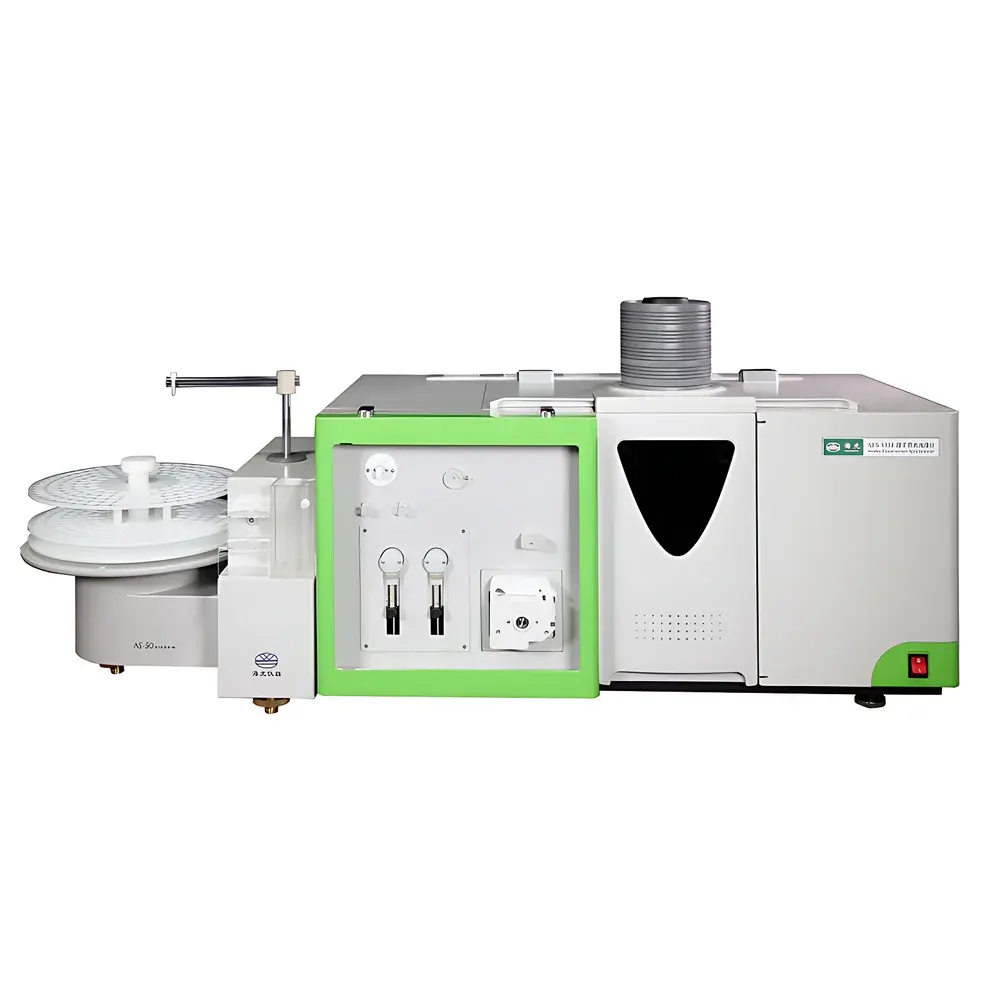
Haiguang AFS-9530 Atomic Fluorescence Spectrometer
| Brand | Haiguang Instrument |
|---|---|
| Origin | Beijing, China |
| Manufacturer Type | Authorized Distributor |
| Product Category | Domestic |
| Model | AFS-9530 |
| Price Range | USD 42,000 – 56,000 |
| Instrument Type | Single-Channel Atomic Fluorescence Spectrometer |
| Sample Introduction | Dual Sequential Injection Pumps |
| Detectable Elements | As, Se, Pb, Bi, Sb, Te, Sn, Hg, Cd, Zn, Ge, Au |
| RSD | <1.0% (typical for As at 1 µg/L) |
| Linear Dynamic Range | >3 orders of magnitude |
| Detection Limits (3σ) | As, Hg, Se < 0.01 µg/L |
Overview
The Haiguang AFS-9530 Atomic Fluorescence Spectrometer is a high-performance, single-channel hydride generation atomic fluorescence instrument engineered for trace and ultra-trace elemental analysis in environmental, food safety, pharmaceutical, and geological laboratories. It operates on the principle of hydride generation coupled with atomic fluorescence detection: analyte elements (e.g., As, Se, Hg, Sb) are chemically reduced to volatile hydride species or cold vapor (for Hg), atomized in a low-temperature quartz cell under argon-hydrogen flame, and excited by a high-intensity hollow cathode lamp. The resulting element-specific fluorescence emission is measured at right angles to the excitation beam, delivering exceptional selectivity and sensitivity. Designed for routine compliance testing and method validation, the AFS-9530 meets core performance requirements aligned with ISO/IEC 17025–accredited workflows and supports regulatory applications referenced in EPA Method 200.9, GB 5009.11–2014 (China), and USP .
Key Features
- Patented dual sequential injection system (ZL 201220739983.7) with isolated reagent flow paths—eliminates diffusion mixing, minimizes carryover, and ensures reproducible hydride generation kinetics.
- Shielded low-temperature quartz furnace atomizer—optimized geometry and thermal shielding reduce fluorescence quenching and gas-phase interferences, enhancing atomization efficiency and signal stability.
- Membrane-based gas–liquid separator—provides robust phase separation without mechanical valves or moving parts, ensuring long-term reliability and minimal maintenance.
- Modular argon gas control architecture with array-type manifold and intelligent flow regulation—reduces argon consumption by up to 40% versus conventional systems while maintaining stable flame conditions.
- Dual-lamp turret with auto-identification and lifetime monitoring—supports simultaneous pre-heating of up to four lamps, improving analytical throughput and lamp longevity tracking.
- High-precision imported syringe pumps with corrosion-resistant fluidic path—engineered for alkaline reagent compatibility (e.g., NaBH₄ solutions) and rated for >500,000 actuation cycles without degradation.
- Integrated diagnostics suite—including automated startup self-check, real-time fault logging, audible/visual alerts, and argon–hydrogen flame observation window for visual verification of plasma integrity.
Sample Compatibility & Compliance
The AFS-9530 accommodates aqueous liquid samples across diverse matrices including drinking water, wastewater, soil extracts (HNO₃/HCl leachates), biological digests (urine, blood, tissue), food homogenates, and pharmaceutical excipients. Its hydride-generation interface is compatible with standard sample preparation protocols per ISO 11929 (uncertainty evaluation), ASTM D5673 (trace metals in water), and GB/T 223.72–2008 (arsenic in iron ores). The instrument’s hardware architecture and firmware support audit-trail-enabled operation, with optional configuration for 21 CFR Part 11–compliant data integrity controls when paired with validated software modules.
Software & Data Management
Controlled via Windows 7/8–compatible desktop software, the AFS-9530 platform delivers intuitive method setup, real-time signal visualization, and automated calibration curve generation—including single-point standard addition and dynamic dilution of over-range samples. Raw spectral data and metadata (lamp current, gas flow, reaction delay, integration time) are stored in structured binary format with embedded timestamps and operator ID fields. Export functions include direct CSV/Excel output, PDF report generation with embedded QC charts (control charts, RSD histograms), and network-enabled file sharing via SMB or FTP protocols. An integrated context-sensitive help system provides procedural guidance aligned with AOAC and IUPAC recommended practices.
Applications
The AFS-9530 is routinely deployed for regulatory monitoring of toxic elements in environmental compliance labs (e.g., arsenic in groundwater per WHO guidelines), quality control of rice and seafood products (inorganic mercury speciation support via pre-reduction), raw material screening in API manufacturing (Cd/Pb limits per ICH Q3D), and forensic toxicology (blood Hg quantification at sub-pptr levels). Its low detection limits and high matrix tolerance make it suitable for method development in emerging areas such as nanoparticle dissolution studies and leachate analysis from electronic waste recycling streams.
FAQ
What elements can be quantified with the AFS-9530, and are certified reference materials available?
The instrument is validated for As, Hg, Se, Sb, Bi, Pb, Sn, Te, Cd, Zn, Ge, and Au. NIST SRM 1640a (Trace Elements in Natural Water) and GBW(E) 080392 (Arsenic in Water) are commonly used for calibration verification.
Does the system support hydride generation for all 12 elements simultaneously?
No—hydride generation chemistry is element-specific. As, Se, Sb, Bi, Te, and Sn use NaBH₄ in acidic medium; Hg uses SnCl₂ reduction; Cd and Zn require higher acid concentration and optimized KBH₄ stabilization; Ge and Au require specialized pre-reduction steps.
Is GLP-compliant data archiving supported out-of-the-box?
Basic electronic recordkeeping is included; full GLP/GMP compliance (e.g., electronic signatures, change control, audit trail export) requires optional software licensing and local IT validation per laboratory SOPs.
What maintenance intervals are recommended for the quartz furnace and gas–liquid separator?
Quartz cells should be inspected every 200 analyses and cleaned ultrasonically in 10% HNO₃; membrane separators require replacement after ~10,000 injections or upon observed pressure drift (>±5% flow deviation).





