
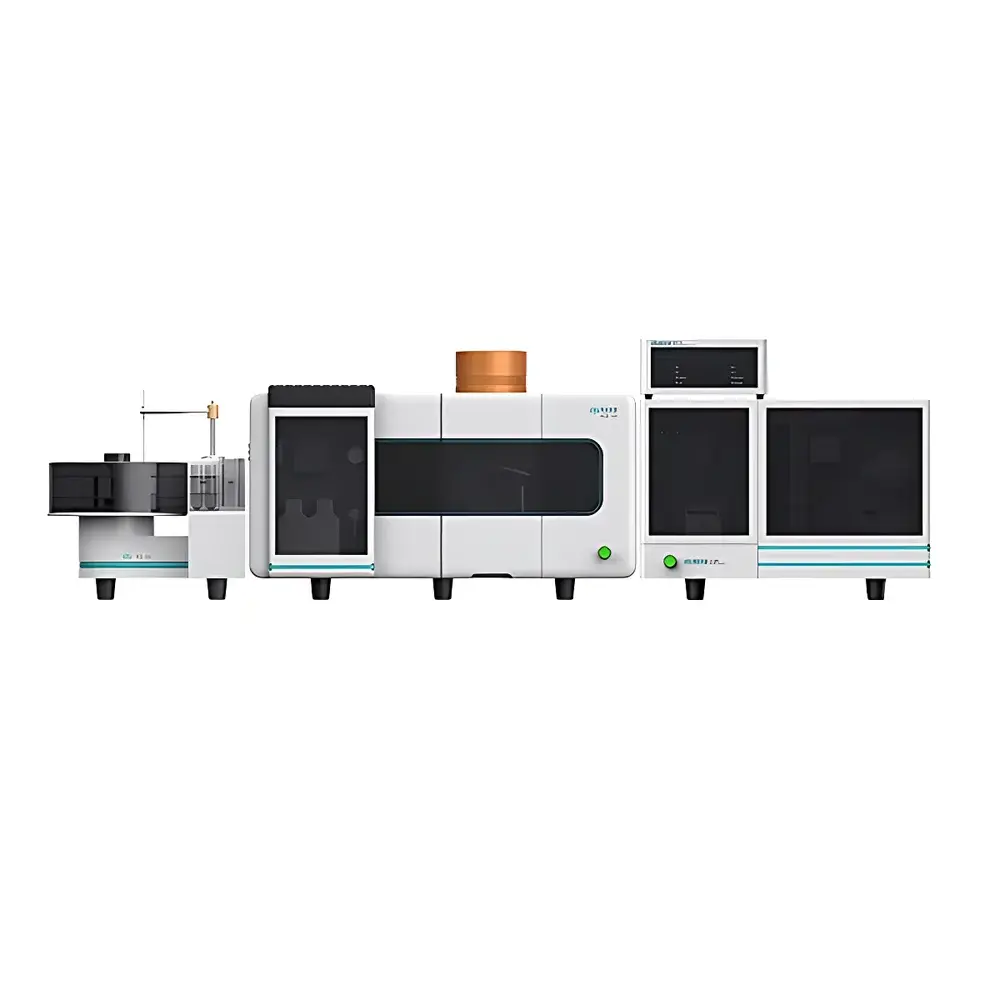
Haiguang HGLF Series Liquid Chromatography–Atomic Fluorescence Spectrometer (LC-AFS)
| Brand | Haiguang Instrument |
|---|---|
| Origin | Beijing, China |
| Manufacturer Type | Authorized Distributor |
| Product Origin | Domestic (China) |
| Model | HGLF |
| Instrument Type | Hyphenated LC-AFS System |
| Sample Introduction | Dual Sequential Injection Pumps |
| Waste Disposal | Gravity-Driven Static Drainage |
| Sample Introduction Mode | Vapor Generation / Hydride Generation |
| Gas Flow Control | Digital Mass Flow Controllers |
| Detectable Elements | As, Se, Pb, Bi, Sb, Te, Sn, Hg, Cd, Zn, Ge, Au |
| Relative Standard Deviation (RSD) | < 0.6% |
| Linear Dynamic Range | > 3 orders of magnitude |
| Detection Limits (As, Se, Pb, Bi, Sb, Te, Sn) | < 0.01 µg/L |
| Photomultiplier Tube Wavelength Range | 160–320 nm |
| Atomizer Temperature Control Range | 50–450 °C |
Overview
The Haiguang HGLF Series Liquid Chromatography–Atomic Fluorescence Spectrometer (LC-AFS) represents the fourth-generation hyphenated instrumentation platform for elemental speciation analysis. Engineered to meet stringent regulatory and research-grade requirements, this system integrates high-resolution liquid chromatography with atomic fluorescence detection via hydride/vapor generation—enabling selective, sensitive, and quantitative determination of individual chemical species (e.g., inorganic vs. organic arsenic, methylmercury vs. inorganic mercury). The instrument operates on the principle of species-specific separation followed by post-column photochemical or chemical vapor generation, atomization in a quartz tube furnace, and fluorescence excitation at element-characteristic wavelengths. Its design adheres to fundamental metrological principles: traceability of calibration standards, minimization of memory effects, and long-term signal stability under continuous operation—making it suitable for routine compliance testing as well as advanced speciation method development.
Key Features
- Multi-channel, multi-lamp-position light source system with auto-alignment capability—eliminates manual lamp adjustment and ensures optimal excitation intensity across all target elements.
- Optical architecture incorporating internal light-trapping threads, asymmetric apertures, and proprietary blackened coatings—reduces stray light by >90%, yielding signal-to-noise ratios exceeding 300:1 for sub-ng/L As standards.
- Three-dimensional integrated microfluidic manifold—minimizes dead volume, suppresses Hg carryover, and eliminates tubing entanglement in routine maintenance workflows.
- Microliter-scale sequential injection system—fully solid-state with no peristaltic pump tubing; enables automated rinse cycles, blank subtraction, and inter-sample cleaning without operator intervention.
- Digital tri-gas control (carrier, auxiliary, and shield gas) using calibrated mass flow controllers—maintains ±0.5% flow accuracy over 72 h, critical for reproducible hydride formation kinetics.
- Self-regulating, water-cooled, three-stage gas–liquid separator—designed for high-matrix biological and environmental extracts; includes foam suppression, moisture removal, and passive waste drainage.
- Thermally stabilized quartz atomizer with PID-controlled heating (50–450 °C)—ensures consistent atomization efficiency across varying sample matrices and long-term operational stability.
- Ignition-free plasma initiation technology—rated for >1,000,000 ignitions without filament replacement, eliminating downtime associated with electrode degradation.
- Hg lamp drift compensation algorithm—monitors baseline fluorescence intensity in real time and applies dynamic correction during sequence acquisition.
- Integrated sensor suite including leak detection, gas flow verification, ignition current monitoring, and real-time atomization chamber video feed—supports predictive maintenance and audit-ready system logs.
Sample Compatibility & Compliance
The HGLF Series is validated for complex, high-organic-content matrices including seafood tissue digests, soil leachates, urine, serum, rice flour, and polymer extracts. Its robust vapor generation chemistry accommodates chloride-, sulfate-, and phosphate-rich samples without matrix-induced signal suppression. The system supports full compliance with internationally recognized analytical standards, including but not limited to:
- GB 5009.11–2014 — Determination of total and inorganic arsenic in foodstuffs
- GB 5009.17–2021 — Determination of total and organic mercury in foodstuffs
- USP — Elemental impurities – procedures for speciated analysis
- ISO/IEC 17025:2017 — General requirements for competence of testing and calibration laboratories
- FDA 21 CFR Part 11 — Electronic records and electronic signatures (when deployed with compliant software configuration)
All hardware and firmware modules are designed to support GLP/GMP-aligned audit trails, user access control, and data integrity protocols required for regulated environments.
Software & Data Management
The HGLF Series runs on Haiguang’s next-generation AFS Control Suite v4.0—a modular, Windows-based application certified for 64-bit OS environments. The software implements fully automated workflows: method loading, column equilibration, gradient programming, UV digestion activation, peak integration, species identification via retention time matching, and report generation—including uncertainty estimation per ISO/IEC Guide 98-3. Raw spectral and chromatographic data are stored in vendor-neutral .CDF format (compatible with third-party chemometrics tools). Audit trail functionality records all user actions, parameter modifications, and instrument status events with timestamps and digital signatures. Remote monitoring is enabled via Ethernet (LAN) or Wi-Fi interfaces, supporting secure TLS-encrypted data transmission and centralized fleet management in multi-instrument labs.
Applications
The HGLF Series delivers validated performance in regulatory and research applications demanding speciation-level resolution:
- Food Safety: Quantification of dimethylarsinic acid (DMA), monomethylarsonic acid (MMA), arsenobetaine (AB), and inorganic As(III)/As(V) in rice, seaweed, and shellfish.
- Environmental Monitoring: Speciation of Se(IV)/Se(VI), Sb(III)/Sb(V), and organotin compounds in wastewater, sediment pore water, and atmospheric particulates.
- Clinical & Public Health: Differentiation of methylmercury (MeHg) from inorganic Hg(II) in human blood and hair for exposure assessment.
- Materials Science: Characterization of metalloprotein-bound Se species in nanocatalysts and quantum dot precursors.
- Pharmaceutical Development: Stability-indicating assays for metal-containing biologics and inorganic excipient impurities.
FAQ
What sample introduction modes does the HGLF support?
The system operates exclusively in hydride generation (HG) and cold vapor generation (CVG) modes—optimized for As, Se, Sb, Bi, Te, Sn, Pb, Hg, Cd, Zn, Ge, and Au. It does not support electrothermal atomization or flame AAS coupling.
Is the UV digestion module optional or integrated?
UV photolysis is fully integrated and configurable—users may select between UV-assisted oxidation (for organometallic cleavage) and conventional thermal hydride generation within the same method sequence.
Can the system perform total elemental analysis alongside speciation?
Yes—the software supports seamless switching between speciation and total-element quantification modes, sharing calibration curves and QC protocols without hardware reconfiguration.
What is the maximum operating temperature of the atomizer?
The quartz tube atomizer is rated for continuous operation up to 450 °C, with programmable ramping and hold steps to accommodate thermally labile species.
Does the system comply with 21 CFR Part 11 requirements?
When deployed with password-protected user roles, electronic signature capture, and immutable audit logs enabled, the HGLF meets the technical controls specified in FDA 21 CFR Part 11 for electronic records in regulated laboratories.





