
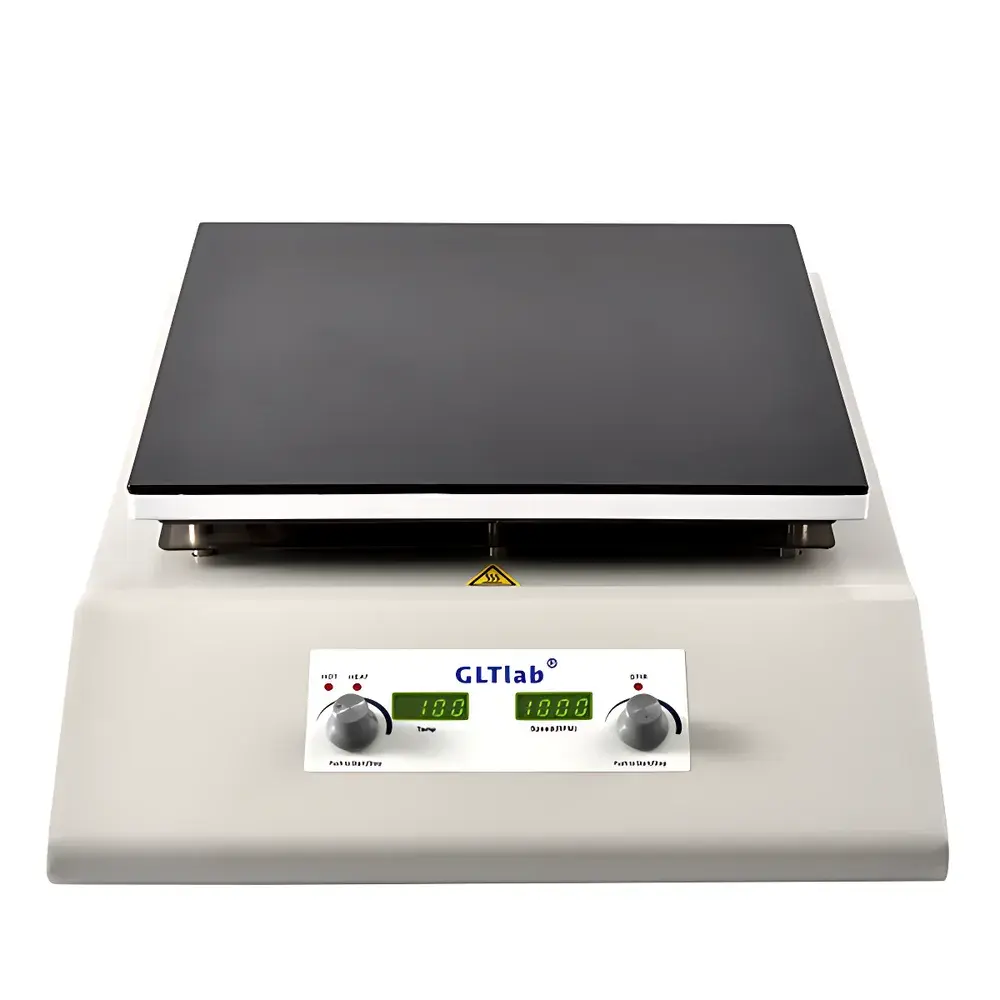
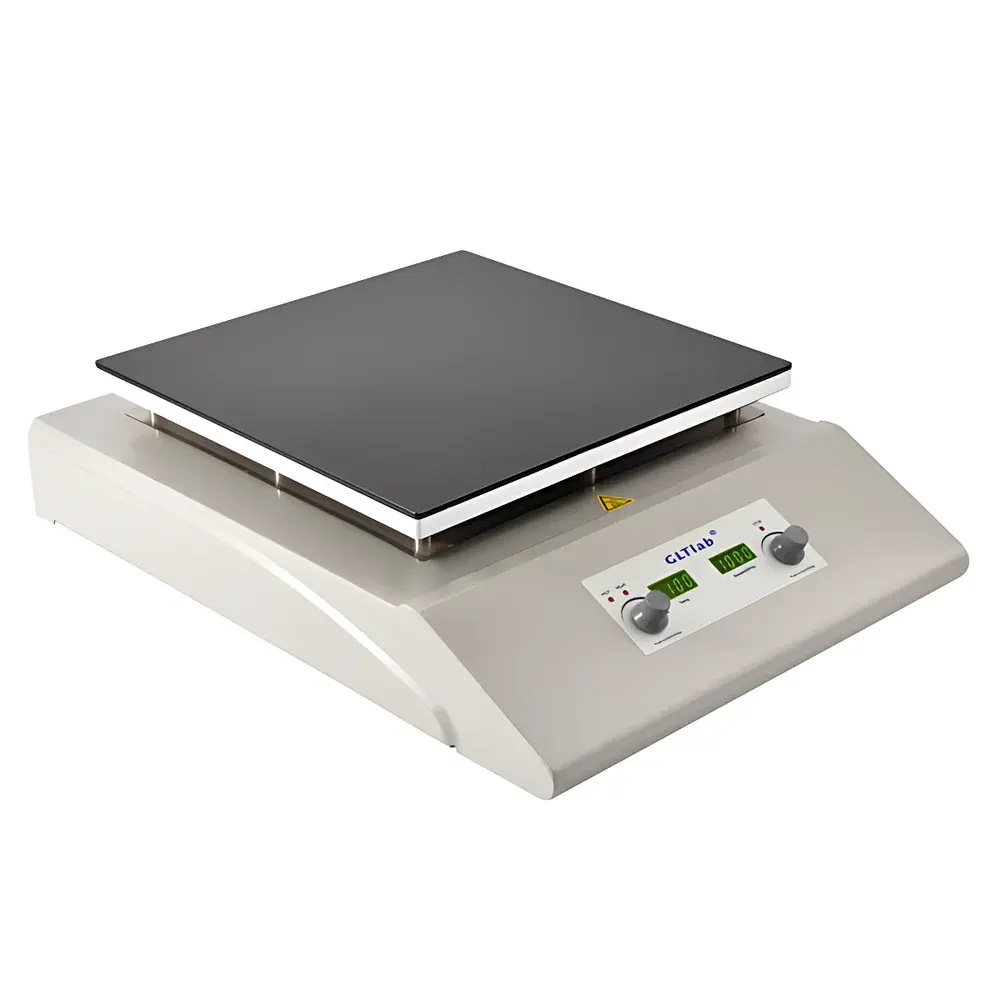
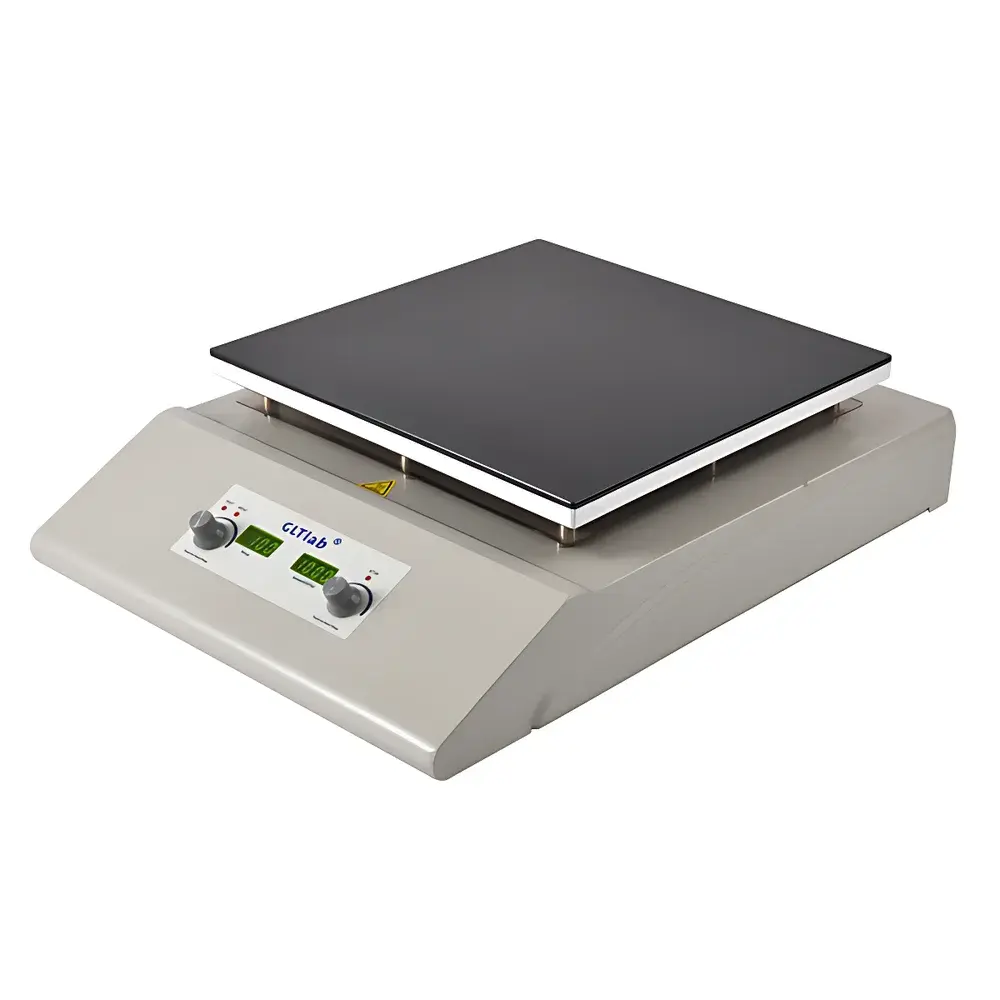
GLTlab SHC-2 12-Inch Ceramic-Plate Magnetic Stirrer with Integrated Heating
| Brand | GLTlab |
|---|---|
| Model | SHC-2 |
| Type | Magnetic Stirrer with Ceramic Heating Plate |
| Max Stirring Volume | 20 L (H₂O) |
| Speed Range | 150–1500 rpm |
| Solution Temperature Range | 35–200 °C |
| Plate Surface Temperature Range | 35–550 °C |
| Temperature Setting Resolution (Solution) | 0.1 °C |
| Temperature Setting Resolution (Plate) | 1 °C |
| Temperature Stability | ±1 °C |
| PT1000 Sensor Accuracy | ±0.5 °C |
| External Probe Calibration | Yes |
| Display | LED |
| Panel Material | Alumina Ceramic |
| Panel Dimensions | 300 × 300 mm |
| Power | 1600 W |
| Input Voltage | 100–130 V / 200–240 V AC, 50/60 Hz |
| IP Rating | IP21 |
| Operating Ambient | 5–40 °C, ≤80% RH |
| Net Weight | 8.5 kg |
| Dimensions (W × D × H) | 290 × 423 × 110 mm |
Overview
The GLTlab SHC-2 is a high-performance 12-inch magnetic stirrer featuring an integrated alumina ceramic heating plate engineered for precision temperature control and robust mechanical stirring in demanding laboratory environments. Unlike conventional stainless-steel or glass-coated hotplates, the SHC-2 utilizes a dense, chemically inert alumina ceramic surface (300 × 300 mm) rated for continuous operation up to 550 °C—enabling rapid thermal response, uniform heat distribution, and resistance to thermal shock, acid corrosion, and mechanical abrasion. Its core operation relies on a brushless DC motor coupled with a high-torque magnetic coupling system, delivering stable rotational speeds from 150 to 1500 rpm with minimal vibration—even under viscous or high-volume loads. The instrument employs dual-mode thermal regulation: direct plate heating (35–550 °C) for rapid ambient heating and solution-mode control (35–200 °C) using a calibrated external PT1000 probe immersed in the sample vessel. This architecture supports reproducible thermal protocols required in synthesis, dissolution testing, buffer preparation, and quality control workflows across pharmaceutical, chemical, and materials science laboratories.
Key Features
- Alumina ceramic heating surface (300 × 300 mm) offering superior thermal uniformity, chemical resistance, and longevity compared to standard enamel or stainless-steel plates
- Dual-range temperature control: independent plate surface mode (35–550 °C) and solution-sensing mode (35–200 °C) with 0.1 °C resolution in solution mode
- PT1000 external temperature sensor with user-accessible calibration function to maintain traceable accuracy within ±0.5 °C
- LED digital display with intuitive parameter navigation, real-time rpm and temperature readouts, and visual overheat warning indicators
- High-power 1600 W heating system enabling rapid ramp rates and stable setpoint maintenance across large-volume vessels (up to 20 L H₂O)
- IP21-rated enclosure ensuring protection against vertically falling drips and solid objects ≥12.5 mm—suitable for general laboratory benchtop use
- Universal power input (100–130 V / 200–240 V AC, 50/60 Hz) supporting global deployment without voltage converters
Sample Compatibility & Compliance
The SHC-2 accommodates standard laboratory glassware—including beakers, flasks, and jacketed reactors—up to 20 L volume when used with appropriately sized magnetic stir bars. Its ceramic surface tolerates contact with aggressive reagents (e.g., concentrated HCl, HNO₃, NaOH) and withstands repeated thermal cycling without delamination or microcracking. The instrument complies with IEC 61010-1:2010 for electrical safety in laboratory equipment and meets EMC requirements per IEC 61326-1:2020. While not certified for hazardous location use, its design aligns with GLP-compliant lab practices: temperature and speed parameters are digitally recorded via optional RS232/USB interface (available as accessory), supporting audit-ready data logs traceable to NIST-traceable PT1000 calibration standards.
Software & Data Management
The SHC-2 operates as a standalone instrument with no embedded operating system; however, it supports external data acquisition through its optional RS232 or USB communication port (sold separately). When connected to a host PC running compliant LabVIEW™, Python (pySerial), or MATLAB® scripts, users can log time-stamped temperature (plate and solution), rpm, and status flags at user-defined intervals. All configuration changes—including setpoint modifications and calibration events—are timestamped and retained in volatile memory for post-run review. Though not FDA 21 CFR Part 11–compliant out-of-the-box, the device may be integrated into validated systems where electronic records are governed by site-specific SOPs and secondary audit trails.
Applications
- Controlled-temperature synthesis of metal-organic frameworks (MOFs) and nanomaterials requiring prolonged heating under inert atmosphere
- Dissolution testing per USP and Ph. Eur. 2.9.3, particularly for poorly soluble APIs where precise bath temperature maintenance is critical
- Buffer and media preparation in bioprocessing labs, where consistent pH stability depends on uniform thermal equilibration
- Accelerated stability studies involving thermal stress exposure of polymer solutions or colloidal dispersions
- Preparation of homogeneous catalyst slurries prior to filtration or centrifugation steps
- Calibration and validation of external thermometers and temperature probes in metrology labs
FAQ
Can the SHC-2 stir viscous solutions such as glycerol or polymer melts?
Yes—the high-torque magnetic drive system maintains stable rotation up to 1500 rpm even with viscosities exceeding 10,000 mPa·s, provided an appropriately sized stir bar (e.g., 40–60 mm elliptical or cross-shaped) is used and the vessel geometry permits efficient fluid turnover.
Is the PT1000 probe included with the unit?
A standard 100 mm immersion-length PT1000 probe is supplied; optional probes with PTFE sheathing, longer stems (200/300 mm), or autoclavable variants are available under separate part numbers.
Does the ceramic plate require special cleaning procedures?
No—routine wiping with ethanol or acetone is sufficient; avoid abrasive pads or chlorine-based cleaners to preserve surface integrity and emissivity.
What is the maximum recommended vessel diameter for optimal stirring efficiency?
For uniform vortex formation and thermal transfer, vessels with diameters between 80 mm and 250 mm are optimal; larger vessels (>300 mm) may require auxiliary support stands to prevent tipping during high-speed operation.
Can the SHC-2 be operated inside a fume hood?
Yes—its IP21 rating and low off-gas emission profile (no coatings or adhesives above 200 °C) make it suitable for ventilated enclosures; ensure adequate clearance (≥10 cm) around rear ventilation grilles.



