
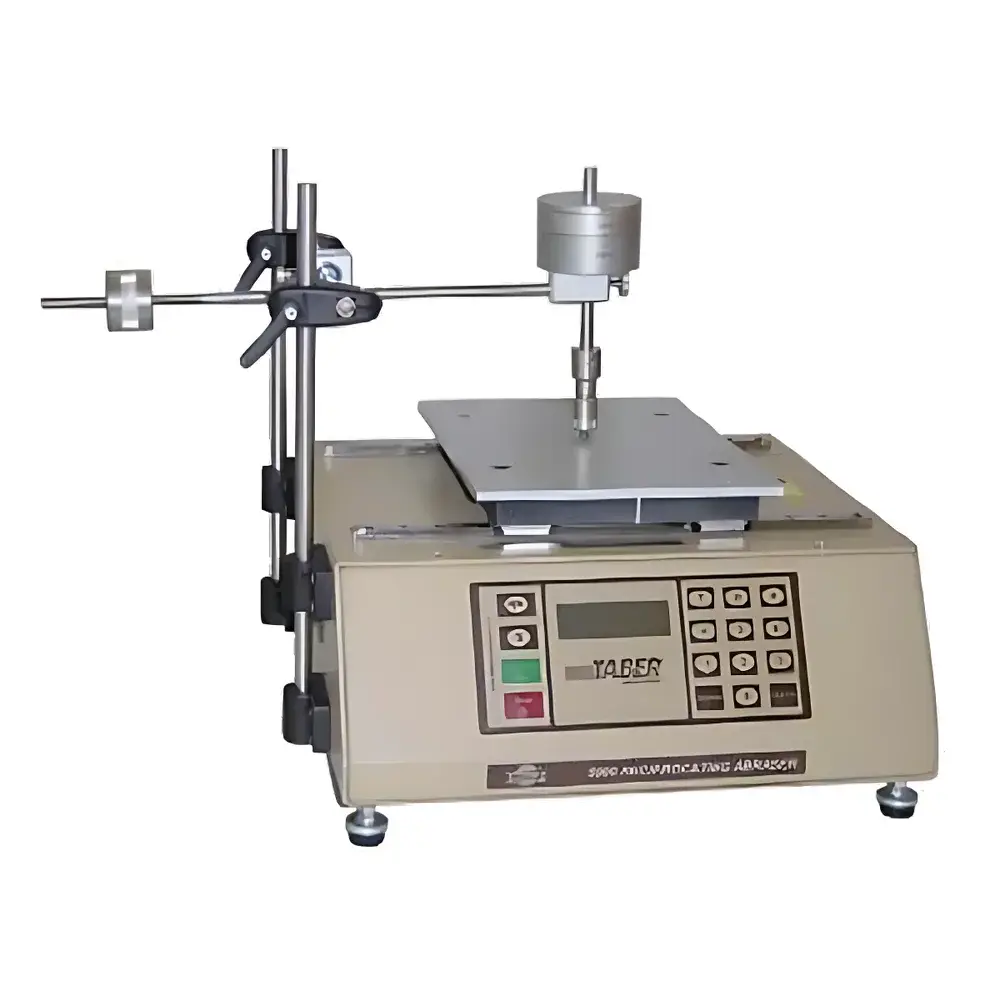
Taber 5900 Reciprocating Abrasion Tester
| Brand | Taber Instruments |
|---|---|
| Origin | USA |
| Model | TABER 5900 |
| Stroke Range | 6–155 mm |
| Reciprocating Speed | 3–75 cycles/min |
| Applied Load | 1–24 N (via calibrated weights) |
| Arm Height Adjustment | up to 130 mm |
| Compliance | ASTM F2495, ISO 1518, GMW 14125, GME 60248, GME 60368 |
| Power Supply | 115/230 V AC, switchable |
Overview
The Taber 5900 Reciprocating Abrasion Tester is an electromechanical precision instrument engineered for quantitative evaluation of surface durability under controlled linear oscillatory motion. Based on the fundamental principle of reciprocating wear—where a standardized abrasive medium traverses a fixed sample surface under defined normal force and kinematic parameters—the system replicates real-world mechanical degradation mechanisms such as scuffing, scratching, and cyclic abrasion. Designed in accordance with ISO 1518 and validated against automotive and industrial material standards including GMW 14125 and ASTM F2495, the Taber 5900 delivers high reproducibility for comparative ranking of coatings, plastics, textiles, composites, and metallic finishes. Its lever-based load application architecture ensures traceable, gravity-derived normal force without hydraulic or pneumatic dependency—critical for GLP-compliant test documentation and inter-laboratory correlation.
Key Features
- Precision-adjustable stroke length (6–155 mm) via calibrated micrometer scale, enabling simulation of both micro-scratching and macro-scale wear regimes.
- Digitally controlled reciprocating frequency (3–75 cycles/min), independently programmable to match material response thresholds and standard-specific dwell times.
- Modular load application system using NIST-traceable stainless-steel weights (1 N, 2 N, 2.5 N, 5 N, 10 N, 24 N), mounted on a balanced first-class lever to maintain constant normal force across full stroke excursion.
- Vertically adjustable test arm (up to 130 mm travel) accommodates samples of varying thickness—including laminated panels, molded parts, and fabric-on-foam substrates—without mechanical interference.
- Wearaser™ abrasive holder accepts standardized abrasive media (e.g., CS-10, H-18, Calibrase® CS-17) with repeatable clamping torque and orthogonal alignment verification.
- Integrated cycle counter with 6-digit display (0–999,999 cycles), supporting automated endpoint detection and long-duration fatigue testing protocols.
- Dual-voltage power supply (115/230 V AC, manually switchable) compliant with international laboratory electrical infrastructure requirements.
Sample Compatibility & Compliance
The Taber 5900 accommodates flat or gently contoured specimens up to 130 mm in height and 150 mm × 150 mm in planar dimension. Standard fixtures include dual-position sample clamps for rigid substrates and optional textile mounting plates compatible with BMW GS 97038 and GMW 14125 textile abrasion methodologies. The instrument satisfies essential regulatory and industry validation requirements: it is explicitly referenced in ASTM F2495 (standard test method for abrasion resistance of coated fabrics), ISO 1518 (paint and varnish—determination of resistance to abrasion), and multiple General Motors Engineering Standards (GME 60248, GME 60368, GMW 14125). All mechanical components are manufactured to ISO 9001-certified processes, and load calibration certificates are supplied with each weight set per ISO/IEC 17025 guidelines.
Software & Data Management
While the Taber 5900 operates as a standalone electromechanical platform, its analog output signals (cycle count, motor status, limit switch triggers) are compatible with third-party data acquisition systems via 0–10 V DC or TTL interfaces. Users implementing LIMS or ELN environments may log test parameters—including applied load, stroke, speed, and cycle count—directly into audit-trail-enabled software platforms compliant with FDA 21 CFR Part 11. Taber Instruments provides detailed calibration procedures and uncertainty budgets aligned with ISO/IEC 17025 Annex A.2, supporting IQ/OQ documentation for GMP-regulated laboratories. Firmware updates (when applicable) are distributed exclusively through authorized service channels with version-controlled release notes.
Applications
- Automotive interior trim: quantifying wear resistance of PVC, TPO, PU leather, and injection-molded thermoplastics per GMW 14125.
- Aerospace cabin materials: evaluating scratch resistance of polycarbonate glazing and flame-retardant composites per ASTM D1044.
- Medical device surfaces: assessing abrasion stability of silicone elastomer housings and antimicrobial polymer coatings.
- Consumer electronics: benchmarking fingerprint resistance and scratch propagation on AR-coated glass and anodized aluminum enclosures.
- Textile performance: conducting Martindale-parallel abrasion simulations on technical fabrics using Scotch-Brite® or Calibrase® media under controlled humidity conditions.
- Coating development: correlating pigment dispersion quality with abrasion loss rate measured gravimetrically before/after exposure.
FAQ
What standards does the Taber 5900 directly support?
The instrument is designed and verified for compliance with ISO 1518, ASTM F2495, GMW 14125, GME 60248, and GME 60368. Full traceability documentation is included with shipment.
Can the Taber 5900 perform simultaneous multi-sample testing?
Yes—using the optional Tri-Sample Test Arm Kit (sold separately), three specimens can be evaluated in parallel under identical kinematic and loading conditions, reducing inter-test variability.
Is calibration certification provided with the system?
Each weight set includes a NIST-traceable calibration certificate. Optional annual recalibration services are available through Taber’s ISO/IEC 17025-accredited service center.
What maintenance is required for long-term accuracy?
Routine inspection of abrasive holder alignment, lubrication of linear guide rails every 500 hours, and verification of stroke repeatability using certified gauge blocks per Taber Maintenance Manual Rev. 4.2.
Does the warranty cover consumables such as abrading media or磨头?
No—abrasive media, stylus tips, and calibration tools are classified as consumables and excluded from the 12-month limited warranty, which applies only to defects in materials and workmanship of the base unit and factory-installed components.





