
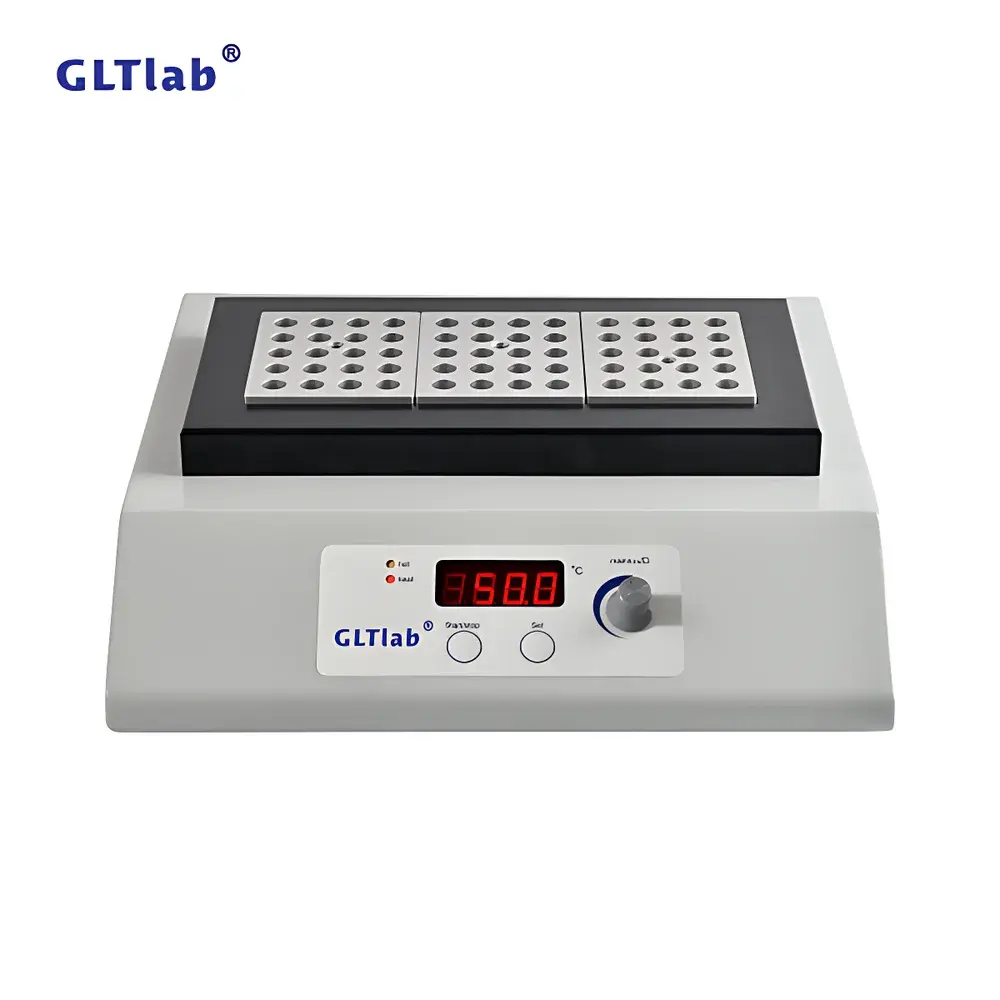
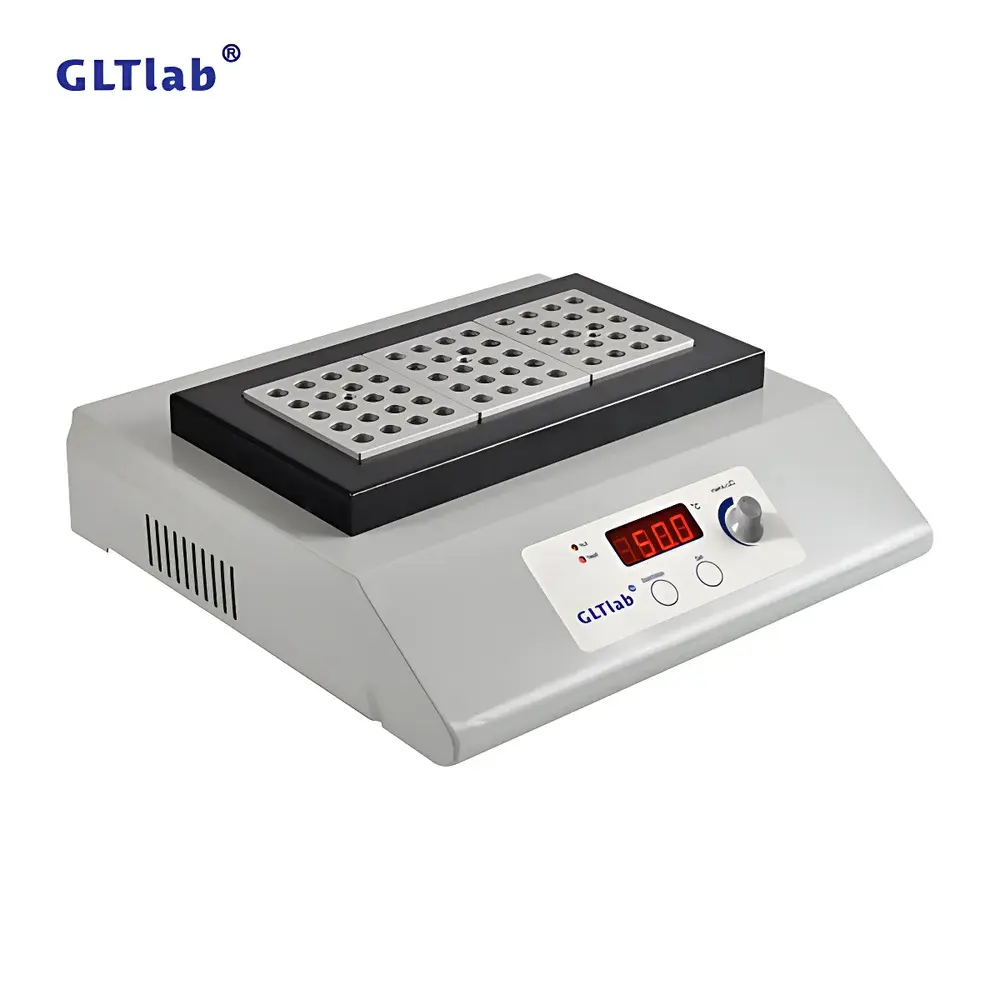
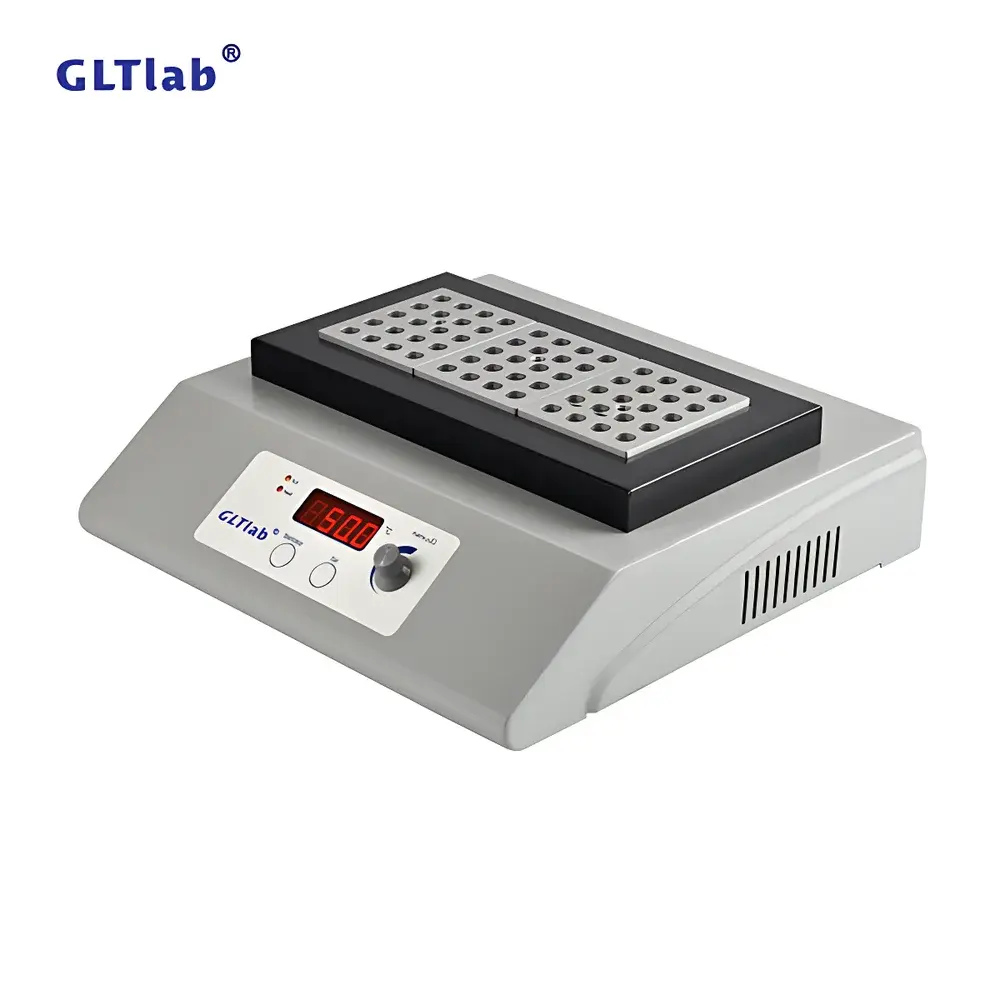
GLTLab BH-603D Digital Programmable Metal Block Heater
| Brand | GLTLab |
|---|---|
| Model | BH-603D |
| Temperature Range | Ambient +10°C to 200°C |
| Temperature Accuracy | ±0.1°C |
| Dimensions (W×D×H) | 305 × 290 × 110 mm |
| Net Weight | 8 kg |
| Heating Block Configuration | Triple-module insertion (modular, user-replaceable) |
| Timer Range | 0–10 hours or continuous operation |
| Control System | Digital PID with built-in calibration function |
| Origin | Guangdong, China |
| Manufacturer Type | Direct OEM/ODM producer |
Overview
The GLTLab BH-603D Digital Programmable Metal Block Heater is a precision-engineered dry bath system designed for consistent, uniform thermal control in life science, clinical diagnostics, analytical chemistry, and quality control laboratories. Unlike water baths or heating mantles, this metal block heater employs solid aluminum heating blocks with optimized thermal conductivity and minimal temperature gradient across the well surface—enabling rapid heat transfer and high reproducibility in sample incubation, enzymatic reactions, DNA denaturation, solvent evaporation, and sample digestion protocols. Its operational range spans from ambient +10°C to 200°C, accommodating both low-temperature incubation and high-temperature dry-down applications. The unit utilizes a closed-loop PID temperature controller with real-time feedback, ensuring stable setpoint maintenance under variable load conditions and ambient fluctuations.
Key Features
- Triple independent heating module slots—supports simultaneous processing of multiple sample types using interchangeable aluminum or stainless-steel blocks (e.g., 0.2 mL, 0.5 mL, 1.5 mL, 2.0 mL, 15 mL, and 50 mL tube formats; modules sold separately)
- Digital front-panel interface with intuitive push-button navigation and large LED display showing set temperature, actual block temperature, and remaining time
- Built-in calibration function accessible via dedicated calibration screw—enables traceable adjustment of displayed temperature against verified reference standards (e.g., NIST-traceable thermometers)
- PID-controlled thermal regulation with auto-tuning capability—minimizes overshoot and stabilizes within ±0.1°C of setpoint after thermal equilibrium
- Programmable timer with dual-mode operation: fixed-duration (0–10 h in 1-min increments) or continuous “hold” mode for unattended overnight runs
- Compact footprint (305 × 290 × 110 mm) and lightweight design (8 kg)—optimized for benchtop integration in space-constrained environments including biosafety cabinets and laminar flow hoods
- Included block removal tool ensures safe, non-damaging extraction of hot modules without gloves or pliers—enhancing workflow safety and longevity of thermal interfaces
Sample Compatibility & Compliance
The BH-603D accommodates standard laboratory consumables—including microcentrifuge tubes, PCR strips, vials, and culture tubes—when paired with GLTLab-certified heating modules. All aluminum blocks undergo anodization for corrosion resistance and thermal stability during repeated exposure to reagents and condensation. The device complies with IEC 61010-1:2010 safety requirements for electrical equipment used in laboratory environments. While not intrinsically rated for hazardous locations, it is suitable for use in ISO 17025-accredited testing labs when operated within validated temperature ranges and documented calibration intervals. For regulated environments (e.g., pharmaceutical QC), users may integrate optional automation protocols compliant with 21 CFR Part 11 data integrity requirements via RS-232 or USB interface (firmware upgrade required).
Software & Data Management
The BH-603D supports optional PC-based control and data logging through GLTLab’s proprietary LabControl Suite (v3.2+), enabling remote parameter setting, real-time temperature graphing, event-triggered alarms, and export of CSV-formatted audit trails. When configured with time-stamped calibration logs and operator ID inputs, the system meets GLP/GMP documentation standards for method validation and instrument qualification (IQ/OQ). Data files include metadata such as block serial number, firmware version, ambient temperature reading (via optional external probe), and deviation alerts—facilitating root-cause analysis during out-of-specification investigations.
Applications
- Enzyme kinetics assays requiring precise thermal initiation (e.g., restriction digests, ligations, phosphatase treatments)
- DNA/RNA sample preparation workflows—including heat inactivation of nucleases, cDNA synthesis, and library normalization
- Clinical specimen processing—such as serum separation, antigen retrieval in IHC, and ELISA plate pre-warming
- Chemical synthesis support—solvent removal, catalyst activation, and reflux simulation under inert atmosphere (with compatible lid accessories)
- Quality assurance procedures—reference material equilibration, viscosity standard conditioning, and stability-indicating assay validation
FAQ
What is the maximum recommended operating temperature for long-term use?
Continuous operation at 200°C is supported; however, for optimal block longevity and thermal uniformity, sustained use above 180°C should be limited to ≤4 hours per cycle.
Are heating modules interchangeable between BH-603D and other GLTLab models?
Yes—BH-603D shares mechanical and thermal interface specifications with the BH-602 and BH-605 series, enabling cross-platform module compatibility with firmware verification.
Does the unit support external temperature probes for sample-core monitoring?
The BH-603D does not include internal probe ports, but optional K-type thermocouple adapters (sold separately) allow real-time sample temperature feedback to LabControl Suite when used with calibrated immersion probes.
How often should calibration be performed?
Per ISO/IEC 17025 guidelines, initial calibration upon installation and semiannual verification are recommended; frequency may increase based on usage intensity and criticality of application.
Is the BH-603D suitable for GMP-regulated environments?
Yes—when deployed with documented calibration records, change control logs, and validated automation scripts, it satisfies Annex 11 and ALCOA+ data integrity principles for ancillary thermal equipment.



