
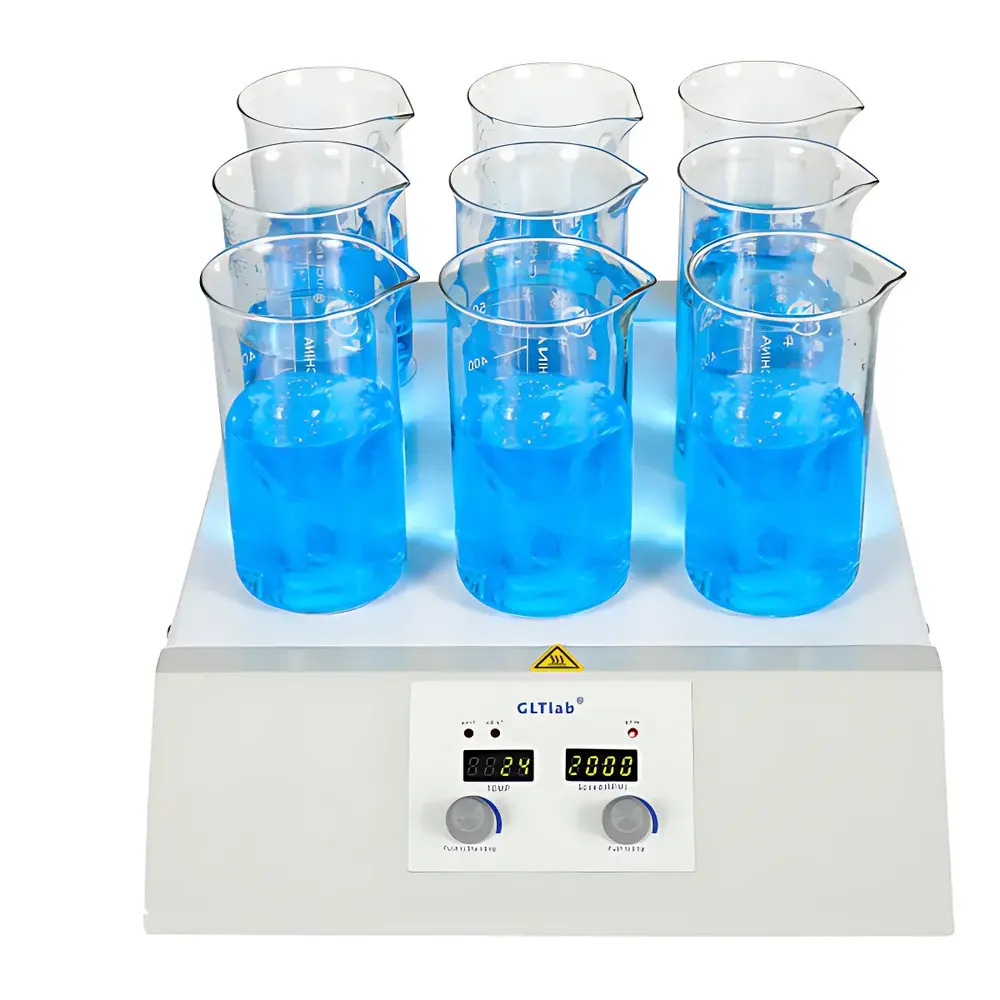
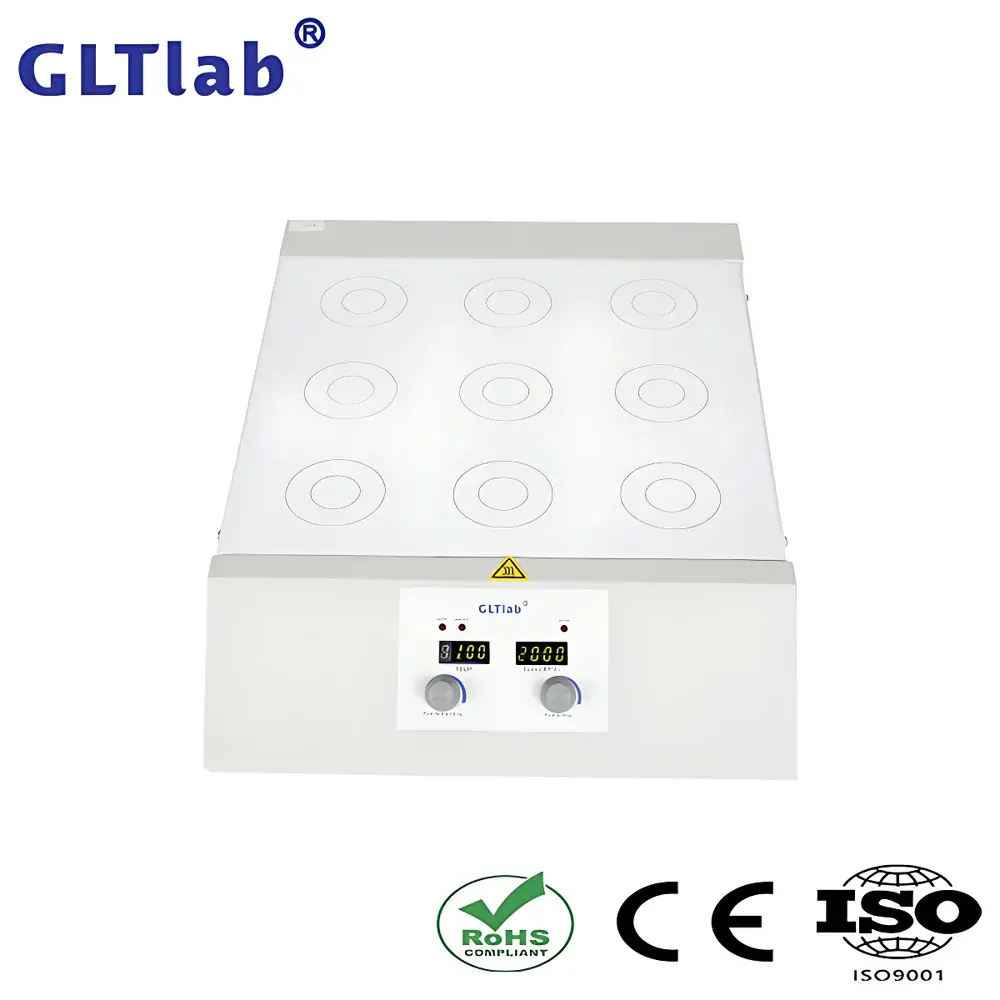
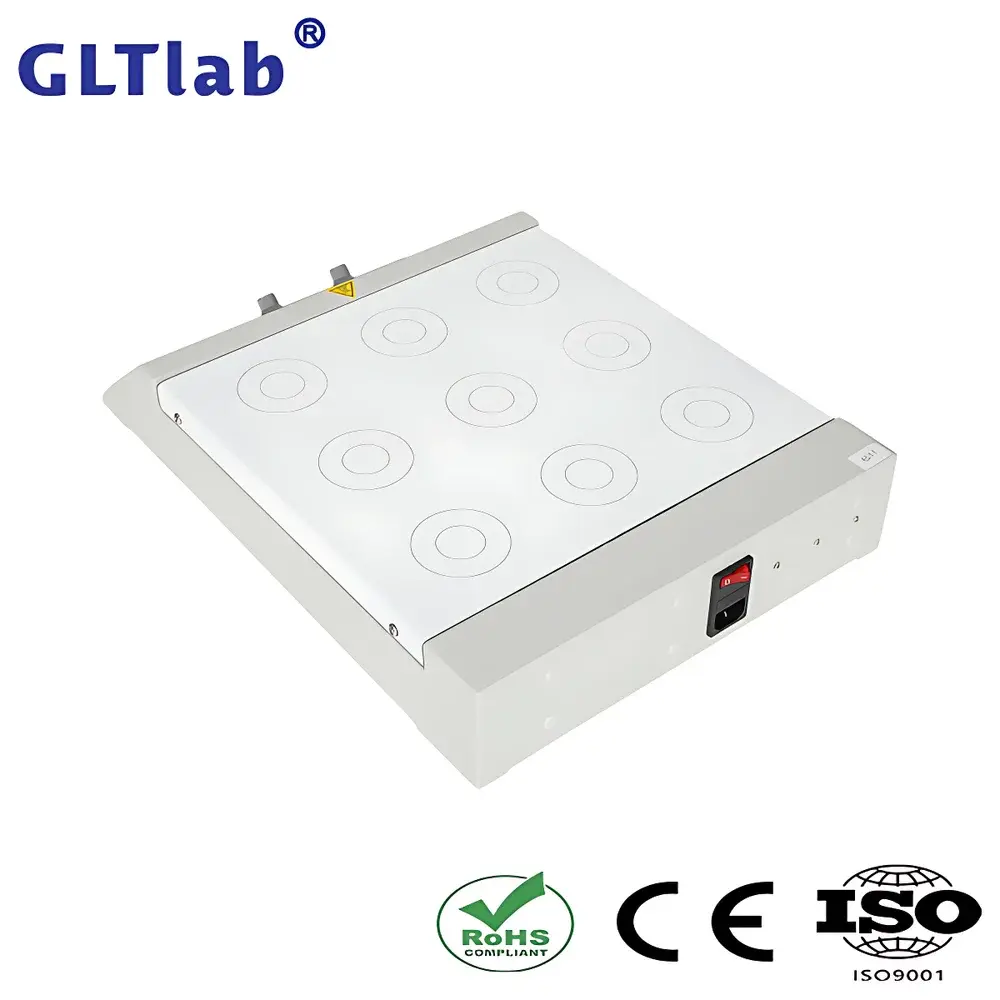
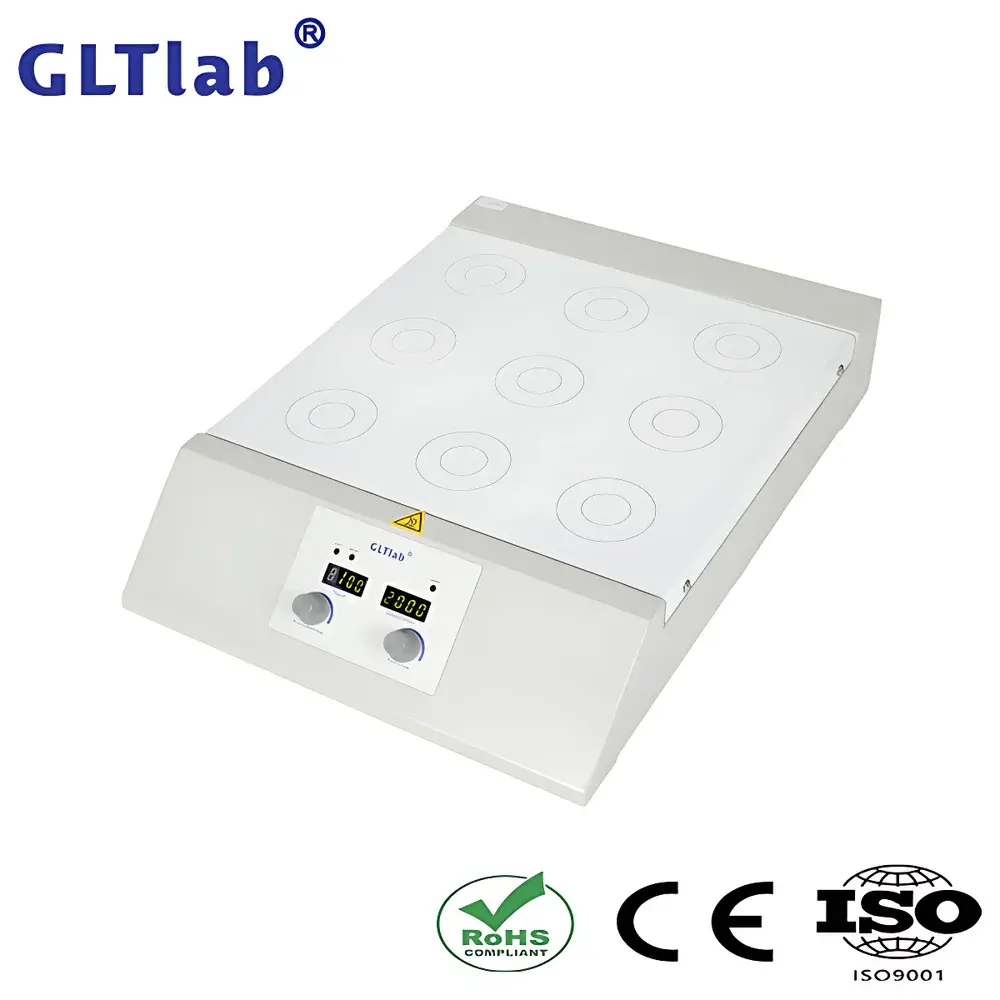
GLTLab SHA-9N 9-Position Digital Programmable Hotplate Magnetic Stirrer
| Brand | GLTLab |
|---|---|
| Model | SHA-9N |
| Origin | Guangdong, China |
| Manufacturer Type | Direct Manufacturer |
| Instrument Type | Hotplate Magnetic Stirrer |
| Max. Stirring Volume | 2 L × 9 positions |
| Speed Range | 150–2000 rpm |
| Temperature Control Range | Ambient to 120 °C |
| Heating Power | 450 W |
| Panel Material | Ceramic-Coated Aluminum |
| Dimensions (L×W×H) | 445 × 345 × 84 mm |
| Weight | 8 kg |
| Operating Temperature | 5–40 °C |
| Operating Humidity | ≤80% RH |
| IP Rating | IP42 |
| Voltage | 110/115/230 VAC |
| Frequency | 50/60 Hz |
| Display | Dual LED (speed & temperature) |
| Stirring Step Resolution | 1 rpm |
| Heating Ramp Rate | ~5 °C/min |
| Chemical Resistance | Yes |
| Stir Bar Length Compatibility | 25–35 mm |
| Stirring Position Spacing | 100 mm |
| Optional Features | Timer Function, RS-485/Modbus or USB Protocol Integration for Automated Lab Systems |
Overview
The GLTLab SHA-9N is a high-precision, 9-position digital programmable hotplate magnetic stirrer engineered for parallel sample processing in analytical, pharmaceutical, quality control, and research laboratories. Designed around Couette flow principles, it delivers consistent rotational torque and uniform thermal distribution across all nine independent stirring zones—enabling reproducible mixing and temperature-controlled reactions under defined rheological conditions. Unlike single-position units, the SHA-9N eliminates inter-run variability by ensuring identical speed and temperature profiles across all stations, supporting method standardization compliant with ISO/IEC 17025 and GLP documentation requirements. Its ceramic-coated aluminum heating surface provides rapid thermal response, chemical inertness, and long-term dimensional stability—critical for extended heating cycles involving organic solvents, acidic/basic reagents, or aqueous buffers.
Key Features
- Nine independently controllable stirring/heating positions with synchronized or asynchronous operation modes
- Dual LED display showing real-time speed (rpm) and surface temperature (°C) for each station or global setpoint
- Brushless DC motor drive delivering stable torque output from 150 to 2000 rpm, with 1-rpm resolution and ±2 rpm repeatability
- Ceramic-coated aluminum plate (445 × 345 mm active area) offering uniform heat distribution, resistance to corrosion, scratching, and thermal shock
- Precise PID temperature control with ambient-to-120 °C range, ±0.5 °C accuracy at 100 °C, and programmable ramp/soak profiles
- Integrated over-temperature protection and thermal warning system (audible + visual alert) meeting IEC 61000-6-2 EMC and IEC 61010-1 safety standards
- Modular communication interface options (RS-485 Modbus RTU or USB CDC) for integration into automated lab workflows and LIMS/SOP-driven protocols
Sample Compatibility & Compliance
The SHA-9N accommodates standard laboratory glassware including 50–2000 mL beakers, Erlenmeyer flasks, and cylindrical reaction vessels. Stir bar compatibility spans 25–35 mm lengths with diameters up to 8 mm—supporting both PTFE-coated and PTFE-sheathed magnetic bars. Its IP42-rated enclosure ensures operational integrity in non-hazardous environments with moderate dust and splashing exposure. The unit complies with CE marking directives (2014/30/EU EMC, 2014/35/EU LVD), RoHS 2011/65/EU, and conforms to key regulatory expectations for equipment used in USP , , and FDA 21 CFR Part 11–enabled environments when paired with validated software controls.
Software & Data Management
While the SHA-9N operates as a standalone instrument via front-panel controls, optional firmware enables bidirectional communication via RS-485 (Modbus RTU) or virtual COM port (USB). This allows remote parameter setting, real-time data logging of speed/temperature per position, and timestamped event reporting—including thermal fault triggers and power interruptions. When integrated into enterprise lab systems, audit trails meet ALCOA+ principles (Attributable, Legible, Contemporaneous, Original, Accurate) and support 21 CFR Part 11 compliance through external electronic signature validation layers. Data export formats include CSV and XML for traceability in QA/QC review cycles.
Applications
- Parallel dissolution testing of solid dosage forms in pharmaceutical development (aligned with USP )
- Multi-vessel buffer equilibration and reagent preparation in molecular biology and immunoassay workflows
- Controlled heating/stirring during titration standardization, calibration curve generation, and reference material conditioning
- Accelerated stability studies requiring identical thermal-mechanical stress across replicate samples
- Preparative chemistry reactions where stoichiometric consistency depends on uniform mixing kinetics and thermal history
- Environmental sample digestion protocols (e.g., EPA Method 3050B) demanding simultaneous acid heating and agitation
FAQ
Is the SHA-9N suitable for use with corrosive reagents such as concentrated HCl or NaOH solutions?
Yes—the ceramic-coated aluminum surface exhibits high resistance to common inorganic acids, alkalis, and organic solvents under standard operating conditions (≤120 °C, non-pressurized). Routine cleaning with mild detergent is recommended; avoid abrasive tools.
Can individual positions be programmed with different speeds and temperatures simultaneously?
Yes. Each of the nine positions supports independent setpoints for speed (150–2000 rpm) and temperature (ambient to 120 °C), with full parameter retention after power cycling.
Does the unit support timed operation or automatic shutdown?
An optional timer module enables user-defined run durations (1 min to 99 h 59 min) per position, with audible end-of-cycle notification and configurable hold/cool-down behavior.
What is the maximum recommended flask size per position?
For optimal vortex formation and thermal homogeneity, use vessels with ≤80% fill volume—up to 2 L capacity in standard cylindrical or low-form beakers (diameter ≤100 mm).
How is calibration verified and maintained?
Speed calibration is traceable to NIST-certified tachometers; temperature calibration uses Class A PT100 reference probes. Annual verification is recommended per ISO/IEC 17025 Clause 6.5.2, with internal diagnostics accessible via service mode.



