
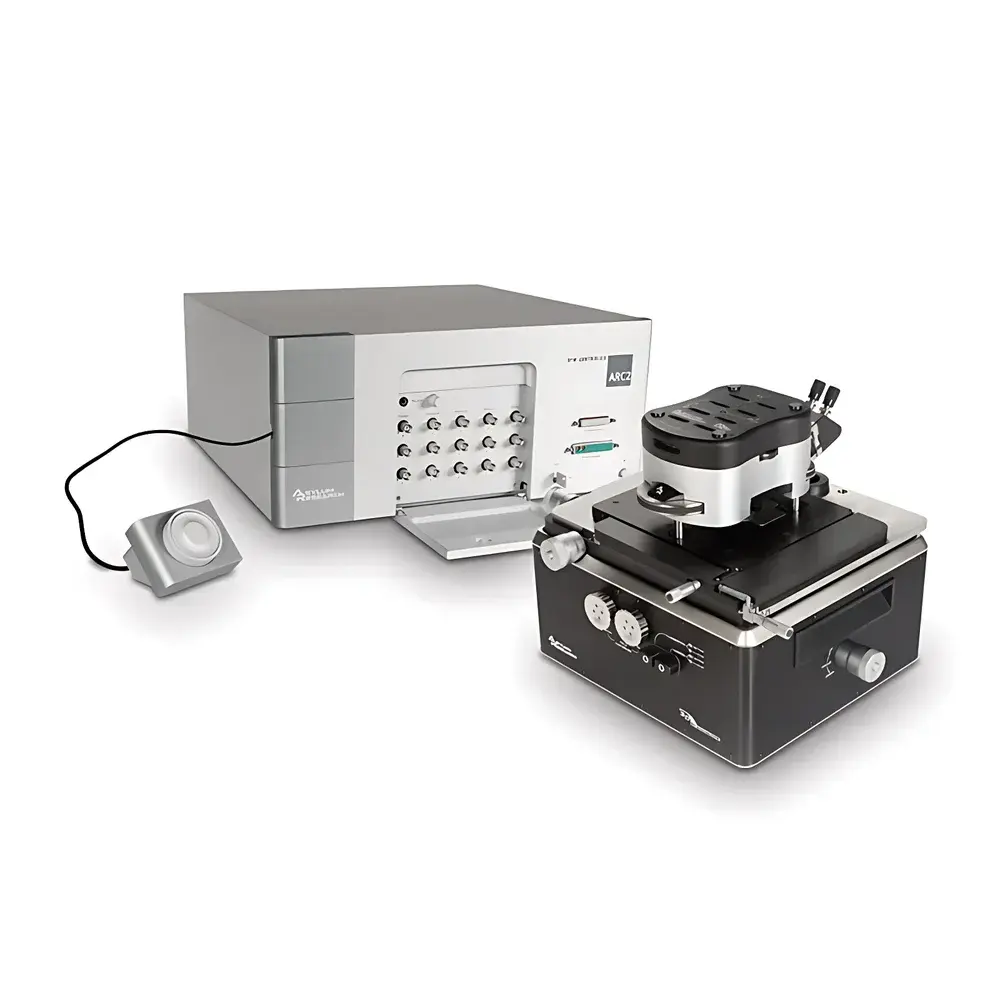
Oxford Instruments Asylum Research MFP-3D Atomic Force Microscope
| Brand | Oxford Instruments |
|---|---|
| Origin | USA |
| Manufacturer Type | Authorized Distributor |
| Origin Category | Imported |
| Model | MFP-3D |
| Price Range | USD 135,000 – 205,000 (FOB) |
| Instrument Type | Atomic Force Microscope (AFM) |
| Application Class | Materials Science AFM |
| Z-Axis Positioning Noise | < 0.06 nm (RMS, in air) |
| X/Y Closed-Loop Scanning Noise | < 0.5 nm (RMS) |
| Sample Diameter | ≤ 80 mm |
| Sample Thickness | ≤ 25 mm |
| Visual Field of View | 200 mm × 200 mm (XY stage travel with optical alignment) |
Overview
The Oxford Instruments Asylum Research MFP-3D is a high-performance, research-grade atomic force microscope engineered for quantitative nanoscale surface characterization across materials science, soft matter, life sciences, and functional nanomaterials. Based on the fundamental principle of mechanical probe–surface interaction detection via optical lever displacement sensing, the MFP-3D implements a true closed-loop, sensor-integrated scanning architecture—distinct from conventional tube scanners—to deliver sub-nanometer spatial fidelity and exceptional measurement reproducibility. Its core innovation lies in the patented NanoPositioner™ (NPSTM) technology, which embeds capacitive position sensors directly into each axis of the planar XY scanner, eliminating hysteresis, creep, and thermal drift inherent to piezoelectric tube designs. Coupled with an ultra-low-noise Z-axis actuator (< 0.06 nm RMS height noise), the system achieves stable, artifact-free topographic imaging and nanomechanical quantification under ambient, liquid, or controlled environmental conditions.
Key Features
- Planar XY scanner with integrated capacitive position sensors (NPSTM) enabling true closed-loop motion control, sub-0.5 nm positional noise, and distortion-free imaging over 200 × 200 mm stage travel
- Optimized optical lever detection using low-coherence illumination and diffraction-limited alignment—eliminating interference artifacts and enabling reliable force calibration down to piconewton resolution
- Full-digital ARC² controller with real-time FPGA-based signal processing, supporting >100 kHz data acquisition bandwidth and synchronized multi-channel feedback
- Modular, open-architecture software platform (Interactive Mode™) with Python API support, enabling custom script development, automated workflows, and third-party integration (e.g., MATLAB, LabVIEW)
- Multi-modal SPM capability: Contact, Tapping, Dual AC™ (dual-resonance harmonic imaging), Force Spectroscopy, Lateral Force Microscopy (LFM), Electric Force Microscopy (EFM), Scanning Kelvin Probe Microscopy (SKPM), Conductive AFM (CAFM), Magnetic Force Microscopy (MFM), Piezoresponse Force Microscopy (PFM), Vector PFM, and nanoindentation
- Configurable optical pathways: Top-view, bottom-view, or dual-path illumination for simultaneous optical microscopy and SPM operation—ideal for opaque, transparent, or optically active samples
Sample Compatibility & Compliance
The MFP-3D accommodates standard and custom substrates up to 80 mm in diameter and 25 mm in thickness, including silicon wafers, glass slides, polymer films, biological tissues, and electrospun membranes. Its modular environmental enclosure options support operation in inert gas (N₂, Ar), humidity-controlled, or liquid-cell configurations—enabling compliance with ASTM E2539 (Standard Guide for AFM Measurements), ISO/IEC 17025 requirements for measurement uncertainty reporting, and GLP/GMP-aligned workflows where traceable calibration and audit trails are required. All force calibration routines adhere to the Sader method (J. Appl. Phys. 84, 64, 1998) and thermal tune protocols per ISO 18760-2. The system supports 21 CFR Part 11-compliant electronic signatures and audit logging when deployed with validated software configurations.
Software & Data Management
The Interactive Mode™ software provides a unified interface for instrument control, real-time data visualization, batch analysis, and publication-ready output generation. It includes built-in modules for automated tip qualification, drift correction, flattening, grain analysis, roughness statistics (Sa, Sq, Sz per ISO 25178), and force–distance curve fitting (Hertz, DMT, JKR models). Raw data are stored in vendor-neutral HDF5 format with embedded metadata (timestamp, scan parameters, calibration constants, user annotations), ensuring long-term FAIR (Findable, Accessible, Interoperable, Reusable) compliance. Software updates are delivered remotely via secure HTTPS; all versions are backward-compatible and documented per IEC 62304 Class B medical device software standards—reflecting Asylum Research’s commitment to sustainable, auditable instrumentation lifecycles.
Applications
The MFP-3D serves as a primary metrology platform in academic and industrial R&D laboratories for: nanomechanical mapping of polymer blends and block copolymers; quantitative adhesion and modulus profiling of battery electrode interfaces; nanoscale conductivity mapping of graphene heterostructures (CAFM); ferroelectric domain switching dynamics (Vector PFM); bacterial nanowire conductivity assessment in electroactive biofilms; and high-resolution topographic validation of nanoimprinted photonic crystals. Its Dual AC™ mode enables simultaneous acquisition of topography and material contrast (e.g., viscoelastic loss tangent) without sacrificing speed or signal-to-noise ratio—critical for dynamic processes such as polymer crystallization or protein unfolding kinetics.
FAQ
What environmental conditions can the MFP-3D operate in?
The base system operates in ambient air; optional enclosures enable operation in liquid (electrochemical cells), vacuum (UHV-compatible variants available), inert atmosphere, or humidity-controlled environments.
Is the MFP-3D compatible with correlative microscopy workflows?
Yes—the dual optical path design supports concurrent optical microscopy (brightfield, fluorescence, DIC) and AFM, and the stage coordinate system is fully registered to optical reference frames for precise feature targeting.
How is force calibration performed and validated?
Calibration follows the thermal noise method (ISO 18760-2) and Sader method, with traceability to NIST-traceable reference samples; in-situ verification is supported via calibrated grating standards and colloidal probe geometry.
Does the system support automated experiment sequencing?
Yes—Interactive Mode™ includes a macro scripting engine with Python bindings, enabling unattended multi-location imaging, force-volume arrays, and conditional logic based on real-time feedback signals.
What service and support options are available globally?
Asylum Research provides a standard 5-year comprehensive warranty, on-site installation and qualification (IQ/OQ), remote diagnostics via OnSight™ web portal, and application scientist-led training programs aligned with ISO/IEC 17025 competency requirements.




