
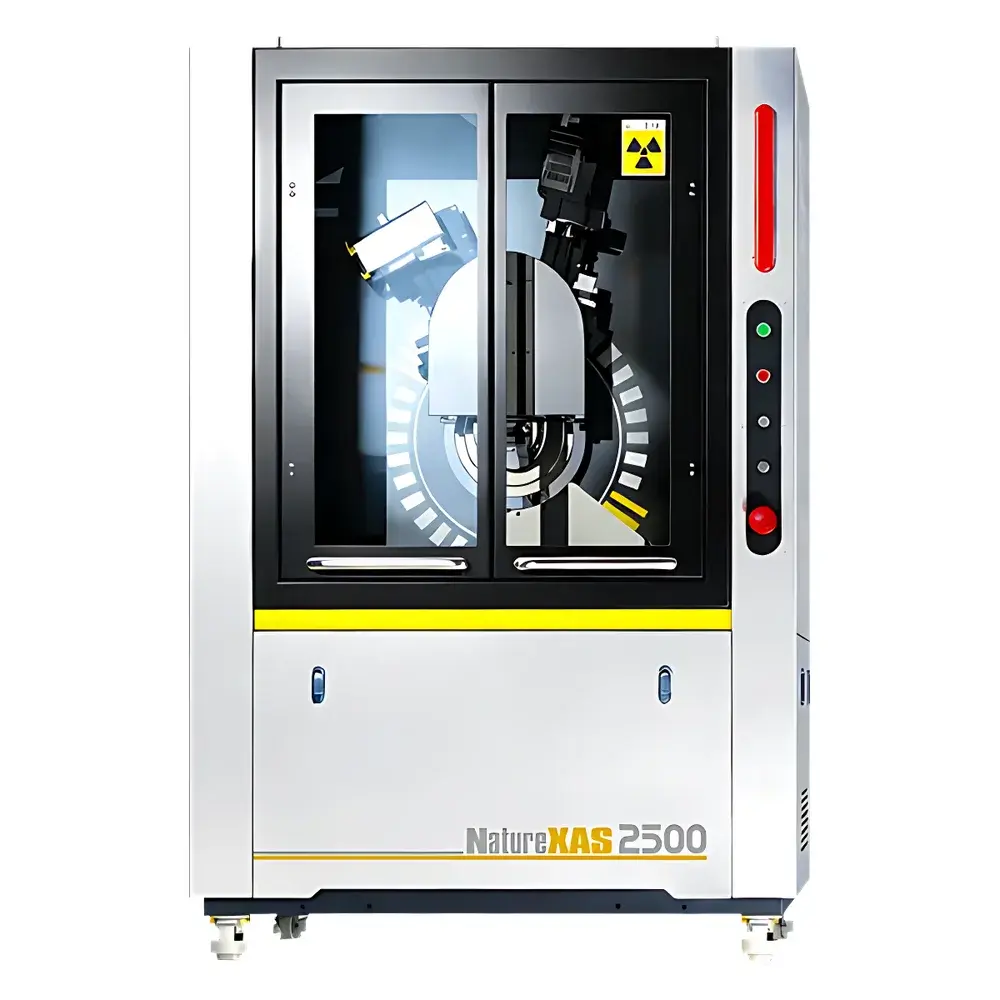
NatureXAS 2500 X-ray Absorption Fine Structure Spectrometer
| Brand | LANScientific |
|---|---|
| Origin | Jiangsu, China |
| Manufacturer Type | Original Equipment Manufacturer (OEM) |
| Product Category | Domestic Laboratory-scale XAFS Instrument |
| Model | NatureXAS 2500 |
| Pricing | Available Upon Request |
Overview
The NatureXAS 2500 is a laboratory-scale, benchtop X-ray Absorption Fine Structure (XAFS) spectrometer engineered for high-fidelity elemental speciation and local structural analysis without reliance on synchrotron radiation. It employs a Rowland-circle optical geometry with large-aperture bent crystal optics and a proprietary high-stability monochromator—enabling full XANES and EXAFS data acquisition under standard laboratory conditions. Unlike conventional XAFS systems requiring beamline access, the NatureXAS 2500 integrates a microfocus X-ray source, precision multi-axis sample stage, and energy-resolved detection into a single, compact enclosure. Its core measurement principle is based on scanning monochromatic X-ray energy across an absorption edge (K- or L-edge) while recording transmission or fluorescence yield, thereby extracting quantitative information on oxidation state, coordination number, bond distance, and local disorder (Debye–Waller factor) via Fourier-transform analysis of the extended fine structure.
Key Features
- Triple-mode operation: Simultaneous support for X-ray Absorption Spectroscopy (XAS), X-ray Emission Spectroscopy (XES), and X-ray Diffraction (XRD) — switchable via software in under 30 seconds without realignment.
- Rowland-circle monochromator with dynamically self-correcting dual-feedback servo system: Patented “adaptive Rowland-circle secondary optical servo” eliminates manual crystal alignment; optical encoders and closed-loop motor control maintain sub-arcsecond angular stability during crystal exchange or long-duration scans.
- Helium-purged quick-release optical enclosure: Tool-free removal and reinstallation preserve optical alignment to <0.5 µrad; enables rapid transition between ambient, inert, or reducing atmospheres without recalibration.
- Integrated high-brightness microfocus X-ray source (≤50 µm spot size) with optimized anode materials (e.g., Rh, Mo, W) for K-edge coverage from P (1.8 keV) to Ce (40.4 keV).
- Real-time instrument status dashboard: Unified GUI displays photon flux, monochromator angle, sample temperature/pressure (when equipped), detector count rate, and spectral signal-to-noise ratio—enabling immediate quality assessment prior to data export.
- Native support for in situ and operando configurations: Standardized vacuum, electrical, and fluidic interfaces accommodate electrochemical cells, gas/liquid flow reactors, cryostats (4–500 K), and heating stages (up to 1200 °C in controlled atmosphere).
Sample Compatibility & Compliance
The NatureXAS 2500 accommodates solid powders, thin films, foils, frozen solutions, and encapsulated liquid samples in custom holders (including Kapton- and Si3N4-membrane cells). It complies with IEC 61000-6-3 (EMC emissions) and IEC 61000-6-2 (immunity), and meets Class 1 laser safety requirements per IEC 60825-1 for its internal alignment lasers. All firmware and acquisition software adhere to GLP-compliant audit trail architecture per FDA 21 CFR Part 11, including electronic signatures, version-controlled method files, and immutable raw data logging. Data formats conform to Demeter-compatible ASCII (.dat) and HDF5 standards for seamless integration with Athena/Artemis, LARCH, or custom Python-based analysis pipelines.
Software & Data Management
The proprietary XASControl Suite provides end-to-end workflow management—from automated energy calibration (using reference foils: e.g., Cu, Fe, Ni) and harmonic rejection optimization to real-time background subtraction and μ(E) normalization. Batch processing supports time-resolved series (e.g., 100+ sequential scans at fixed energy or step-scan mode), with built-in noise filtering (Savitzky–Golay, wavelet denoising) and automatic edge-step detection. Raw spectra are stored with embedded metadata (sample ID, environment parameters, monochromator settings, detector gain) in timestamped, checksum-verified archives. Export options include standardized .chi (χ(k)), .fft (R-space), and .prj (project file) formats compatible with third-party modeling tools. Remote monitoring and queue-based scheduling are supported via secure SSH or TLS-enabled API endpoints.
Applications
- Catalysis: In situ tracking of Pt–O/N coordination number and Pt oxidation state evolution during CO oxidation; identification of transient Niδ+ species in NiFe oxyhydroxide oxygen evolution catalysts.
- Battery Materials: Operando monitoring of Mn K-edge shift and coordination loss in layered NMC cathodes during deep discharge; quantification of Zn–S bond length contraction in ZnS conversion anodes.
- Nanomaterials: Discrimination of surface vs. bulk Co oxidation states in Co3O4 nanoparticles; determination of dopant site preference (substitutional vs. interstitial) in Ti-doped hematite photoanodes.
- Geochemistry: Speciation of As(III)/As(V) and Fe redox couples in sulfidic sediments; quantification of Cr coordination symmetry changes during chromate reduction by green rust.
- Biological Systems: Fe K-edge XANES analysis of heme versus non-heme iron sites in nitrogenase; detection of Cu–S bond elongation in plastocyanin under photoreduction.
- Environmental Science: Direct identification of Pb–O vs. Pb–S coordination in contaminated soils; differentiation of Cr(VI) adsorption mechanisms on γ-Al2O3 vs. ferrihydrite surfaces.
FAQ
Does the NatureXAS 2500 require synchrotron beamtime?
No. It is a self-contained laboratory instrument utilizing a high-brightness microfocus X-ray source and advanced bent-crystal monochromation to deliver synchrotron-comparable XANES resolution (ΔE/E ≈ 1×10⁻⁴) and EXAFS k-range up to 14 Å−1.
Can it perform time-resolved measurements?
Yes. With optimized detector gating and fast monochromator stepping, it achieves sub-second temporal resolution for pump-probe experiments and operando kinetic series (e.g., 50-ms dwell per point over 500 points).
Is XRD data collection quantitatively comparable to dedicated diffractometers?
While optimized for complementary local-structure analysis, its XRD mode delivers phase identification and lattice parameter accuracy within ±0.005 Å for crystalline standards (e.g., Si, LaB6), sufficient for correlating long-range order with XAS-derived short-range metrics.
What maintenance is required for the monochromator?
Zero routine optical alignment. The dual-feedback servo system continuously monitors and corrects crystal position; only annual vacuum pump oil change and detector gain verification are recommended.
Is remote operation supported?
Yes. Full instrument control, live data preview, and method queuing are accessible via encrypted web interface or VNC, with role-based access control and session logging for multi-user labs.




