
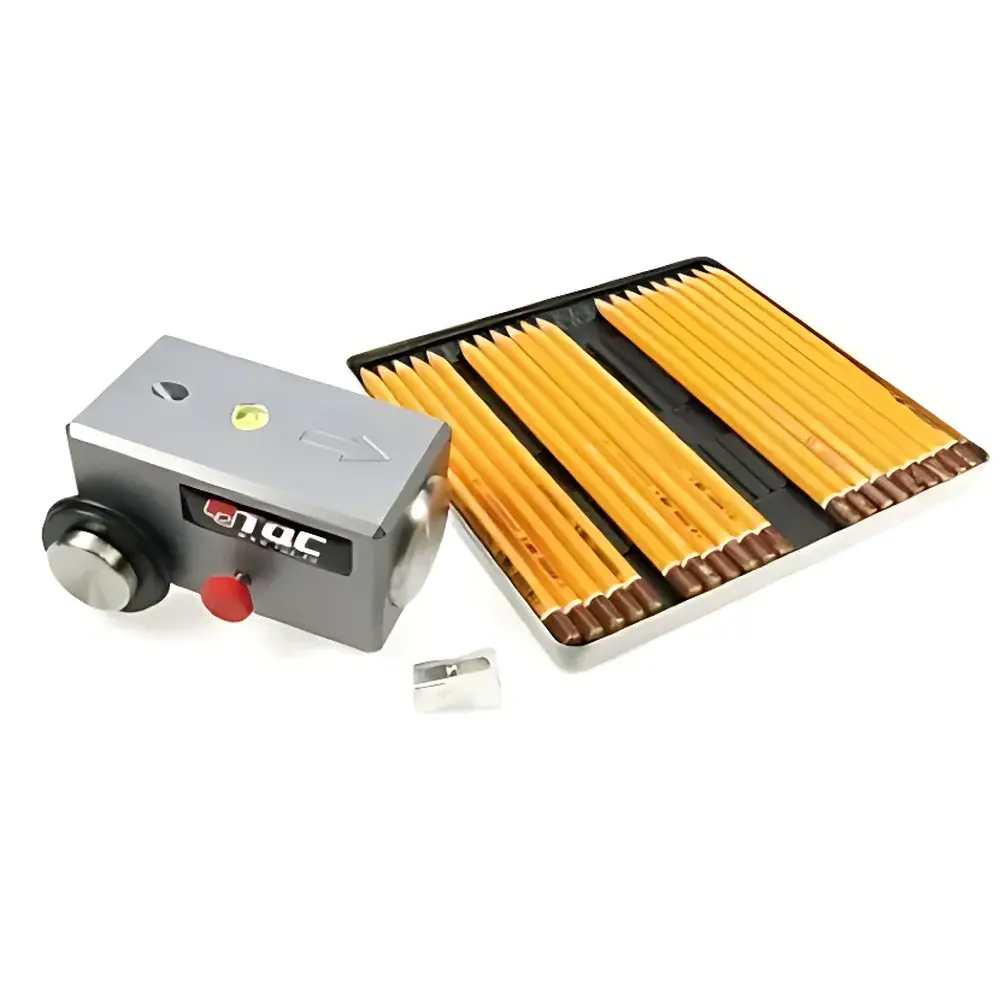
TQC VF1003 Wolstenholme–Wilborn Pencil Hardness Tester
| Brand | TQC |
|---|---|
| Origin | Netherlands |
| Model | VF1003 |
| Compliance | ISO 15184, ASTM D3363, JIS K-5600, JIS K-5400, ECCA-T4-1, BS 3900-E19, SNV 37113, SIS 184187, NEN 5350, MIL-C-27227 |
| Standard Accessories | 20× Koh-i-noor pencils (3B–8H), precision pencil sharpener, aluminum pencil case |
| Load Options | 750 g, 1000 g (VF2377) |
Overview
The TQC VF1003 Wolstenholme–Wilborn Pencil Hardness Tester is a precision mechanical instrument engineered for standardized assessment of coating surface resistance to scratching and gouging under controlled loading conditions. Based on the Wolstenholme–Wilborn method—a widely accepted empirical technique in coatings quality control—the device applies a defined normal force via a calibrated weight onto a standardized graphite pencil held at a fixed 45° angle relative to the test substrate. The hardness rating is determined by identifying the hardest pencil grade that produces visible scratch damage (e.g., film removal, cracking, or permanent deformation) after a single, unidirectional stroke across the cured coating surface. This method provides a rapid, non-destructive (for non-failing grades), and repeatable comparative index for evaluating cross-link density, binder formulation integrity, and curing efficiency in industrial and R&D environments.
Key Features
- Robust anodized aluminum frame with precisely machined guide rails ensuring consistent 45° pencil orientation and linear motion path
- Interchangeable weight modules enabling compliance with multiple international test standards (500 g, 750 g, and 1000 g loading options)
- Included set of 20 certified Koh-i-noor graphite pencils covering the full hardness spectrum from 3B to 8H (per ISO 15184 Annex A)
- Dedicated precision pencil sharpener (VF1003) designed to maintain uniform 2.0 mm exposed lead length and conical tip geometry per ASTM D3363 Section 6.2
- Aluminum storage case with labeled compartments for organized pencil inventory and traceability
- No electrical components or software dependencies—designed for long-term stability, field portability, and minimal maintenance
- Calibration-ready design; optional VF2378 variant supplied with UKAS-traceable calibration certificate valid for 12 months
Sample Compatibility & Compliance
The VF1003 is validated for use on flat, rigid substrates including metal panels (steel, aluminum), glass, plastic sheets (e.g., polycarbonate, PET), and ceramic tiles—provided surface roughness (Ra) does not exceed 1.0 µm and coating thickness remains within 20–120 µm per ISO 15184 Clause 5. It is not suitable for flexible films, textured surfaces, or thermally unstable coatings prone to cold flow under static load. The instrument fully complies with ISO 15184:2020 “Paints and varnishes — Determination of film hardness by pencil test”, ASTM D3363-22 “Standard Test Method for Film Hardness by Pencil Test”, JIS K-5600-5-4:2019, JIS K-5400-5-4:1990, BS 3900-E19:2015, and additional regional specifications including ECCA-T4-1 (European Coil Coating Association), SNV 37113 (Swiss), SIS 184187 (Swedish), NEN 5350 (Dutch), and MIL-C-27227 (U.S. Department of Defense). For thin-film applications in display manufacturing (e.g., ITO, AR, and anti-fingerprint layers), the 500 g configuration (VF2379) is routinely adopted as a de facto extension of ISO 15184 under internal quality protocols.
Software & Data Management
The TQC VF1003 operates as a standalone mechanical tester with no embedded electronics or digital interface. Consequently, data recording follows manual GLP-compliant documentation practices: operators log pencil grade, applied load, substrate ID, environmental conditions (temperature, RH per ISO 3270), and pass/fail observations in bound laboratory notebooks or LIMS-integrated electronic forms. While no proprietary software is required, results are fully compatible with standard QA/QC reporting frameworks supporting FDA 21 CFR Part 11 audit trails when entered into validated electronic systems. Calibration records—including date, technician ID, reference standard used (e.g., certified deadweights traceable to NIST or NMi), and deviation tolerances (< ±0.5% of nominal load)—must be retained for regulatory audits per ISO/IEC 17025 and GMP Annex 11 requirements.
Applications
- Quality assurance of architectural, automotive, and coil coatings during production line release testing
- R&D screening of new resin systems, catalysts, and UV-curable formulations
- Supplier qualification for OEM paint and ink suppliers (e.g., Tier-1 automotive suppliers)
- Failure analysis of adhesion-related defects such as mud-cracking or edge lifting
- Process validation of curing oven parameters (time, temperature, UV dose) through hardness trend monitoring
- Thin-film hardness benchmarking in optical and semiconductor packaging applications where 500 g loading mitigates substrate deformation artifacts
FAQ
What pencil grades are included with the standard VF1003 configuration?
The standard kit includes 20 Koh-i-noor pencils spanning 3B to 8H, aligned with ISO 15184 Annex A and ASTM D3363 Table 1.
Can the VF1003 be used for testing soft elastomeric coatings?
No—elastomers and low-modulus polymers exhibit viscoelastic recovery and indentation creep, violating the fundamental assumption of instantaneous, elastic-plastic failure required by the Wolstenholme–Wilborn method.
Is recalibration required before each test series?
Weight calibration is performed annually or after physical impact; however, daily verification using the included reference weights and visual alignment check of the guide rail is recommended per ISO/IEC 17025 Clause 6.5.
Why does the 500 g configuration (VF2379) lack formal standardization?
While ISO 15184 specifies 750 g as the default load, the 500 g variant emerged empirically in LCD and touch-panel manufacturing to reduce substrate flexure and improve resolution for ultra-thin (< 5 µm) functional layers.
How should pencils be stored to maintain consistency?
Store in the supplied aluminum case at 23 ± 2 °C and 50 ± 5 % RH; avoid exposure to direct sunlight or solvents, which may alter graphite-clay binding matrix integrity.





