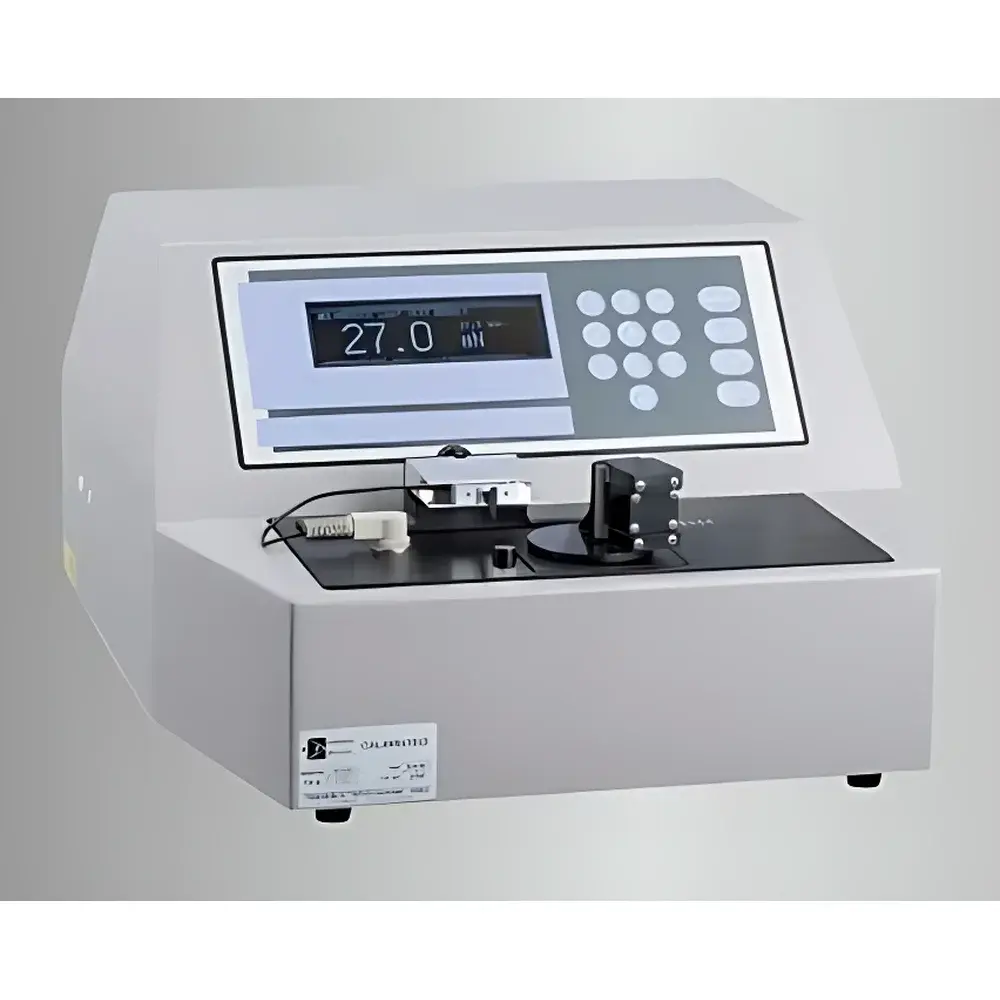
Buchel BV 79-25 Advanced Bending Stiffness Tester
| Brand | Buchel BV |
|---|---|
| Origin | Netherlands |
| Model | 79-25 |
| Testing Units | mN, N·mm, Taber |
| Force Range | 0–1000 mN or 0–10 N |
| Minimum Resolution | 0.5 mN (at 1000 mN scale) |
| Accuracy | ±1% of full scale |
| Angular Precision | ±0.1° |
| Bending Speed | 5°/s |
| Adjustable Bend Lengths | 5, 10, 15, 20, 25, and 50 mm |
| Power Supply | 120 V / 60 Hz or 220 V / 50 Hz |
| Compliance Standards | ISO 2493, AS/NZS 1301.453:2016, BS 3748, DIN 53121, SCAN P29:2017, TAPPI T556, GB/T 23144 |
Overview
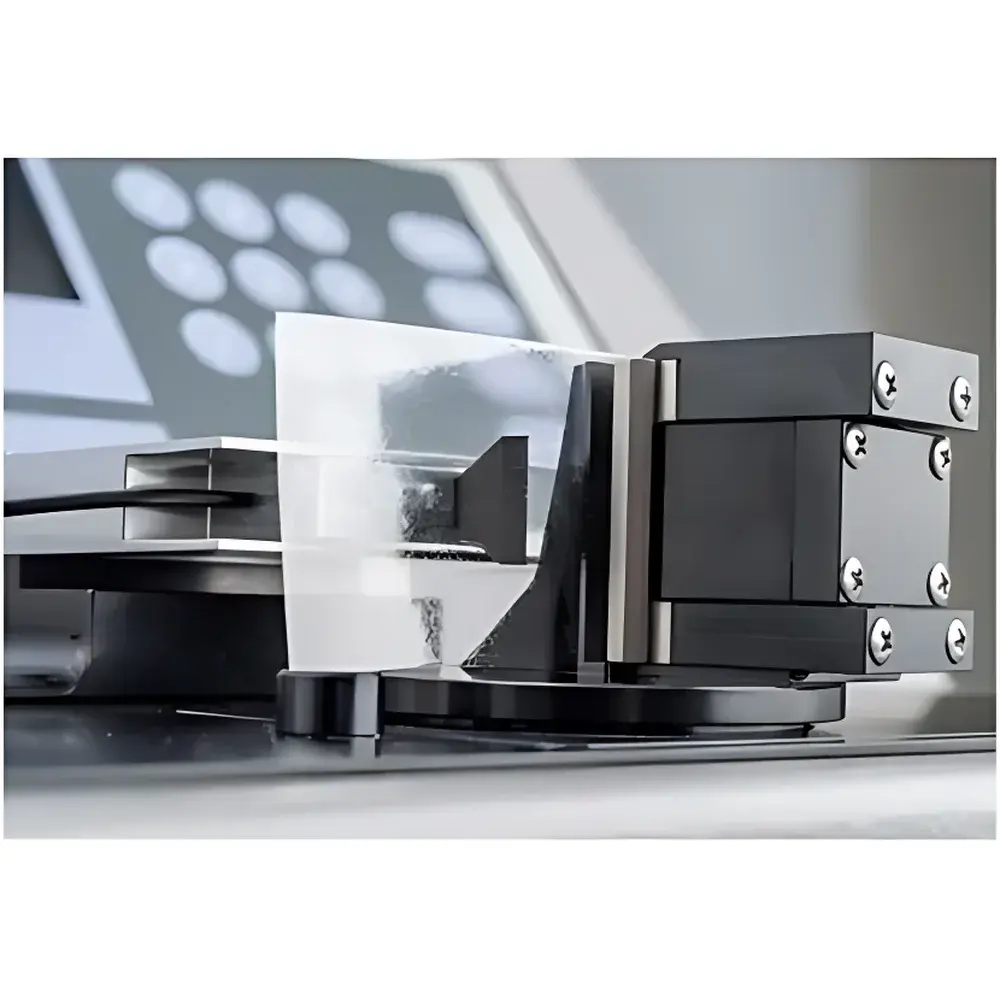
The Buchel BV 79-25 Advanced Bending Stiffness Tester is a microprocessor-controlled instrument engineered for precise quantification of bending resistance in flexible sheet and filamentary materials. It operates on the principle of controlled angular deflection under defined moment loading—measuring the force required to bend a specimen through a fixed angle over a specified support span. This mechanical response directly correlates with flexural rigidity, a material property derived from both elastic modulus and geometric second moment of area. Unlike torsional or tensile stiffness measurements, bending stiffness reflects real-world handling behavior in packaging, medical device assembly, and personal care product dispensing—where resistance to buckling, creasing, or kinking governs functional performance. The 79-25 delivers repeatable, traceable results across diverse substrates without requiring sample conditioning beyond standard laboratory ambient conditions (23 °C ± 1 °C, 50% RH ± 5%), making it suitable for routine QC as well as R&D validation.
Key Features
- Microprocessor-driven closed-loop control ensures consistent bending speed (5°/s) and angular positioning accuracy (±0.1°), minimizing operator-induced variability.
- Interchangeable bending length fixtures (5, 10, 15, 20, 25, and 50 mm) enable method-specific compliance with ISO 2493 (15 mm span for paperboard), TAPPI T556 (10 mm for thin films), and SCAN P29 (25 mm for coated papers).
- Dual-range force transducer (0–1000 mN / 0–10 N) with 0.5 mN resolution at the low end supports high-sensitivity testing of ultra-thin films (<12 µm) and robust evaluation of corrugated board panels.
- Integrated digital display with real-time force-angle curve visualization allows immediate verification of linear elastic response prior to data export.
- Robust stainless-steel frame and precision-ground bearing surfaces ensure long-term dimensional stability and repeatability across >50,000 test cycles.
- Universal power input (120 V / 60 Hz or 220 V / 50 Hz) with internal voltage regulation eliminates need for external transformers in global lab environments.
Sample Compatibility & Compliance
The 79-25 accommodates specimens up to 100 mm wide and 300 mm long, supporting standardized strip geometries per ISO 2493 (15 × 100 mm), TAPPI T556 (10 × 100 mm), and ASTM D2923 (for plastic films). Validated applications include solid bleached sulfate (SBS) board, metallized PET laminates, extruded polyolefin tubing, spunbond polypropylene nonwovens, and nitinol-based guidewires. All measurement protocols align with internationally recognized standards: ISO 2493:2010 (paper and board), AS/NZS 1301.453:2016 (Australian/New Zealand paper testing), BS 3748:1990 (UK specification for bending resistance), DIN 53121:1982 (German standard for plastics film stiffness), SCAN P29:2017 (Scandinavian pulp and paper method), TAPPI T556 om-22 (US industry benchmark), and GB/T 23144–2008 (Chinese national standard for packaging materials). Instrument calibration certificates are traceable to NIST and EU-accredited metrology institutes.
Software & Data Management
While the 79-25 operates as a standalone benchtop unit with local display and manual data recording, optional RS-232 or USB interface enables direct integration with LIMS or ELN platforms. Exported datasets include timestamped force (mN), bending angle (°), calculated bending moment (N·mm), and user-defined test ID—formatted as CSV for compatibility with statistical process control (SPC) software such as Minitab or JMP. Audit trail functionality (when connected to validated PC systems) satisfies FDA 21 CFR Part 11 requirements for electronic records, including operator login, parameter change logs, and result immutability flags. Raw data files retain full-resolution sensor readings at 100 Hz sampling rate, permitting post-test reanalysis of elastic region slope or yield onset detection.
Applications
- Packaging development: Quantifying fold endurance of folding cartons, evaluating crease recovery in corrugated liners, and benchmarking lid stiffness in thermoformed trays.
- Medical device manufacturing: Verifying kink resistance of PTFE-coated catheter shafts and torque transmission consistency in braided polymer guidewires.
- Personal care: Measuring dispensing force of laminated pouches for viscous gels and validating cap hinge rigidity in flip-top bottles.
- Flexible electronics: Characterizing substrate bending hysteresis in printed circuit foils and assessing interlayer delamination thresholds in multilayer OLED encapsulation films.
- Nonwoven hygiene products: Correlating basis weight uniformity with longitudinal stiffness in diaper leg cuffs and evaluating elastic recovery after cyclic bending in panty-liner backing layers.
FAQ
What standards does the 79-25 support out-of-the-box?
The instrument is pre-configured for ISO 2493, TAPPI T556, SCAN P29, and DIN 53121; custom span and speed settings allow adaptation to AS/NZS 1301.453 and GB/T 23144.
Can the 79-25 test wet-strength papers or humidity-conditioned samples?
Yes—provided specimens are mounted within environmental enclosures (e.g., humidity-controlled glove boxes); the base unit itself is not rated for high-humidity operation but interfaces with external climate chambers via analog trigger signals.
Is third-party calibration available with NIST-traceable documentation?
Buchel BV authorizes certified service partners in North America, EMEA, and APAC to perform annual calibration with full uncertainty budgets compliant with ISO/IEC 17025.
How is bending length selected during setup?
Mechanical spacers are inserted into the anvil assembly; each spacer corresponds to one of six discrete spans (5–50 mm) and locks via precision dowel pins to eliminate alignment drift.
Does the system support GLP-compliant reporting?
When paired with validated PC software (e.g., Buchel LabSuite v3.2), the 79-25 generates 21 CFR Part 11–compliant reports including electronic signatures, revision history, and raw data archiving metadata.