
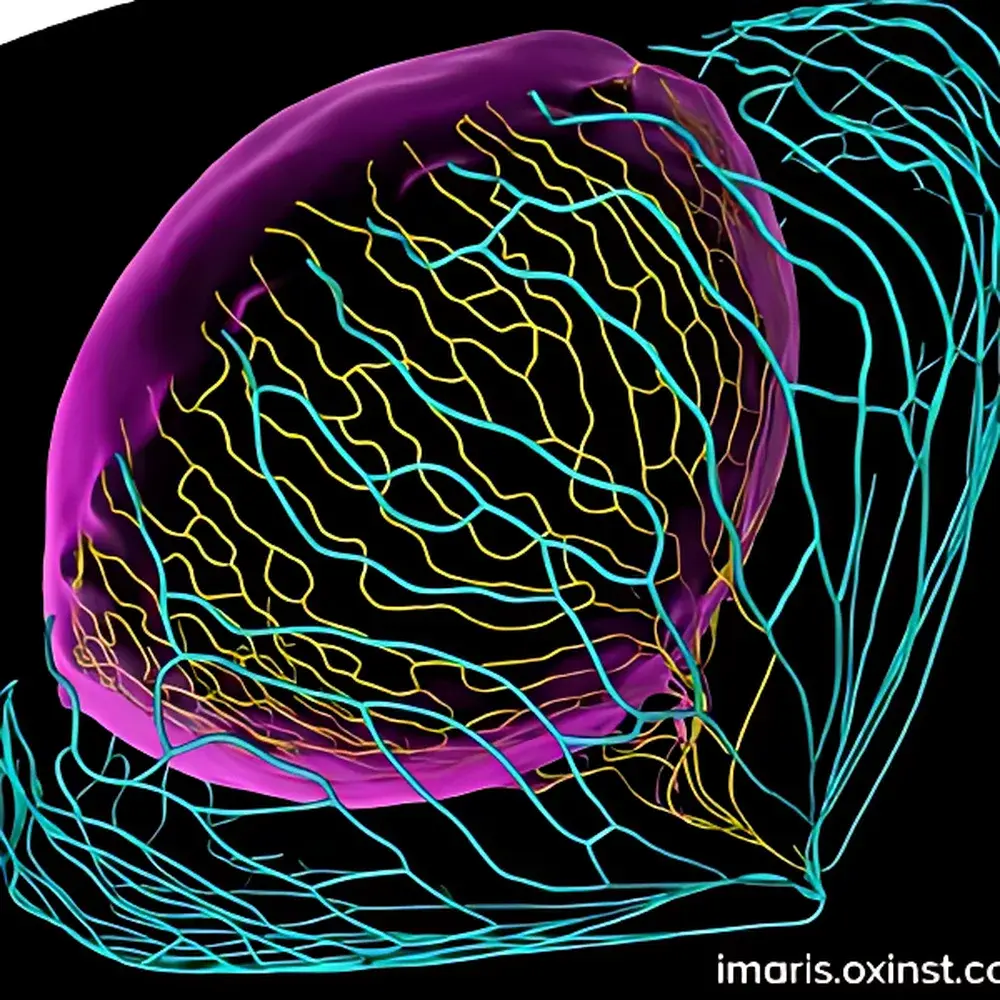
Imaris Multidimensional Image Analysis Software by Oxford Instruments
| Brand | Oxford Instruments |
|---|---|
| Origin | United Kingdom |
| Manufacturer Type | Authorized Distributor |
| Origin Category | Imported |
| Model | Imaris |
| Price | Contact for Quote |
Overview
Imaris is a high-performance, multidimensional scientific image analysis platform developed by Oxford Instruments and widely adopted in advanced light microscopy laboratories worldwide. Engineered for precision and scalability, Imaris enables quantitative visualization, segmentation, tracking, and statistical analysis of 3D and 4D (x, y, z, t) fluorescence microscopy datasets—including confocal, light-sheet, STED, SIM, and widefield acquisitions. Its architecture is built upon a robust computational engine optimized for large-volume image processing, supporting native handling of multi-terabyte datasets without reliance on downsampling or lossy compression. Unlike generic visualization tools, Imaris implements biophysically informed algorithms for object detection (e.g., surface-based cell segmentation), particle tracking with sub-pixel localization accuracy, and time-resolved morphometric quantification—making it essential for rigorous hypothesis testing in cell biology, neuroscience, developmental biology, and immuno-oncology.
Key Features
- Native 4D Visualization & Rendering: GPU-accelerated volume rendering with real-time interactive rotation, slicing, and transparency control across x, y, z, and time dimensions.
- Automated Object Detection & Segmentation: Surface, spot, filament, and cell modules employ adaptive thresholding, watershed refinement, and machine learning–assisted classification to distinguish overlapping structures in dense tissue volumes.
- Quantitative Tracking & Kinetics Analysis: Supports multi-object trajectory reconstruction with gap-filling, drift correction, and export of velocity, displacement, confinement ratio, and mean squared displacement (MSD) metrics.
- Imaris Stitcher Module: A standalone application for precise tile alignment and fusion of large-area mosaic acquisitions; corrects for stage positioning errors, lens distortion, and chromatic shift using cross-correlation and affine/non-rigid registration algorithms.
- Imaris Viewer: A free, redistributable runtime client enabling full-featured 3D/4D navigation, measurement, and annotation of Imaris-generated files (.ims) without requiring a licensed seat—ideal for collaboration, manuscript review, and conference presentations.
- Batch Processing Framework: Scriptable workflow automation via Python API (ImarisLib) and macro recorder, compatible with pipeline integration into KNIME, Fiji/ImageJ, and MATLAB environments.
Sample Compatibility & Compliance
Imaris natively supports over 100 microscope vendor formats—including Zeiss CZI, Nikon ND2, Olympus OIR, Leica LIF, and TIFF stacks with metadata preservation (e.g., voxel size, channel emission spectra, acquisition timestamps). All analyses retain original bit-depth and spatial calibration, ensuring traceability for GLP/GMP-regulated workflows. The software complies with ISO/IEC 17025 requirements for analytical instrument validation, and its audit trail functionality (via optional Imaris Server) meets FDA 21 CFR Part 11 criteria for electronic records and signatures when deployed in regulated life science R&D settings.
Software & Data Management
Imaris operates as a desktop application for Windows and macOS (Intel and Apple Silicon), with optional centralized deployment via Imaris Server for multi-user license management, project sharing, and version-controlled dataset archiving. All processed results—including surfaces, spots, tracks, and statistical summaries—are stored within the proprietary .ims container format, which embeds raw image data, metadata, analysis parameters, and user annotations in a single file. Export options include publication-ready TIFF/PNG sequences, CSV/Excel tables for statistical analysis, and interactive HTML reports with embedded 3D viewers. Integration with institutional LIMS and ELN systems is supported through RESTful API endpoints and standardized metadata exchange (OME-XML).
Applications
- Subcellular organelle dynamics and co-localization quantification in live-cell imaging
- Neuronal arborization mapping, synapse density profiling, and axonal transport kinetics in brain tissue volumes
- 3D tumor spheroid growth modeling and drug penetration depth analysis
- Mitotic spindle geometry, chromosome segregation fidelity, and cytokinetic ring assembly kinetics
- Whole-organism light-sheet imaging of zebrafish or Drosophila embryos across developmental time courses
- High-content screening (HCS) data mining from automated microscopy platforms
FAQ
Is Imaris compatible with my microscope’s native file format?
Yes—Imaris supports direct import of raw data from major vendors including Zeiss, Nikon, Olympus, Leica, and Andor, preserving all acquisition metadata and calibration information.
Can Imaris handle terabyte-scale datasets without downsampling?
Yes—its memory-mapped I/O architecture and out-of-core processing enable seamless navigation and analysis of multi-TB 3D/4D volumes while maintaining full resolution and quantitative integrity.
Does Imaris support reproducible, auditable analysis workflows?
Yes—every analysis step is logged with timestamp, user ID, parameter values, and input/output references. Optional Imaris Server adds role-based access control and electronic signature capability for regulatory compliance.
What scripting interfaces are available for automation?
Imaris provides a documented Python API (ImarisLib), macro recording functionality, and command-line batch execution—enabling integration into CI/CD pipelines and high-throughput analysis frameworks.
Is Imaris Viewer sufficient for presenting results at conferences?
Yes—Imaris Viewer delivers identical rendering quality and interactivity as the full version, supports annotation, measurement, and movie export, and requires no license or installation overhead.



