
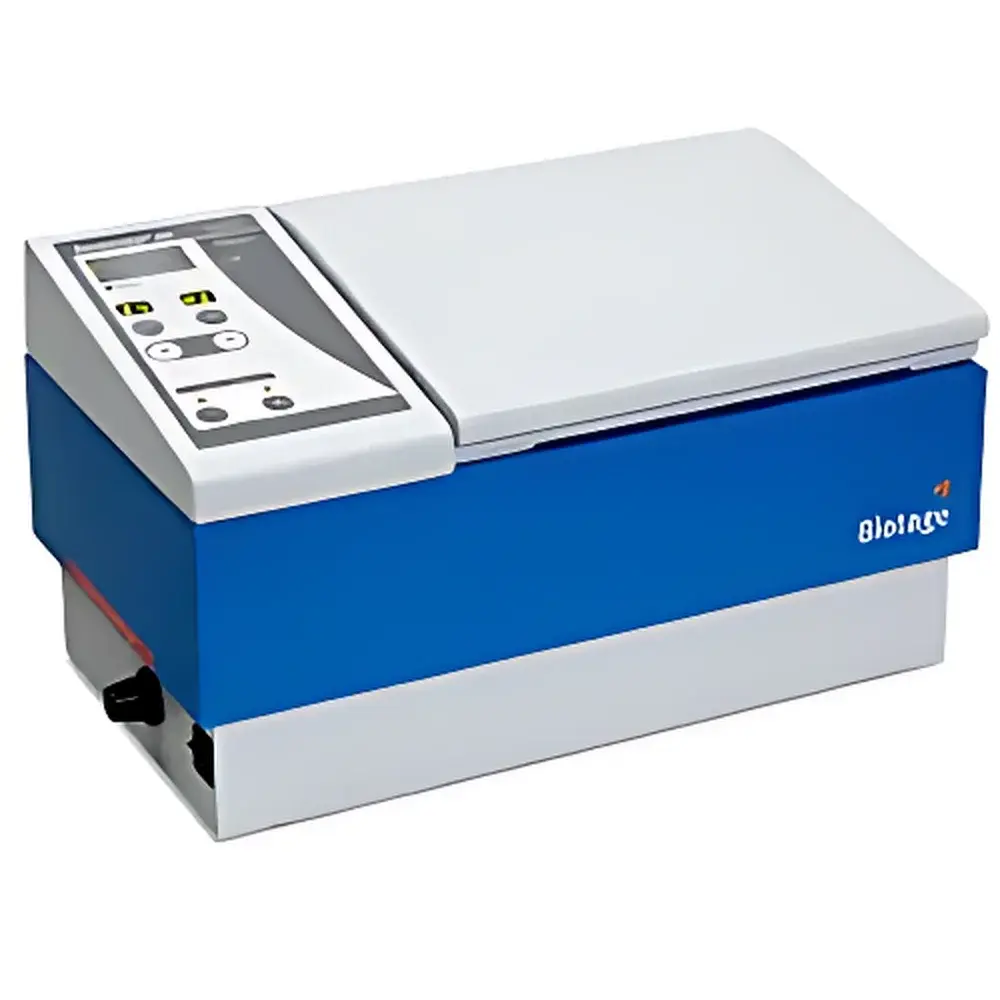
Biotage TurboVap 96 Automated Nitrogen Evaporator
| Brand | Biotage |
|---|---|
| Origin | USA |
| Model | TURBOVAP 96 |
| Power Supply | 220–240 V, 50/60 Hz, 5 A |
| Dimensions | 61 × 30.5 × 30.5 cm (24" × 12" × 12") |
| Capacity | Dual 96-well plate configuration (standard microplates or deep-well plates) |
| Air Flow Range | 0–90 SCFH |
| Minimum Inlet Pressure | 70 PSI |
| Air Consumption | 25 CFM |
| Operating Temperature Range | Ambient to 80 °C |
| Compliance | Compatible with TFA, DMSO, and DMF solvents |
| Safety | Integrated airflow, pressure, and timer fault detection with automatic shutdown and audible/visual alarm |
| Ventilation | Benchtop operation without fume hood required |
Overview
The Biotage TurboVap 96 Automated Nitrogen Evaporator is an engineered solution for high-throughput, reproducible solvent removal from biological, pharmaceutical, and environmental samples in 96-well microplate or deep-well plate formats. Designed around the principle of controlled nitrogen gas displacement—where a precisely directed, rotating laminar gas stream accelerates surface evaporation while minimizing sample cross-contamination and thermal degradation—the system delivers consistent concentration performance across all wells. Unlike passive heating or unregulated gas blowdown methods, the TurboVap 96 employs patented vortex airflow technology to generate uniform turbulence at the liquid meniscus, significantly enhancing mass transfer coefficients without requiring elevated temperatures. This enables efficient removal of volatile and semi-volatile solvents—including trifluoroacetic acid (TFA), dimethyl sulfoxide (DMSO), and N,N-dimethylformamide (DMF)—under conditions compatible with thermolabile analytes such as peptides, metabolites, and nucleotides. Its benchtop footprint and integrated safety architecture eliminate dependence on fume hoods, supporting flexible deployment in regulated QC laboratories, core analytical facilities, and GLP-compliant research environments.
Key Features
- Patented vortex airflow delivery system ensures uniform solvent evaporation across all 96 wells with minimal well-to-well variability.
- Dual-plate capacity supports parallel processing of two standard 96-well microplates or deep-well plates—doubling throughput without compromising control fidelity.
- Independent regulation of three critical parameters: nitrogen flow rate (0–90 SCFH), block temperature (ambient to 80 °C), and run duration—each programmable via intuitive front-panel interface.
- One-touch start functionality with preconfigured method recall simplifies routine operation and reduces operator-dependent variability.
- Real-time monitoring and fail-safe interlocks detect deviations in inlet pressure, airflow continuity, or elapsed time; triggering immediate shutdown and dual-mode (audible + visual) alarm notification.
- Robust aluminum heating block with precision PID temperature control maintains ±0.5 °C stability across the full operating range.
- No fume hood required: engineered for safe, low-emission operation under standard laboratory ventilation conditions.
Sample Compatibility & Compliance
The TurboVap 96 is validated for use with a broad spectrum of organic solvents commonly employed in solid-phase extraction (SPE), liquid-liquid extraction (LLE), and preparative HPLC workflows. Its compatibility with TFA, DMSO, and DMF—solvents known for high boiling points and low volatility—reflects optimized thermal management and gas dynamics that prevent bumping, foaming, or analyte oxidation. The system meets mechanical and electrical safety requirements per IEC 61010-1 and complies with electromagnetic compatibility standards (IEC 61326-1). While not a data-integrity instrument per se, its operational consistency supports adherence to FDA 21 CFR Part 11 when paired with validated LIMS or ELN systems, particularly in method transfer and stability-indicating assay development under ICH Q5C and USP guidelines.
Software & Data Management
The TurboVap 96 operates via embedded firmware with no external PC dependency. All method parameters—including temperature setpoint, gas flow ramp profiles, hold times, and endpoint criteria—are stored locally in non-volatile memory with audit-trail-capable timestamping. Although it does not feature native network connectivity or electronic signature capability, its deterministic behavior and repeatable endpoint detection (time-based termination) facilitate integration into computerized system validation (CSV) protocols. Laboratories implementing 21 CFR Part 11 compliance may document method execution using external logbooks or electronic batch records synchronized with instrument run logs. Firmware updates are performed via USB interface and require formal change control documentation per GMP Annex 11 expectations.
Applications
- Routine concentration of SPE eluates prior to LC-MS/MS analysis in clinical toxicology and doping control labs.
- High-throughput sample prep for metabolomics and lipidomics workflows involving plasma, urine, and tissue homogenates.
- Final volume adjustment of oligonucleotide synthesis cleavage mixtures containing ammonia and methylamine.
- Preparative-scale solvent exchange in peptide purification workflows where residual DMSO must be reduced to <0.1% v/v.
- Environmental residue analysis requiring parallel processing of soil extracts across multiple pesticide classes.
- Stability study sample handling under ICH Q1A(R3) conditions where thermal stress minimization is critical.
FAQ
Does the TurboVap 96 support gradient temperature programming during a single run?
No. Temperature is held constant throughout the run; however, users may manually adjust setpoints between sequential runs.
Can the system accommodate 384-well plates?
No. It is mechanically and thermally optimized exclusively for 96-well format plates—both shallow and deep-well variants.
Is calibration traceable to NIST standards?
Temperature calibration is performed using a NIST-traceable RTD probe; users receive a certificate of conformance with each unit shipment.
What maintenance is required for long-term reliability?
Annual inspection of gas distribution manifolds and cleaning of air filters is recommended; no consumables beyond standard nitrogen supply lines are required.
How is method reproducibility verified across instruments?
Biotage provides standardized test protocols using caffeine-in-methanol solutions; inter-unit CVs for final volume recovery are typically ≤3.2% (n=6, 96-well replicates).



