
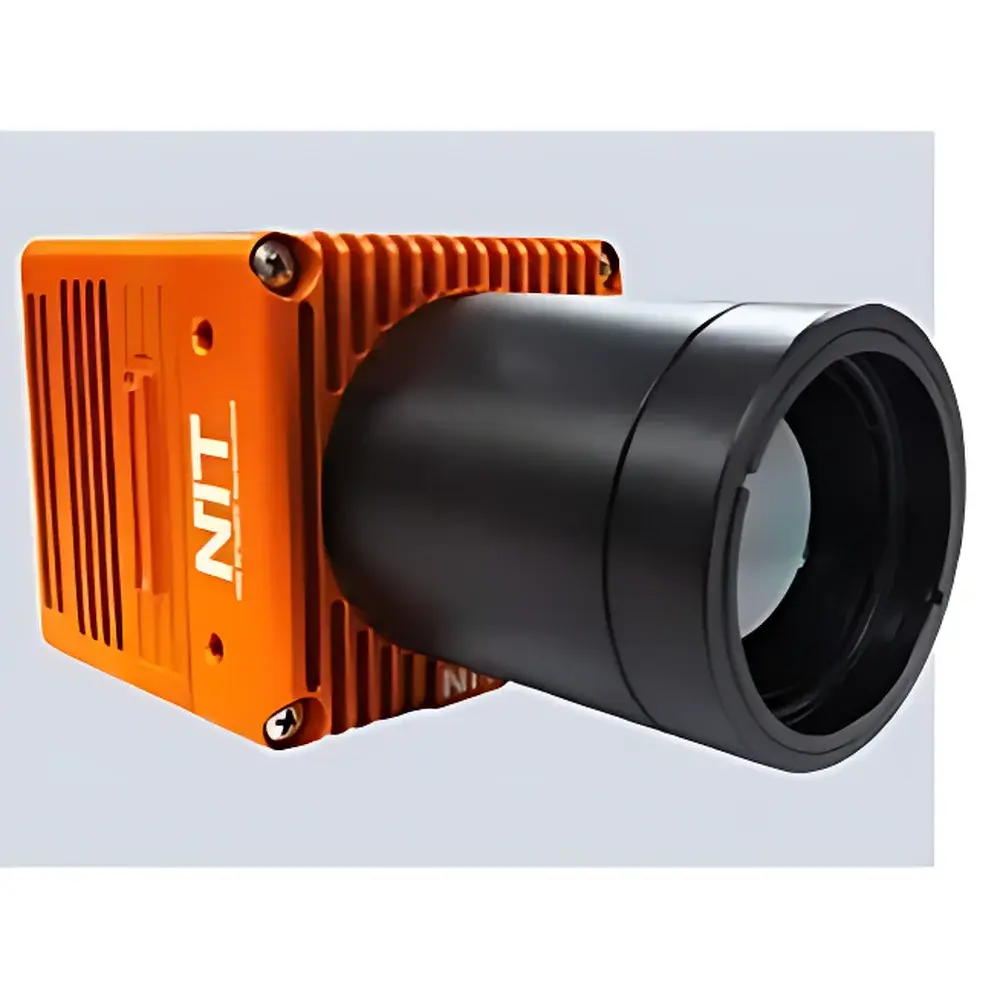
Auniontech NIT Aunion 16 High-Speed NWIR Camera (1.5–5.0 µm)
| Brand | Auniontech |
|---|---|
| Manufacturer | NIT (New Infrared Technologies) |
| Detector Type | Uncooled VPD/PbSe Focal Plane Array (FPA) with Digital Interface |
| Resolution | 128 × 128 pixels |
| Pixel Pitch | 50 µm × 50 µm |
| Spectral Range | 1.5–5.0 µm |
| Integration Time | Adjustable from 10 µs to 1000 µs |
| ADC Resolution | 14-bit |
| Frame Rate | Up to 2000 Hz |
| Cooling | Uncooled Operation |
| Compliance | RoHS-compliant design, CE-marked for industrial use |
Overview
The Auniontech NIT Aunion 16 High-Speed NWIR Camera is a compact, uncooled imaging system engineered for real-time detection and analysis in the near-to-mid-wave infrared (NWIR) spectral band spanning 1.5–5.0 µm. Leveraging lead selenide (PbSe) photoconductive focal plane array (FPA) technology with voltage-photodiode (VPD) readout architecture, this camera delivers high temporal resolution without cryogenic cooling—enabling robust deployment in field-portable, embedded, and industrial environments. Its core measurement principle relies on photon-induced conductivity changes in PbSe pixels, digitized via integrated 14-bit analog-to-digital conversion and transmitted over a high-throughput digital interface. Designed for applications demanding rapid thermal transients capture—such as laser-material interaction monitoring, combustion dynamics, or gas-phase emission spectroscopy—the Aunion 16 provides sub-millisecond integration control and deterministic frame timing synchronized to external triggers.
Key Features
- Uncooled PbSe-based FPA ensures low power consumption (<3 W typical), minimal thermal drift, and extended operational lifetime without vacuum or Stirling-cycle maintenance.
- Native 128 × 128 spatial resolution with uniform 50 µm pixel pitch, optimized for signal-to-noise ratio (SNR) in the 1.5–5.0 µm atmospheric transmission window.
- Programmable integration time (10–1000 µs) enables dynamic range adaptation across varying irradiance levels—from weak molecular emission lines to intense blackbody radiation.
- Real-time 2000 Hz full-frame output supports high-speed process monitoring, including melt pool dynamics in additive manufacturing and flame front propagation in combustion research.
- Ruggedized aluminum housing (IP52-rated) with standardized C-mount lens interface facilitates integration into OEM systems, UAV gimbals, and automated inspection platforms.
- Digital interface compliant with Camera Link Base or customizable LVDS protocols—ensuring deterministic latency and compatibility with industrial frame grabbers and real-time OS environments (e.g., NI LabVIEW RT, QNX, or Linux with kernel DMA support).
Sample Compatibility & Compliance
The Aunion 16 is compatible with standard reflective and transmissive optics designed for the 1.5–5.0 µm range, including ZnSe, Ge, and CaF2 lenses and beam splitters. It does not require spectral filtering for basic broadband imaging but supports optional narrowband interference filters (e.g., centered at 3.3 µm for CH4 detection or 4.2 µm for CO2) mounted externally or integrated into lens assemblies. The system meets CE marking requirements for electromagnetic compatibility (EN 61326-1) and safety (EN 61010-1). While not certified for medical or aviation-specific standards, its hardware architecture supports traceability documentation required under ISO 9001 quality management systems and aligns with general-purpose industrial imaging guidelines referenced in ASTM E1934 (Standard Guide for Examining Electrical Insulation by Infrared Imaging) and IEC 62906-5-2 (Laser display devices — Safety).
Software & Data Management
Auniontech provides a cross-platform SDK (C/C++, Python, MATLAB APIs) supporting direct memory-mapped acquisition, ROI selection, non-uniformity correction (NUC) calibration tables, and radiometric linearization lookup tables (LUTs). Raw 14-bit frames are streamed in lossless format; metadata—including timestamp (µs resolution), integration time, gain setting, and sensor temperature—is embedded in each frame header. The SDK includes tools for batch calibration file generation and supports third-party integration with HDF5-based data archives. For regulated environments, the acquisition software can be configured to generate audit trails compliant with FDA 21 CFR Part 11 requirements (electronic signatures, user access logs, immutable raw data storage) when deployed on validated Windows Server or Linux LTS platforms with appropriate IT governance controls.
Applications
- Industrial Process Monitoring: Real-time thermal profiling of glass annealing furnaces, ceramic sintering belts, and metal casting molds—leveraging emissivity-insensitive contrast in the 3–5 µm band.
- Additive Manufacturing: In-situ melt pool geometry tracking, spatter detection, and layer-wise defect identification during laser powder bed fusion (LPBF) and directed energy deposition (DED).
- Gas Detection & Emission Imaging: Passive imaging of hydrocarbon leaks (CH4, C2H6) and CO2 plumes using spectral contrast enhancement techniques; compatible with optical gas imaging (OGI) workflows per EPA OOOOa and ISO 17284-2.
- Machine Vision: High-speed sorting of polymer types based on characteristic absorption features in the 1.7–2.5 µm region; used in recycling line automation and pharmaceutical blister-pack inspection.
- Defense & Security: Covert surveillance under ambient thermal background conditions; integration into gimbal-mounted payloads for UAV-based persistent observation.
FAQ
Is the Aunion 16 suitable for quantitative radiometry?
Yes—when calibrated with a NIST-traceable blackbody source and paired with appropriate optics transmission data, the camera supports relative radiometric accuracy within ±5% across its dynamic range. Absolute calibration requires site-specific characterization.
What lens options are supported?
C-mount lenses with anti-reflection coatings optimized for 1.5–5.0 µm (e.g., Thorlabs AC254 series with Ge elements, Edmund Optics NIR achromats). Custom telecentric and wide-angle designs are available upon request.
Does the camera support triggering and synchronization?
Yes—it accepts TTL-level external trigger input (rising-edge) with programmable delay (0–10 ms, 1 µs resolution) and provides synchronous output strobe signals for laser gating or illumination control.
Can it operate continuously at 2000 Hz?
Yes—under ambient temperatures ≤40°C and with adequate heat dissipation (e.g., passive finned heatsink or forced-air cooling); sustained operation at maximum frame rate requires stable power supply (12 VDC ±5%, ripple <50 mVpp).
Is firmware upgradeable in the field?
Yes—via USB-C service port using signed firmware images; version history and rollback capability are maintained in non-volatile memory for GxP-aligned deployments.





