
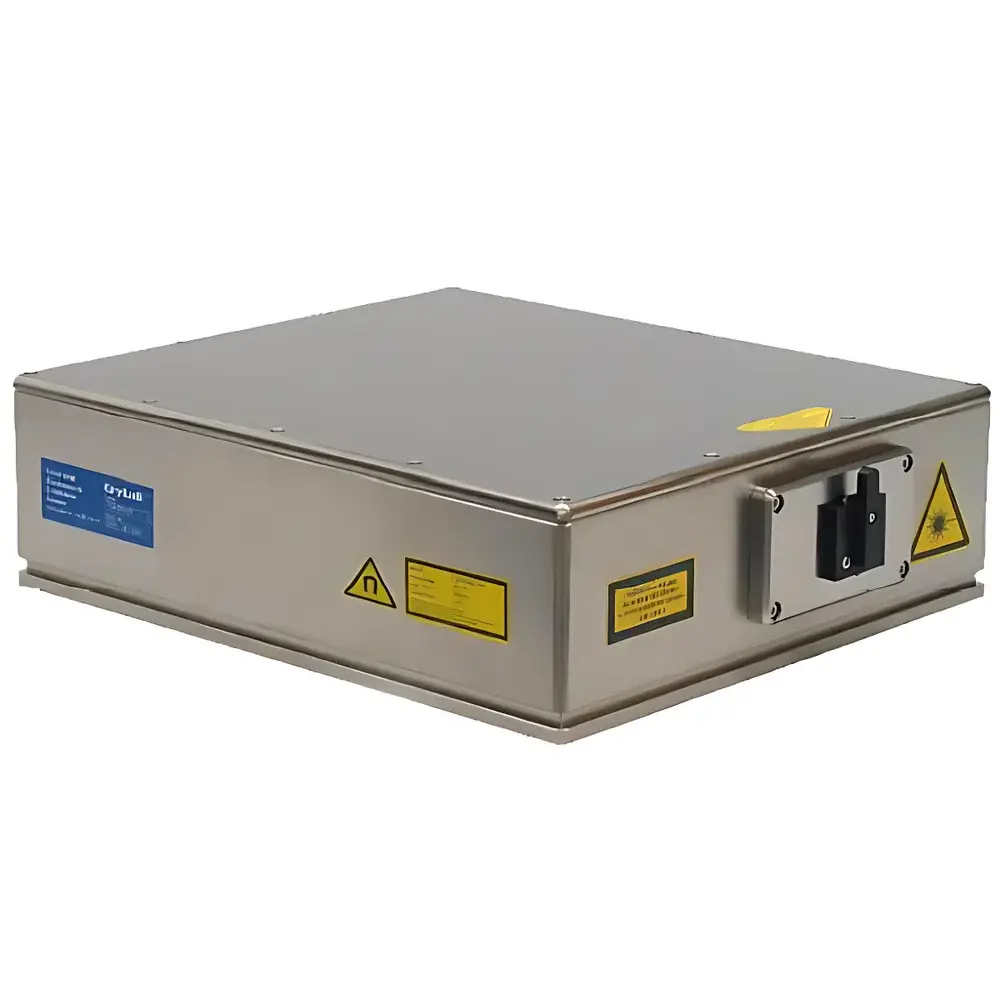
Auniontech AUT-FQCW-266 Deep-Ultraviolet Single-Longitudinal-Mode Continuous-Wave Laser
| Brand | Auniontech |
|---|---|
| Model | AUT-FQCW-266 |
| Wavelength | 266 nm |
| Output Power | Up to 500 mW |
| Linewidth | < 300 kHz |
| Coherence Length | > 1000 m |
| Beam Quality (M²) | < 1.3 |
| Beam Divergence | < 0.8 mrad (full angle) |
| Intensity Noise | < 0.5% RMS (100 kHz – 10 MHz) |
| Power Stability | < 1% over 8 h |
| Power Consumption | < 200 W (avg. 100 W) |
| Footprint | 380 × 270 mm |
| Control Interfaces | RS232, USB |
| Laser Type | Diode-Pumped Solid-State (DPSS), CW, TEM₀₀ |
Overview
The Auniontech AUT-FQCW-266 is a diode-pumped solid-state (DPSS), continuous-wave (CW), single-longitudinal-mode (SLM) deep-ultraviolet laser operating at a fixed wavelength of 266 nm. Engineered for high-fidelity optical metrology and precision photonic applications, this laser leverages fourth-harmonic generation (FHG) in nonlinear crystals—typically BBO or CLBO—pumped by a frequency-doubled Nd:YAG or Nd:YVO₄ fundamental source. Its SLM operation ensures diffraction-limited beam propagation, minimal mode competition, and stable interference contrast essential for interferometric, holographic, and spectroscopic applications requiring long temporal coherence. With a coherence length exceeding 1000 meters and sub-300 kHz spectral linewidth, the AUT-FQCW-266 meets stringent requirements for ultra-stable UV illumination in semiconductor metrology, high-resolution Raman excitation, and fiber Bragg grating (FBG) inscription where phase noise and wavelength drift directly impact measurement fidelity.
Key Features
- Deep-UV output at 266 nm with continuous-wave operation and single-longitudinal-mode spectral purity
- Output power up to 500 mW with excellent spatial beam quality (M² < 1.3) and low divergence (< 0.8 mrad, full angle)
- Narrow intrinsic linewidth ( 1000 m) for interferometric stability
- Low intensity noise (< 0.5% RMS, 100 kHz – 10 MHz bandwidth) and superior power stability (< 1% over 8 hours)
- Compact integrated architecture (380 × 270 mm footprint) with low thermal load and average power consumption of ~100 W
- Integrated control unit supporting local push-button operation and remote control via RS232 and USB interfaces
- TEM₀₀ Gaussian beam profile optimized for coupling into single-mode fibers, waveguides, and high-NA microscope objectives
Sample Compatibility & Compliance
The AUT-FQCW-266 is compatible with standard UV-grade optical components—including fused silica lenses, reflective optics with enhanced aluminum or dielectric coatings, and quartz cuvettes—provided appropriate UV-induced degradation and solarization effects are mitigated through controlled exposure protocols. The system conforms to IEC 60825-1:2014 Class 4 laser safety standards, requiring interlocked enclosures, UV-blocking eyewear (OD ≥ 6 at 266 nm), and beam path containment per ANSI Z136.1 guidelines. While not certified for GMP or FDA 21 CFR Part 11 out-of-the-box, its deterministic digital control interface supports integration into validated environments when paired with audit-trail-capable host software and hardware interlock circuits. It is routinely deployed in laboratories adhering to ISO/IEC 17025 for calibration traceability and ASTM E2912–22 for UV source characterization in thin-film metrology.
Software & Data Management
The laser includes a vendor-provided Windows-compatible configuration utility that enables real-time monitoring of output power, internal temperature diagnostics, pump diode current, and operational status flags. All control commands—including on/off sequencing, power ramping, and error reset—are accessible via ASCII-based serial protocol (RS232) or HID-compliant USB virtual COM port, facilitating integration with LabVIEW, Python (PySerial), MATLAB, or custom SCADA systems. Firmware logs timestamped operational events (e.g., thermal warnings, mode-lock detection failures) with UTC-synchronized entries. For regulated environments, third-party middleware can be deployed to enforce electronic signature workflows, data integrity validation, and export of CSV-formatted performance logs compliant with ALCOA+ principles (Attributable, Legible, Contemporaneous, Original, Accurate, Complete, Consistent, Enduring, Available).
Applications
- Semiconductor wafer inspection: Defect detection via deep-UV dark-field microscopy and scatterometry at sub-100 nm resolution
- UV resonance Raman spectroscopy: Enhanced cross-section for aromatic amino acids, nucleic acid bases, and carbon nanomaterials
- Fiber Bragg grating fabrication: High-contrast index modulation in photosensitive germanosilicate fibers using phase-mask interferometry
- UV holography and interferometry: Long-baseline optical testing of EUV mirror substrates and aspheric lens metrology
- Photoelectron spectroscopy (PES) light sources: Fixed-energy excitation for angle-resolved UPS (ultraviolet photoelectron spectroscopy)
- Fluorescence lifetime imaging (FLIM): Time-gated excitation of endogenous fluorophores with minimal photodamage
FAQ
What is the typical warm-up time required to achieve spectral and power stability?
The system reaches thermal equilibrium and specified power stability within 30 minutes after cold start, with active temperature stabilization of both nonlinear crystal and resonator cavity.
Is the 266 nm output polarization-maintained?
Yes—the laser delivers linearly polarized output with extinction ratio >100:1, oriented parallel to the baseplate mechanical reference plane.
Can this laser be fiber-coupled?
It is designed for free-space output; however, coupling into UV-grade single-mode fiber (e.g., Solaris 266-5/125) is feasible using AR-coated aspheric focusing optics and active alignment, achieving >65% coupling efficiency under optimal conditions.
Does the system include beam pointing stabilization?
No active beam-pointing correction is built-in; however, the mechanical design minimizes thermal drift to <5 µrad/hour, and external tip-tilt platforms may be integrated for long-duration experiments.
Are OEM integration options available?
Yes—Auniontech provides mechanical drawings, electrical interface specifications, and SDK documentation for embedded integration into larger photonic instruments or automated production tools.





