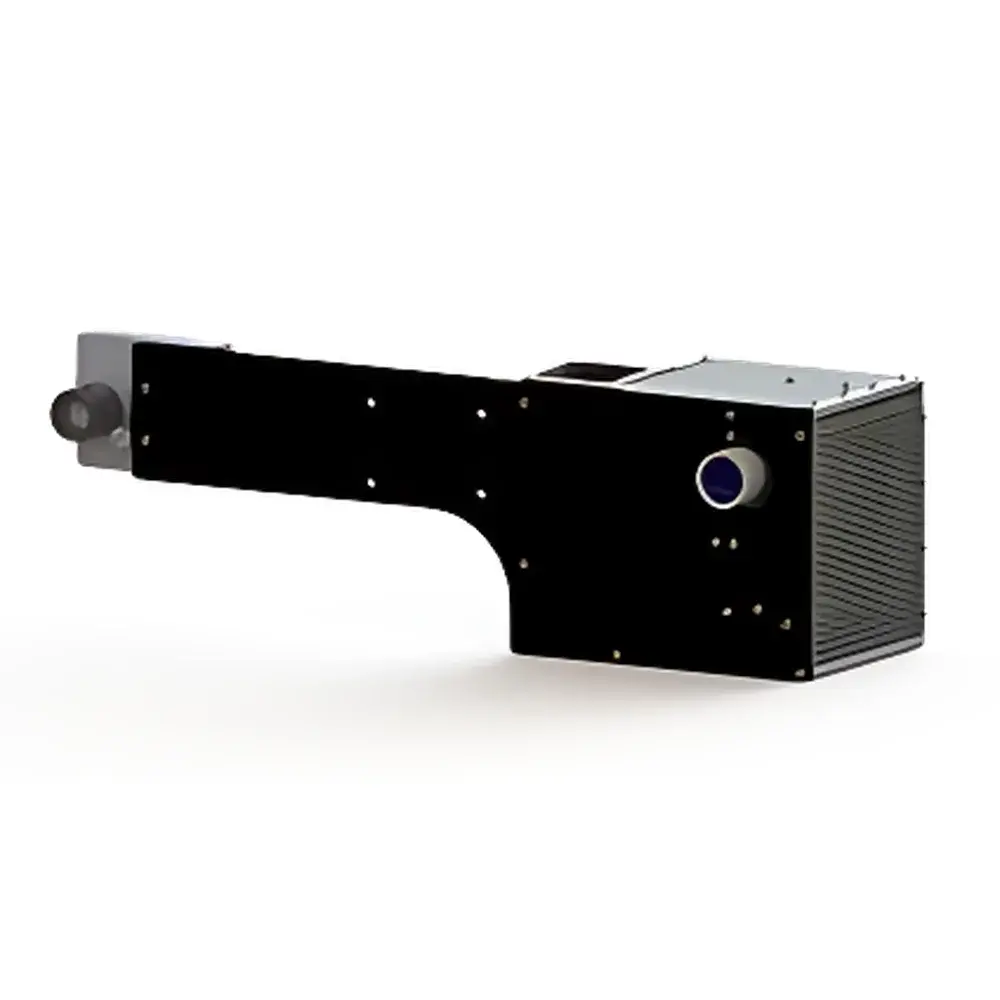
VIALUX zSnapper® 3D Customizable 3D Camera Module
| Brand | VIALUX |
|---|---|
| Model | zSnapper® 3D |
| Type | Structured Light 3D Imaging Module |
| Sensor Architecture | Dual Sony CMOS + DLP-based Pattern Projection |
| Synchronization | FPGA-controlled Hardware Sync |
| Interface | USB 3.2 SuperSpeed (Gen 1) |
| Onboard RAM | 1.592 frames @ 10-bit, 1920×1200 |
| Max Frame Rate | 5000 FPS (ROI-dependent) |
| Projection Bit Depth | 3–8 bit (configurable) |
| Sensor Bit Depth | 10 bit |
| Output Format | Native (x,y,z) + grayscale texture |
| API | zSn.dll (64-bit Windows DLL) |
| OS Support | Microsoft Windows 10 (64-bit) |
| Compliance | CE, RoHS, FCC Class B |
| Software Features | HDR capture, multi-device sync, custom pattern upload, ROI readout, lossless real-time compression, pixel binning |
Overview
The VIALUX zSnapper® 3D is a high-performance, FPGA-architected structured light 3D camera module engineered for integration into industrial machine vision, automated metrology, and custom 3D inspection systems. Unlike off-the-shelf 3D scanners, the zSnapper® 3D operates as a modular hardware-software platform—designed from the ground up to support deep system-level customization. Its core measurement principle relies on active triangulation: a high-speed DLP projection unit (driven by ViALUX’s proprietary DMD controller) projects precisely timed, user-defined fringe or binary patterns onto a target surface; synchronized Sony CMOS image sensors capture the deformed pattern geometry; and onboard FPGA logic executes real-time phase unwrapping, epipolar rectification, and disparity-to-depth conversion. This deterministic hardware pipeline eliminates host-CPU dependency for core 3D reconstruction, ensuring sub-millisecond latency and deterministic timing—critical for inline inspection, robotic guidance, and closed-loop control applications.
Key Features
- FPGA-centric architecture enabling hardware-synchronized projection and imaging with <1 µs jitter between DLP trigger and sensor exposure
- Configurable dual-Sony CMOS sensor interface supporting global shutter operation at up to 5000 FPS (region-of-interest mode)
- High-fidelity DLP projection engine with programmable 3–8 bit grayscale pattern depth and on-chip RAM for up to 128 user-uploaded sequences
- Onboard frame buffer (1.592 frames @ 1920×1200, 10-bit) for burst acquisition without host bandwidth bottleneck
- DirectLink interface reduces external cabling to a single USB 3.2 Gen 1 (5 Gbps) connection—no PCIe, no external power supply required
- Lossless real-time compression (ViALUX-proprietary algorithm) maintains full dynamic range while doubling effective transfer throughput
- zSnapper® API (zSn.dll) provides native C++ access to calibrated 3D point clouds, grayscale textures, and raw sensor data—fully compatible with OpenCV, HALCON, and common ROS2 middleware
Sample Compatibility & Compliance
The zSnapper® 3D module is optimized for rigid, non-specular surfaces with moderate reflectivity (matte plastics, machined metals, ceramics, composites). It supports surface normal estimation and robust outlier rejection for parts exhibiting mild occlusion or step edges. For highly reflective or transparent objects, optional polarization filters or multi-angle illumination configurations can be implemented at the integration level. The module complies with CE Directive 2014/30/EU (EMC), 2011/65/EU (RoHS), and FCC Part 15 Subpart B (Class B digital device). All firmware and API libraries are developed under ISO 9001-certified engineering processes. While not a standalone medical or safety-critical device, its deterministic timing behavior and traceable calibration protocols align with requirements for GLP-compliant R&D environments and ISO/IEC 17025-accredited metrology labs when integrated into validated systems.
Software & Data Management
The zSnapper® API is delivered as a statically linked 64-bit Windows DLL (zSn.dll), fully documented with header files, example projects (Visual Studio 2019+), and comprehensive Doxygen-generated reference manuals. It exposes low-overhead functions for device enumeration, parameter configuration (LED intensity, exposure time, gain, binning, ROI), pattern sequence loading, and synchronous 2D/3D frame acquisition. All 3D output is provided in world-referenced (x,y,z) coordinates with sub-pixel accuracy—calibrated against NIST-traceable ceramic gauge blocks. The API supports multi-device synchronization via hardware trigger lines (TTL-compatible), enabling stereo or multi-view setups without software-level drift compensation. Data logging is handled externally via application code; however, the API includes timestamping at FPGA level (±10 ns resolution) for audit-ready temporal correlation. No cloud connectivity or telemetry is embedded—ensuring full data sovereignty and compatibility with air-gapped production networks.
Applications
- Automated dimensional inspection of molded plastic components (e.g., automotive interior trim, consumer electronics housings)
- Robotic bin-picking guidance with real-time pose estimation for unstructured part feeding
- In-line PCB solder paste height and volume verification prior to reflow
- Reverse engineering of legacy mechanical parts where CAD models are unavailable
- Customized 3D biometric capture systems (e.g., ear canal scanning for hearing aid fitting)
- Research-grade surface deformation tracking under thermal or mechanical load (with external trigger synchronization)
FAQ
Is the zSnapper® 3D module supplied with factory calibration data?
Yes—each unit ships with a per-device calibration certificate including intrinsic parameters (focal length, distortion coefficients), extrinsic alignment matrices (projector-to-sensor), and depth map uncertainty maps derived from ISO 10360-8 compliant validation procedures.
Can I replace the default Sony sensors with third-party CMOS devices?
No—the sensor interface is electrically and logically locked to Sony IMX series global-shutter sensors (IMX250, IMX252, IMX264 supported); custom sensor integration requires ViALUX’s OEM design partnership program.
Does the API support Linux or macOS?
Not natively—the current zSn.dll is Windows-only; however, ViALUX provides source-level porting support and reference implementations for Linux users under NDA as part of the Advanced Integration License tier.
What is the typical depth measurement uncertainty at 500 mm working distance?
Under standard configuration (IMX250, 1920×1200, 8-bit pattern, 24 Hz frame rate), volumetric uncertainty is ≤±12 µm (2σ, ISO 15530-3 compliant evaluation using calibrated step gauges).
Is FDA 21 CFR Part 11 compliance supported?
The module itself is not a regulated medical device—but when deployed within a validated system architecture, its deterministic data flow, FPGA-level timestamps, and audit-log-capable API enable full Part 11 compliance implementation by the system integrator.