
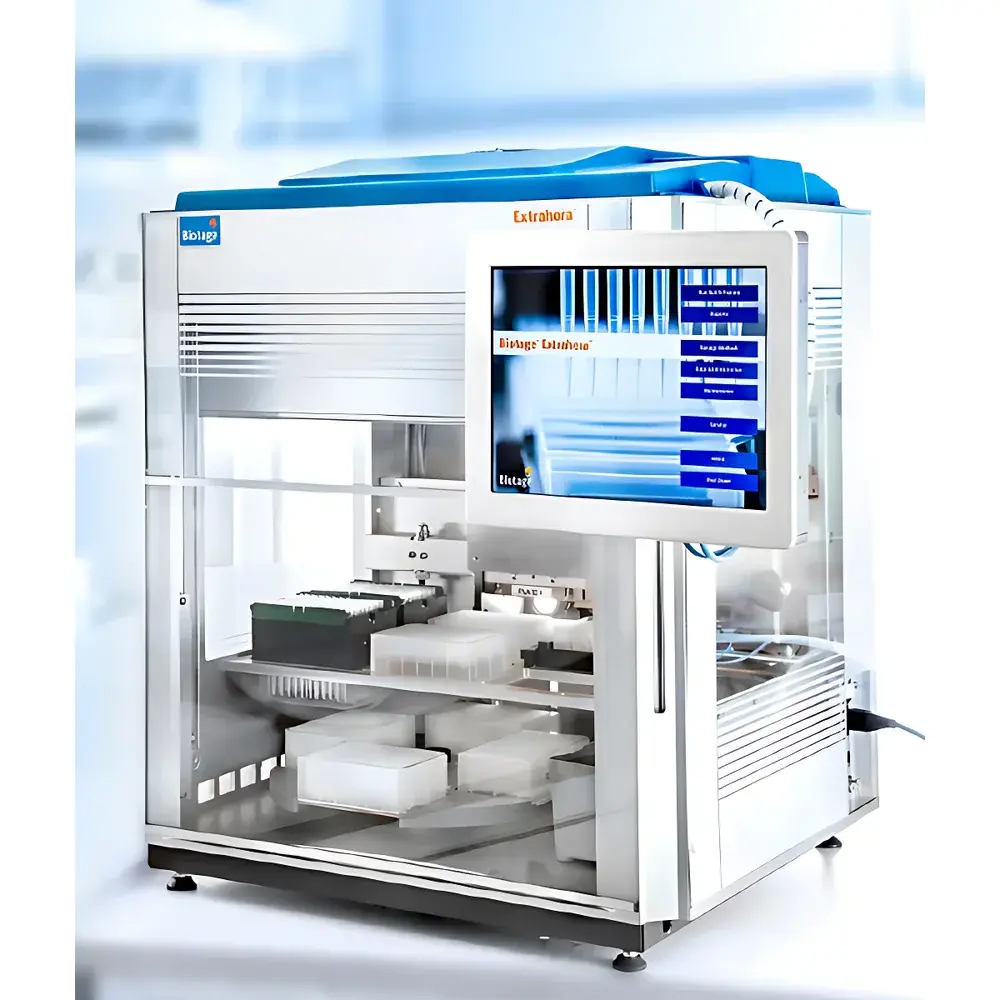
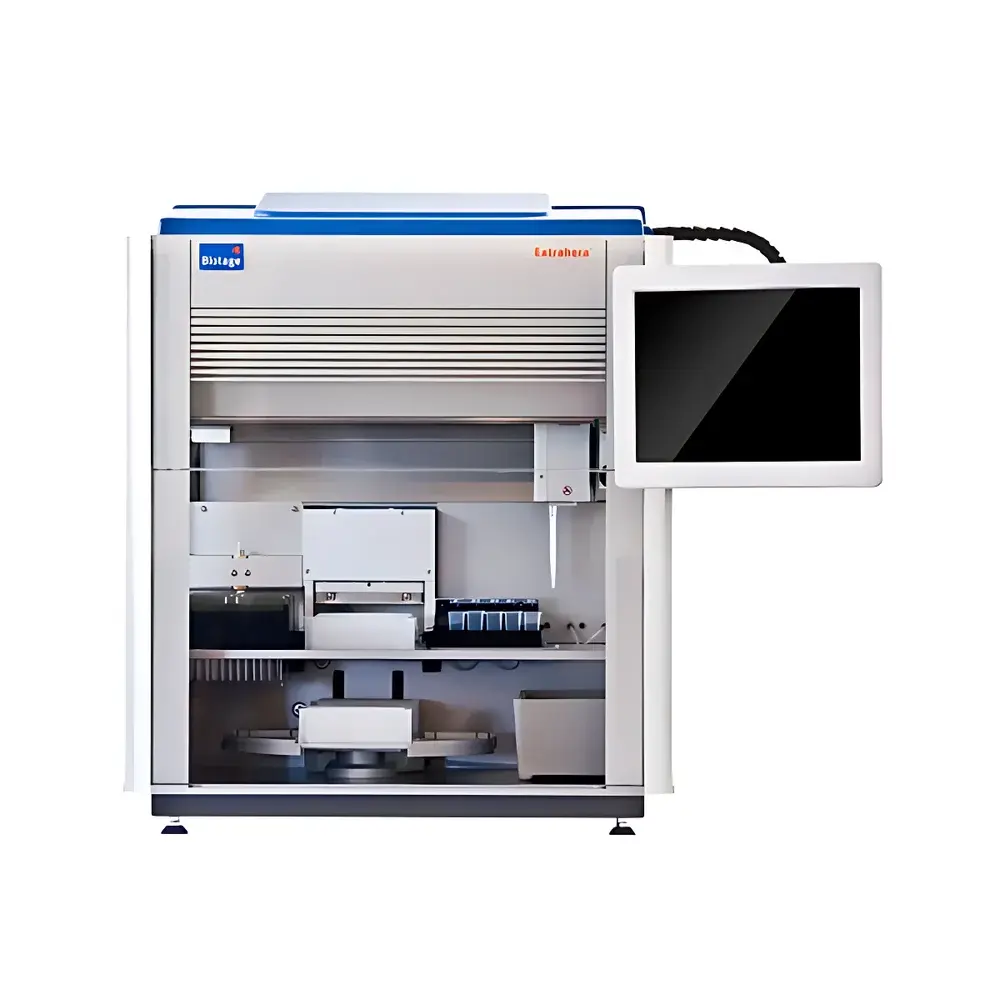
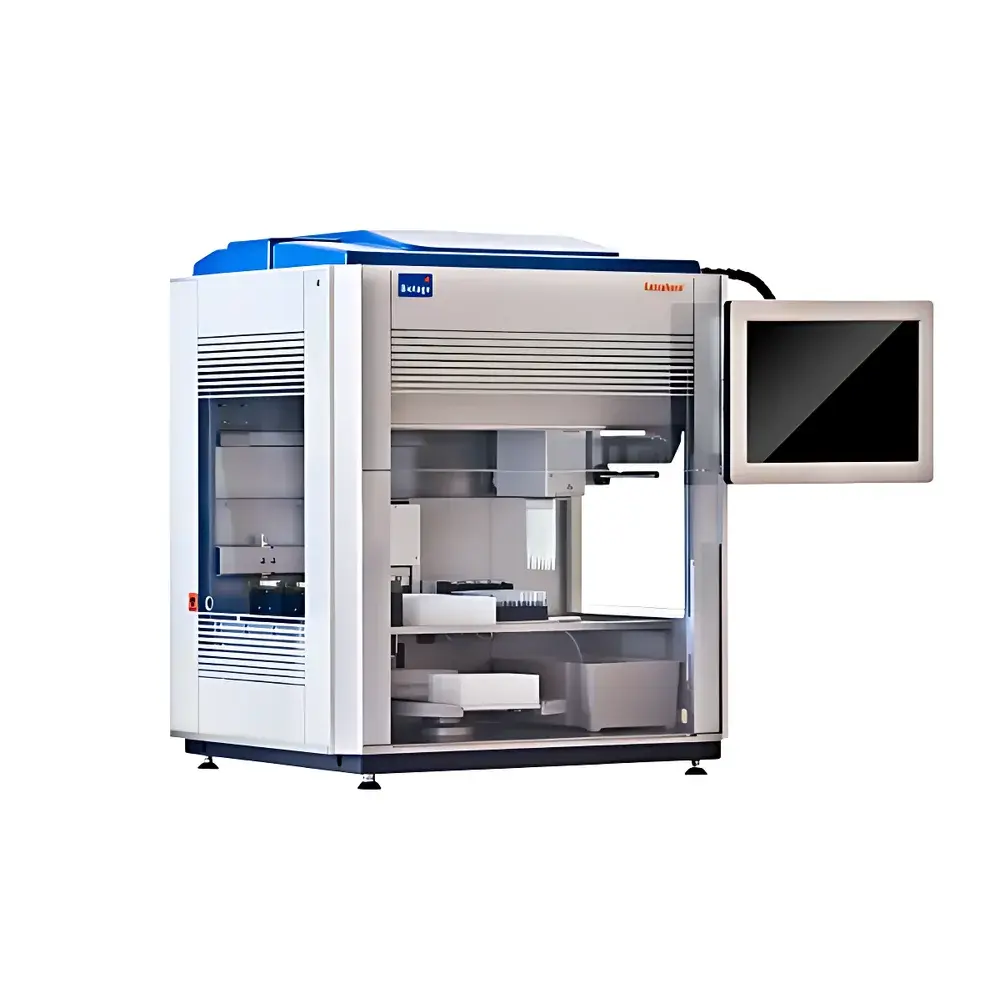
Biotage Extrahera Automated Sample Preparation System
| Brand | Biotage |
|---|---|
| Origin | United Kingdom |
| Model | Extrahera |
| Automation Level | Fully Automatic |
| Channel Count | 8-Channel |
| Extraction Mode | Column-Based SPE |
| Flow Rate Control | 0.1–60 mL/min |
| Solvent Reservoirs | 5 independent solvent positions (supports up to 10 distinct solvents via sequential loading) |
| Sample Capacity | 4–96 samples per run |
| Sample Loading Volume | 0.05–100 mL |
| Wetted Materials | PTFE, Polypropylene (PP) |
Overview
The Biotage® Extrahera™ Automated Sample Preparation System is an engineered solution for high-throughput, reproducible solid-phase extraction (SPE), supported liquid-liquid extraction (SLE), phospholipid depletion (PLD), and protein precipitation (PPT) in regulated and research laboratories. Based on positive-pressure column elution and precision positive-displacement pipetting, the system eliminates reliance on vacuum manifolds or peristaltic pumps—common sources of flow variability, channel clogging, and carryover. Its core architecture integrates eight independently controlled fluidic channels with real-time pressure monitoring and adaptive flow regulation, enabling consistent method execution across diverse sample matrices—including plasma, urine, tissue homogenates, environmental water, and food extracts. Designed for compliance-ready workflows, the Extrahera supports method standardization under GLP, GMP, and ISO/IEC 17025 frameworks, serving as a foundational platform for LC-MS/MS, GC-MS, and HPLC sample preparation in pharmaceutical, clinical toxicology, environmental, and food safety applications.
Key Features
- Eight-channel parallel processing with independent pressure-controlled fluid delivery for simultaneous conditioning, loading, washing, and elution steps
- Dual-format compatibility: seamless switching between 96-well plate formats and individual 1 mL, 3 mL, or 6 mL SPE cartridges without hardware modification
- Positive-displacement pipetting technology using disposable or reusable pipette tips—eliminating tubing-based cross-contamination and pump-induced pulsation
- Integrated touchscreen interface with embedded operating system; no external PC required for routine operation or method execution
- Five dedicated solvent reservoir positions with programmable solvent selection logic; optional solvent recycling protocol minimizes hazardous waste generation by up to 40% versus conventional systems
- Intelligent tip reuse algorithm with automated tip washing and integrity verification prior to each aspiration step
- Real-time pressure monitoring and automatic fault detection for column blockage, air bubble ingress, or seal failure
- Compact footprint (W × D × H: 58 × 62 × 52 cm) optimized for benchtop integration in space-constrained analytical labs
Sample Compatibility & Compliance
The Extrahera accommodates a broad range of biological, environmental, and industrial sample types—including whole blood, serum, plasma, urine, saliva, wastewater, soil extracts, and beverage matrices—without requiring manual dilution or pre-filtration in most cases. All wetted components are constructed from chemically inert materials: PTFE for solvent pathways and polypropylene for structural housings and tip racks, ensuring compatibility with aggressive organic solvents (e.g., acetonitrile, methanol, dichloromethane, ethyl acetate) and aqueous buffers across pH 1–14. The system meets CE marking requirements and complies with IEC 61000-6-2 (EMC immunity) and IEC 61000-6-4 (EMC emission) standards. For regulated environments, audit-trail-enabled software modules support 21 CFR Part 11 compliance when paired with Biotage’s optional LIMS-integrated control suite, including electronic signatures, user role management, and immutable method versioning.
Software & Data Management
Control is managed through the built-in Biotage MethodStudio™ interface—a graphical, wizard-driven environment supporting method creation, validation, and transfer. Each method stores complete parameter sets: flow profiles, dwell times, tip wash cycles, solvent sequences, and pressure thresholds. All run logs—including timestamps, operator ID, error codes, and real-time pressure traces—are stored locally with optional export to CSV or direct integration into laboratory information management systems (LIMS) via HL7 or RESTful API. Version-controlled method libraries can be backed up to network drives or cloud storage, and method validation reports include system suitability metrics such as inter-run CV% for elution volume consistency and intra-run repeatability of peak area RSD in representative QC samples.
Applications
- High-throughput bioanalysis: automated SPE cleanup of plasma/urine samples prior to LC-MS/MS quantification of small-molecule drugs and metabolites (per ASTM D8169 and USP <232>)
- Clinical toxicology screening: parallel processing of 96 forensic urine specimens for amphetamines, opioids, and benzodiazepines using mixed-mode cation-exchange SPE
- Environmental residue analysis: SLE-based phospholipid removal from fish tissue extracts followed by d-SPE cleanup for GC-MS pesticide multiresidue methods (EN 15662)
- Food contaminant testing: PPT/SPE hybrid workflows for mycotoxin extraction from cereal matrices, compliant with EU Commission Regulation (EC) No 401/2006
- Method development labs: rapid evaluation of alternative sorbents, solvent gradients, and flow-rate profiles using identical hardware conditions across multiple protocols
FAQ
Does the Extrahera support unattended overnight runs?
Yes—the system includes automatic shutdown sequencing, solvent-level monitoring, and end-of-run notification via email or local alert. Up to 4 consecutive 96-well plates can be queued with staggered start times.
Can I validate an Extrahera method for GLP compliance?
Absolutely. The system supports IQ/OQ documentation packages, and its software provides full traceability of all critical parameters, deviations, and maintenance events required for FDA or EMA inspection readiness.
What maintenance is required beyond routine tip replacement?
Annual calibration of pressure sensors and pipetting accuracy verification are recommended. No pump tubing or vacuum manifold servicing is needed due to the positive-pressure, tip-based fluid handling architecture.
Is method transfer from manual SPE possible?
Yes—Biotage provides validated translation guides that map manual vacuum-based protocols to Extrahera pressure and timing parameters, typically achieving <95% recovery equivalence with ≤5% inter-run RSD improvement.
How does the system handle viscous or particulate-laden samples?
Pre-filtering is optional but not mandatory; the positive-pressure design enables reliable loading of samples containing up to 5% suspended solids or viscosity up to 20 cP without clogging, provided appropriate pore-size frits are selected.



