
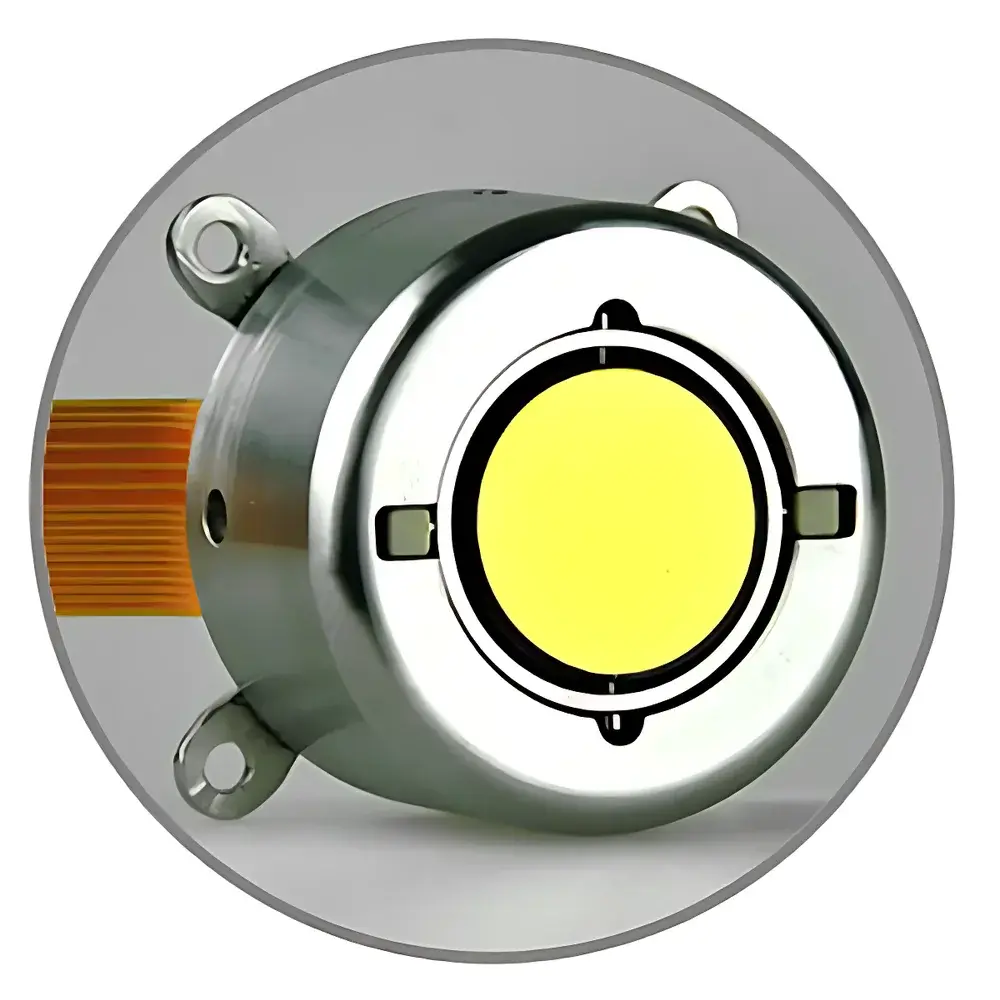
Auniontech W-Series Large-Angle Closed-Loop Miniature Galvanometer Scanner
| Brand | Auniontech |
|---|---|
| Model | W |
| Actuator Type | 4-Quadrant (2-axis, bi-directional) |
| Mechanical Tilt Angle (DC) | ±25° (X & Y axes) |
| Mirror Diameter | 15 mm |
| Center of Rotation to Mirror Surface | 1.3 mm |
| External Diameter | 30 mm |
| Zero Drift | ≤25 µrad/°C |
| Closed-Loop Resolution | <5 µrad |
| Repeatability (RMS, typical) | 30–100 µrad |
| Full-Scale Bandwidth (Sine, ±25°) | 20 Hz |
| Small-Signal Bandwidth | 350 Hz |
| Large-Angle Step Response (20° step) | 7.5 ms |
| Small-Angle Step Response (0.1° step) | 1.4 ms |
| Instrument Form Factor | Benchtop |
Overview
The Auniontech W-Series Large-Angle Closed-Loop Miniature Galvanometer Scanner is a high-performance optical beam steering device engineered for precision two-dimensional laser deflection in space-constrained environments. Based on electromagnetic actuation architecture with integrated position-sensing feedback, this galvo scanner operates on the principle of torque-driven mirror rotation within a rigid, low-inertia mechanical frame. Unlike open-loop scanners, the W-Series incorporates a closed-loop control system utilizing high-linearity capacitive or eddy-current position sensors—enabling real-time correction of thermal drift, hysteresis, and nonlinearities inherent in electromagnetic actuators. Its ±25° mechanical tilt range per axis (±50° optical scan angle) and 15 mm mirror diameter support high-throughput light delivery while maintaining diffraction-limited wavefront fidelity across its operational bandwidth. Designed for integration into OEM optical subsystems, it meets the mechanical and thermal stability requirements of scanning electron microscope (SEM) auxiliary optics, confocal imaging paths, and time-resolved spectroscopy setups where compact footprint and deterministic angular repeatability are critical.
Key Features
- 15 mm monolithic mirror aperture with optimized surface flatness (λ/10 @ 633 nm) and broadband dielectric coating (350–1100 nm AR)
- True two-axis closed-loop operation with <5 µrad angular resolution and RMS repeatability of 30–100 µrad over full stroke
- Low thermal zero drift (≤25 µrad/°C), enabling stable long-duration raster scanning without active recalibration
- Benchtop-compatible form factor (30 mm external diameter, 1.3 mm center-of-rotation offset) for direct mounting into vacuum-compatible SEM column ports or optical breadboard assemblies
- Dynamic response optimized for both high-speed small-angle modulation (1.4 ms for 0.1° step) and large-field positioning (7.5 ms for 20° step)
- Full-scale sinusoidal bandwidth of 20 Hz at ±25° mechanical deflection—validated per ISO 21088 for angular motion metrology
Sample Compatibility & Compliance
The W-Series is compatible with standard SEM-compatible vacuum feedthroughs (KF-16 or CF-16 flanges optional) and operates reliably under ambient conditions ranging from 15°C to 35°C. Mirror substrates are fabricated from single-crystal silicon or low-expansion ULE® glass, ensuring dimensional stability during extended electron-beam exposure. The scanner conforms to IEC 61000-6-3 (EMC emission limits) and IEC 61000-6-2 (immunity to electrostatic discharge and RF fields). When deployed in regulated diagnostic or industrial metrology applications, its closed-loop traceability supports alignment with ISO/IEC 17025 calibration protocols and FDA 21 CFR Part 11-compliant data audit trails when paired with validated controller firmware.
Software & Data Management
The scanner interfaces via analog ±10 V input (for position command) and differential LVDS output (for real-time sensor feedback), supporting synchronization with external timing generators (e.g., FPGA-based pulse sequencers or SEM scan generators). AUnionTech provides SDKs for Windows/Linux (C/C++, Python, MATLAB) enabling custom trajectory generation—including Lissajous, spiral, and arbitrary vector-based scan patterns. All position data streams include timestamped metadata compliant with HDF5 v1.12 schema, facilitating post-acquisition co-registration with secondary detectors (e.g., EDS, CL, or SE signals). Firmware supports non-volatile storage of up to 16 calibrated scan profiles with user-defined gain/offset compensation tables—essential for multi-wavelength or multi-detector configurations.
Applications
- Laser scanning in SEM-based cathodoluminescence (CL) and electron beam-induced current (EBIC) systems
- Dynamic field-of-view expansion in high-resolution optical sectioning microscopes coupled to SEM chambers
- Beam steering for adaptive focus correction in multi-photon excitation platforms integrated with electron microscopy workstations
- Real-time optical path switching in hybrid SEM-Raman or SEM-FTIR analytical modules
- High-fidelity raster scanning for additive manufacturing process monitoring in metal powder bed fusion systems
- Time-of-flight laser radar calibration targets requiring sub-milliradian pointing stability over temperature gradients
FAQ
Is the W-Series compatible with ultra-high vacuum (UHV) environments?
Yes—optional UHV-rated versions feature bakeable stainless-steel housings, ceramic shaft seals, and outgassing-certified adhesives (per ASTM E595), supporting pressures down to 1×10⁻⁹ mbar.
Can multiple W-Series scanners be synchronized for compound scanning geometries?
Yes—the analog input/output architecture supports master-slave daisy-chaining with <100 ns inter-unit skew when driven by a common clock reference.
What calibration documentation is provided with shipment?
Each unit ships with NIST-traceable angular calibration certificates covering linearity, hysteresis, and thermal drift across the full operating temperature range.
Does the closed-loop controller support third-party PID tuning?
Yes—the embedded DSP allows user-defined proportional, integral, and derivative gains via RS-422 serial interface, with real-time Bode plot acquisition for loop characterization.
Are custom mirror coatings available?
Yes—custom dielectric stacks (e.g., high-reflectivity at 1550 nm or dual-band AR for 405/785 nm) can be specified at order entry with lead-time adjustment.




