
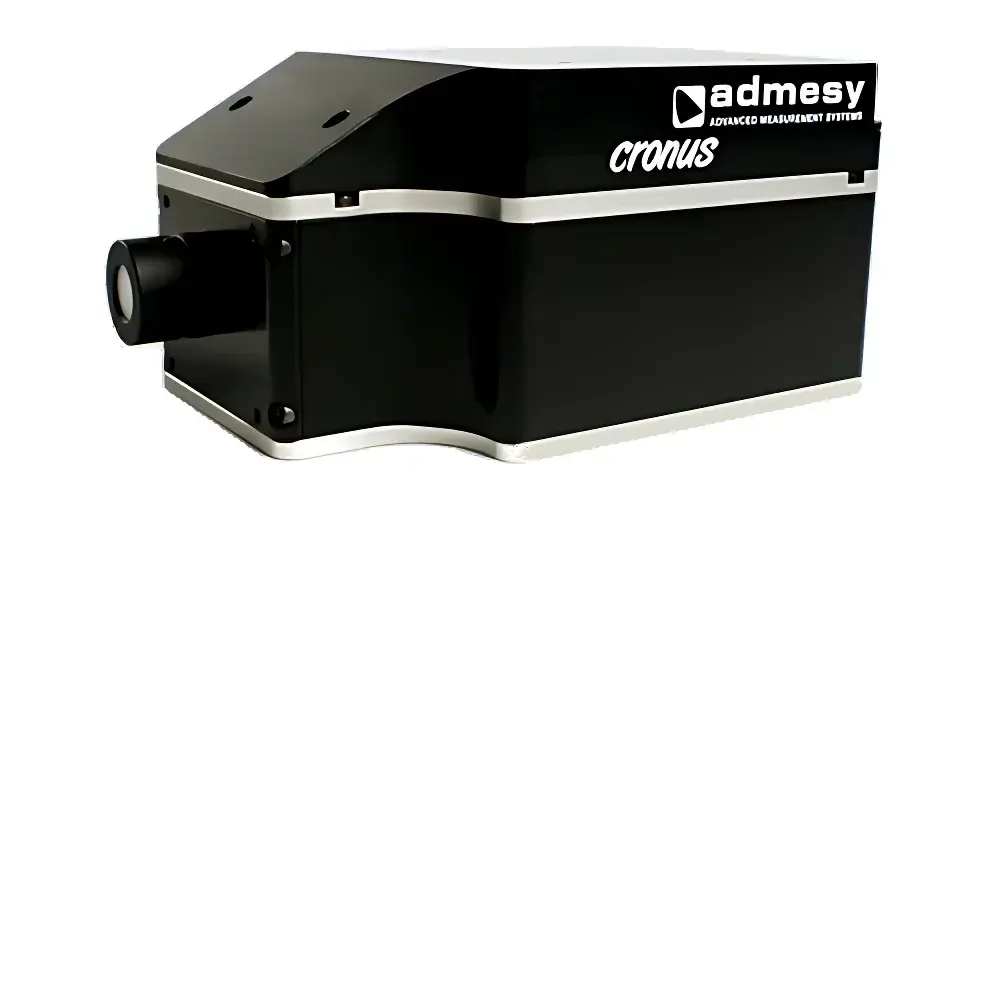
Admesy Cronus Spectrocolorimeter
| Brand | Admesy |
|---|---|
| Origin | Netherlands |
| Model | Cronus |
| Spectral Range | 380–780 nm |
| Spectral Resolution (FWHM) | 2.3 nm |
| Integration Time | 2.5 ms – 20 s |
| Linearity Error | < 0.5% |
| Dynamic Range (Spectrometer) | >150,000 |
| Dynamic Range (Colorimeter) | >10,000,000 |
| Luminance Measurement Speed | >50,000 readings/s |
| Colorimetric Accuracy (Y, x, y) | ±4%, ±0.002 |
| Colorimetric Repeatability (Y, x, y) | <0.5%, ±0.0002 |
| Detector | Silicon photodiodes with XYZ interference filters conforming to CIE 1931 color matching functions |
| Optical Input Options | Cosine corrector (fixed or fiber-coupled), integrating spheres (75 mm / 150 mm / 250 mm), lens systems (5 mm / 10 mm / 20 mm focal lengths) |
| Interface | High-speed USB (USBTMC-compliant), RS-232, Ethernet, external trigger I/O |
| Mechanical Shutter Lifetime | >1 million cycles |
| Operating Temperature | 10–35 °C |
| Compliance | USBTMC standard, SCPI command set |
Overview
The Admesy Cronus Spectrocolorimeter is an integrated optical measurement instrument engineered for simultaneous spectral radiometric and colorimetric analysis with industrial-grade speed and laboratory-grade accuracy. Based on dual-path optical architecture—combining a high-fidelity CCD-based spectrometer and a dedicated tristimulus colorimeter—the Cronus delivers synchronized acquisition of full spectral power distribution (SPD), CIE 1931 chromaticity coordinates (x, y), luminance (Y), correlated color temperature (CCT), color rendering index (CRI), flicker metrics (e.g., SVM, percent flicker), and startup transient behavior. Its core design leverages CIE 1931-matched XYZ filter photodiodes for colorimetry and a thermally stabilized grating spectrometer with 2.3 nm FWHM resolution across the photobiologically relevant 380–780 nm visible range. This architecture enables traceable, NIST-aligned color measurements while supporting high-throughput validation in LED manufacturing, display calibration, automotive lighting QA, and OLED aging studies—where sub-millisecond temporal resolution and long-term photometric stability are critical.
Key Features
- Dual-mode operation: Independent yet time-synchronized spectro-radiometric and tristimulus colorimetric channels ensure cross-validated results without trade-offs between speed and spectral fidelity.
- Ultra-high-speed photometry: Luminance measurement rate exceeding 50,000 readings per second supports real-time flicker analysis, PWM dimming characterization, and dynamic backlight response profiling.
- Auto-ranging integration control: Intelligent exposure optimization eliminates manual gain selection and prevents saturation during rapid intensity transitions (e.g., LED turn-on transients).
- Thermal and dark-current compensation: Onboard temperature monitoring and pixel-level dark reference subtraction maintain measurement integrity across ambient fluctuations (10–35 °C operating range).
- Modular optical interface: Interchangeable input options—including cosine-corrected diffusers (25 mm² active area), integrating spheres (75/150/250 mm), and telecentric lenses (5/10/20 mm)—enable adaptation to diverse sample geometries and irradiance levels.
- Industrial-grade mechanical shutter: Rated for >1 million actuations, ensuring stable baseline referencing and robustness in automated test cell environments.
- Standardized programmability: Fully compliant with USBTMC 1.0 and SCPI command sets; supports seamless integration into LabVIEW, Python (PyVISA), MATLAB, and custom CI/CD test frameworks.
Sample Compatibility & Compliance
The Cronus accommodates a broad spectrum of light-emitting devices—from micro-LED arrays and mini-LED backlights to high-power automotive headlamps and large-area OLED panels—without requiring recalibration between configurations. Its cosine response meets ISO/CIE requirements for angular sensitivity (f2 < 3%), and spectral data comply with CIE S 026/E:2015 for photobiological safety assessments. The instrument’s traceable calibration certificates align with ISO/IEC 17025-accredited procedures, and its deterministic timing architecture satisfies GLP/GMP audit requirements for measurement reproducibility. While not FDA 21 CFR Part 11–certified out-of-the-box, its logging engine supports timestamped, user-attributed data exports suitable for regulated environments when deployed with validated software protocols.
Software & Data Management
Admesy’s Chronos software provides native support for real-time visualization, batch analysis, and export to industry-standard formats (CSV, XML, CIE xyY, SPD .jdx). It includes built-in modules for flicker evaluation (IEC TR 61000-3-3 Annex A), CRI/Rf calculations (ANSI/IES TM-30-20), and spectral comparison (ΔEuv, RMS error). All raw spectra and colorimetric records retain full metadata—including integration time, shutter state, temperature, and optical configuration—for complete measurement provenance. Data export APIs enable direct ingestion into MES platforms (e.g., Siemens Opcenter, Rockwell FactoryTalk) and statistical process control (SPC) dashboards. Audit trails record operator login, parameter changes, and calibration events—supporting internal quality system requirements.
Applications
- LED and SSL product development: Rapid binning, CCT drift tracking, and lifetime lumen maintenance analysis under accelerated stress conditions.
- Display manufacturing: Pixel-level uniformity mapping, HDR tone curve verification, and wide-gamut color space coverage assessment (e.g., DCI-P3, Rec.2020).
- Automotive lighting: Adaptive driving beam (ADB) pattern validation, glare metric computation (UGR, Ev), and regulatory compliance testing per ECE R149 and SAE J1383.
- Medical device illumination: Phototherapy lamp spectral output verification against ISO 15223-1 labeling requirements and IEC 62471 photobiological safety classification.
- Research laboratories: Time-resolved spectral kinetics of phosphor-converted LEDs, ultrafast OLED turn-on dynamics, and human-centric lighting studies requiring circadian stimulus quantification (melanopic EDI, α-opic irradiance).
FAQ
Does the Cronus require periodic factory recalibration?
Yes—Admesy recommends annual recalibration against NIST-traceable standards to maintain stated accuracy specifications. Field verification using certified reference lamps (e.g., tungsten halogen standards) is supported via built-in routines.
Can the Cronus measure pulsed or modulated light sources?
Yes—its 2.5 ms minimum integration time and external trigger synchronization enable precise phase-locked acquisition of PWM-driven LEDs, laser diodes, and strobed displays.
Is remote operation possible over Ethernet?
Yes—full SCPI command access is available via TCP/IP; no proprietary drivers required. Configuration, acquisition, and data streaming operate deterministically with sub-10 ms latency.
How is spectral stray light handled in the 380–780 nm range?
The spectrometer employs order-sorting filters and optimized grating blaze angles to suppress second-order contributions; residual stray light is characterized and corrected in firmware using empirical models derived from mercury-argon line source validation.
What level of uncertainty applies to CRI calculations?
Under standard conditions (2° observer, D65 illuminant, 100 cd/m²), expanded uncertainty (k=2) for Ra is ±1.2 units, as verified per ISO/CIE 11664-6:2019 Annex B protocols.





