
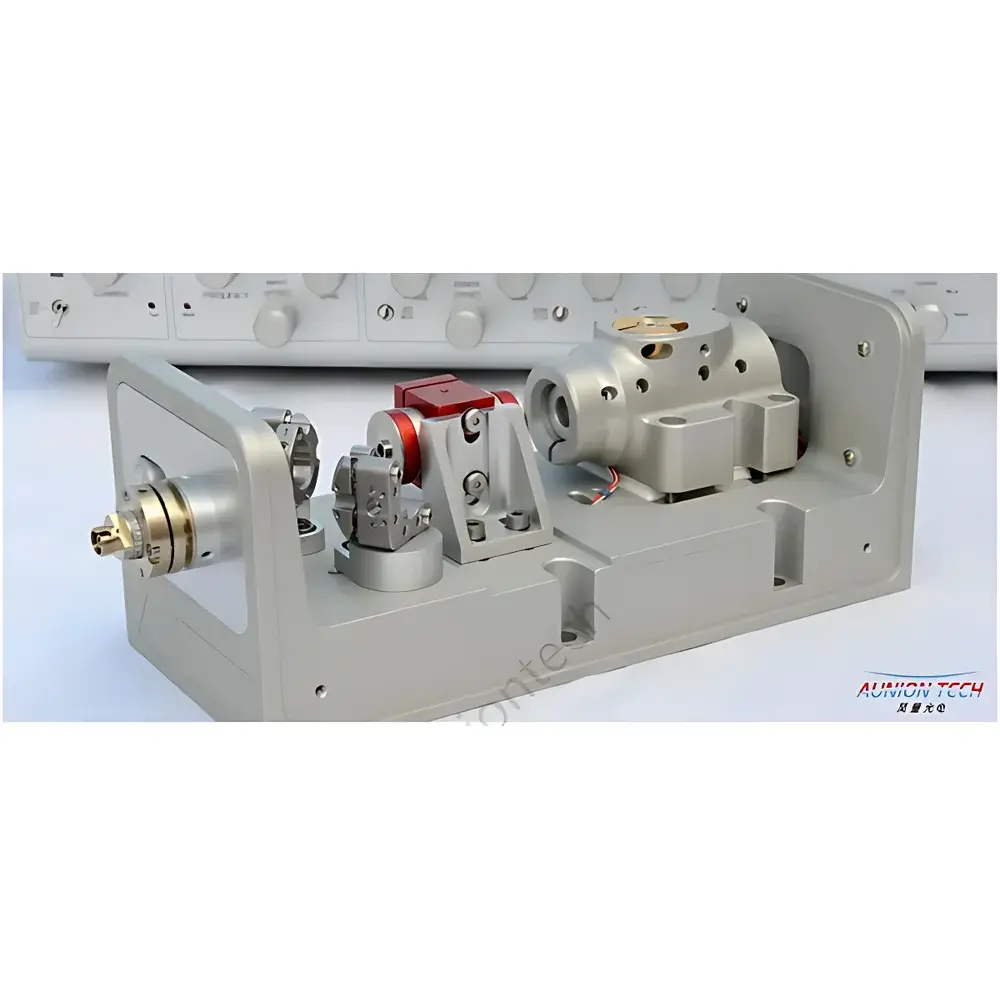
CEL MOGLabs CEL Series Cat’s-Eye Tunable External Cavity Diode Laser
| Brand | MOGLabs |
|---|---|
| Model | CEL Series |
| Type | Cat’s-Eye External Cavity Diode Laser (ECDL) |
| Wavelength Range | 369.5 nm – 1550 nm (model-dependent) |
| Output Power | Up to 250 mW |
| Linewidth | < 100 kHz (with MOGLabs controller) |
| Tuning Mechanism | Cat’s-eye retroreflector + narrowband interference filter (replacing conventional diffraction grating) |
| Polarization | Linear, PER ≥ 100:1 |
| Beam Dimensions | ~0.6 mm × 0.3 mm (elliptical, diode-dependent) |
| Scan Speed | Up to 15 GHz/s (with MOGLabs controller) |
| Modulation Bandwidth | 10 MHz (AC/DC coupling), RF bias-T option up to >2.5 GHz |
| Coarse Tuning Range | e.g., 776–802 nm or 850–895 nm (single-mode, diode-dependent) |
| Optional Accessories | Fiber coupling module, external optical isolator |
Overview
The CEL Series Cat’s-Eye Tunable External Cavity Diode Laser, developed by MOGLabs and distributed globally by Auniontech, represents a robust engineering solution for high-stability, narrow-linewidth laser sources in precision spectroscopy, atomic physics, quantum optics, and metrology applications. Unlike conventional Littrow- or Littman-configured external cavity diode lasers (ECDLs), the CEL design replaces the angle-sensitive diffraction grating with a cat’s-eye retroreflector combined with a narrowband interference filter. This architecture eliminates sensitivity to mechanical angular drift and vibration-induced wavelength jitter—key limitations of grating-based ECDLs—thereby delivering superior long-term frequency stability and mode-hop-free tuning. The laser operates on the principle of wavelength-selective feedback: light emitted from the gain chip is collimated, filtered spectrally by the interference filter, and retroreflected with precise wavefront fidelity by the cat’s-eye optic back into the diode facet. This configuration ensures high optical feedback efficiency while maintaining mechanical rigidity and thermal insensitivity. Designed for integration into ultra-high-vacuum (UHV) chambers and active stabilization loops, the CEL series is engineered for precision demanding environments where sub-MHz linewidths and reproducible coarse/fine tuning are essential.
Key Features
- Patented cat’s-eye retroreflector architecture eliminates angular alignment sensitivity—enabling stable operation under thermal fluctuation and mechanical stress
- Narrow intrinsic linewidth (<100 kHz) when paired with MOGLabs’ dedicated low-noise current and piezo controllers
- Mode-hop-free continuous tuning over up to 15 GHz at speeds exceeding 15 GHz/s (dependent on controller and diode selection)
- Linear polarization output with polarization extinction ratio ≥ 100:1, suitable for polarization-sensitive experiments including magneto-optical traps (MOTs) and optical pumping
- Compact, monolithic housing with integrated thermal management—designed for OEM integration and rack-mount compatibility
- Modulation-ready interface: 10 MHz analog modulation bandwidth (AC or DC coupled); optional RF bias-T supporting >2.5 GHz electro-optic sideband generation
- Factory-aligned beam profile (~0.6 mm × 0.3 mm elliptical) optimized for efficient coupling into single-mode fibers or vacuum-compatible optical paths
Sample Compatibility & Compliance
The CEL laser system is compatible with a broad range of gain chips across UV–NIR spectral bands—including but not limited to 369.5 nm (Ca⁺ cooling), 420–425 nm (Yb⁺), 633–639 nm (HeNe replacement), 729 nm (Al⁺/Ca⁺ clock transitions), 767/770 nm (Rb D1), 780 nm (Rb D2), 852 nm (Cs D2), 1064 nm (Nd:YAG pump seeding), and 1550 nm (telecom-band fiber integration). All units undergo factory calibration against NIST-traceable wavemeters and are supplied with spectral certification reports. The optical design complies with ISO 11146 (laser beam parameters) and IEC 60825-1:2014 (laser safety class classification—typically Class 3B or 4 depending on output power configuration). For regulated laboratory environments, the system supports GLP/GMP-aligned documentation packages upon request, including instrument qualification protocols (IQ/OQ/PQ) and traceable calibration logs.
Software & Data Management
MOGLabs provides the proprietary LaserControl software suite—compatible with Windows and Linux—for full remote operation via USB or Ethernet. The software enables real-time monitoring of diode current, temperature, piezo voltage, and photodiode feedback; implements closed-loop frequency locking (Pound–Drever–Hall or offset locking); and supports scripting (Python API) for automated spectral scans and sequence-triggered experiments. Data export is compliant with HDF5 and CSV formats, ensuring interoperability with MATLAB, LabVIEW, and Python-based analysis pipelines. When deployed in FDA-regulated facilities, the software can be configured to meet 21 CFR Part 11 requirements—including electronic signatures, audit trails, and user-access-level controls—upon installation of validated configuration modules.
Applications
- Atomic and molecular spectroscopy: Doppler-free saturation spectroscopy, Lamb-dip measurements, and hyperfine structure analysis
- Quantum information processing: Laser cooling and trapping of neutral atoms (Rb, Cs, Sr, Yb) and trapped ions (Ca⁺, Sr⁺, Ba⁺, Al⁺)
- Optical frequency standards: Local oscillators for optical clocks and femtosecond comb stabilization
- Coherent Raman scattering (CARS) and stimulated Raman spectroscopy requiring precisely tunable narrowband excitation
- Interferometric sensing: High-resolution cavity ring-down spectroscopy (CRDS) and dispersion-based refractometry
- OEM integration: Seed sources for fiber amplifiers, Ti:sapphire pump lasers, and compact optical parametric oscillators (OPOs)
FAQ
What distinguishes the cat’s-eye architecture from traditional grating-based ECDLs?
The cat’s-eye retroreflector provides inherent angular error correction: any small tilt of the optic results in a parallel displacement of the return beam—not an angular deviation—preserving cavity alignment stability without active feedback.
Can the CEL laser be fiber-coupled?
Yes—optional fiber coupling modules (FC/PC or FC/APC) are available for single-mode PM or non-PM fibers; coupling efficiency exceeds 65% for standard configurations.
Is the system compatible with vacuum environments?
The core laser head is UHV-compatible (10⁻⁹ mbar rated); feedthroughs for current, temperature, and piezo control are available as custom options.
What controller is required to achieve <100 kHz linewidth?
The MOGLabs LDC501 low-noise laser diode controller and PZT501 piezo driver, operated in synchronized mode, are required to realize sub-100 kHz performance.
How is wavelength calibration performed?
Each unit ships with a calibrated wavemeter trace report; users may perform in-situ calibration using a scanning Fabry–Pérot interferometer or a commercial optical spectrum analyzer with known reference lines.





