
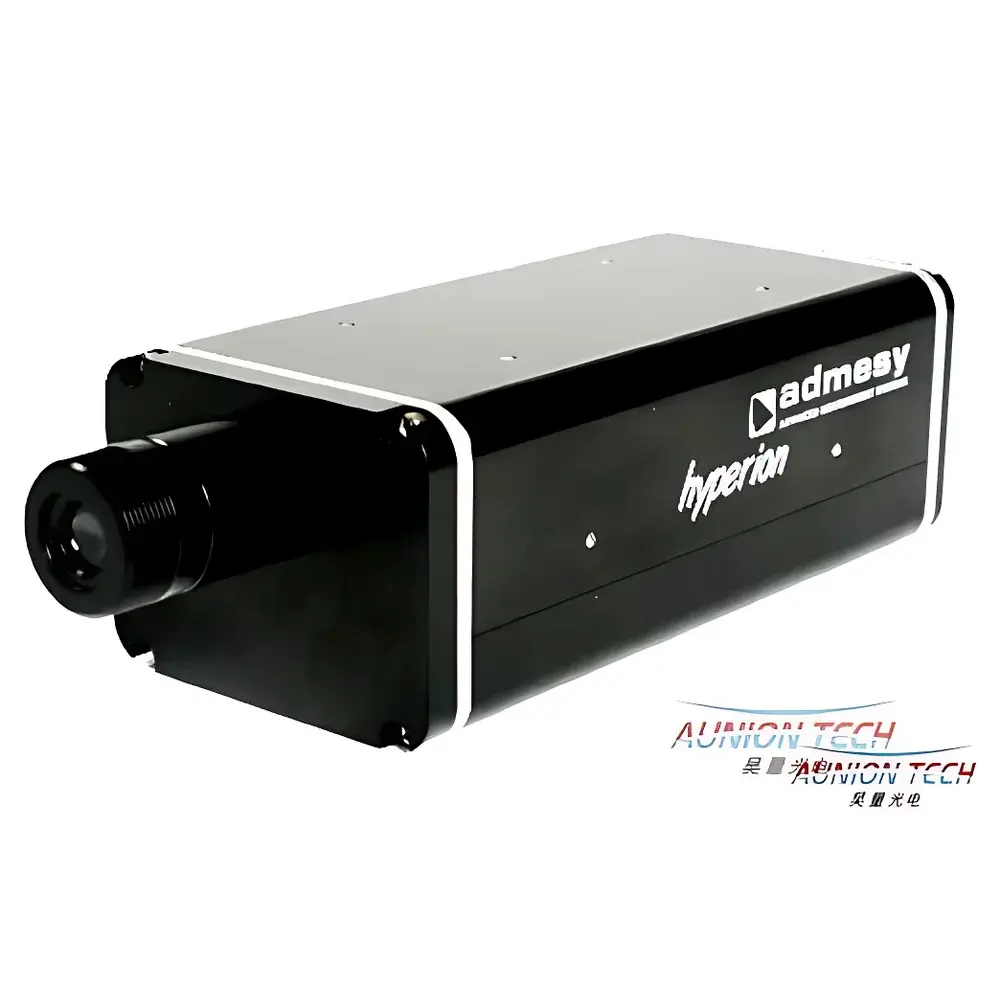
Admesy Hyperion Series High-Speed Online Colorimeter for Display and Light Source Measurement
| Brand | Admesy |
|---|---|
| Origin | Netherlands |
| Model | Hyperion Series |
| Detector | Triple silicon photodiodes with XYZ interference filters |
| Spectral Response | CIE 1931-compliant |
| Weight | 670 g |
| Dimensions (w/o lens) | 53 × 70 × 147 mm |
| Mounting | 12× M3 threaded holes |
| Power Supply | USB-powered + optional 9 V DC |
| Interfaces | USB 2.0, RS-232 |
| Measurement Parameters | XYZ, Yxy, Yu’v’, CCT, DWL, Flicker (JEITA & Contrast methods) |
| Luminance Range | 0.003–12,000 cd/m² |
| Luminance Accuracy | ±2% (at 150 cd/m², white field) |
| Chromaticity Accuracy (x,y) | ±0.001 (at 150 cd/m², white field) |
| Repeatability (Y) | ±0.1% (≥5 cd/m²) |
| Chromaticity Repeatability (x,y) | ±0.0002 (≥5 cd/m²) |
| Flicker Sampling Rate | 2000 Hz (XYZ & flicker simultaneously) |
| Minimum Detectable Flicker Frequency | 1 Hz |
| Measurement Speed | Up to 40 Hz (at ≥5 cd/m²) |
| Integration Time | 0.5 ms – 1 s |
| Dynamic Range | >80 dB |
| A/D Resolution | 16-bit per channel |
| Operating Temperature | 10–35 °C |
| Shutter Lifetime | >1 million cycles |
| Shutter Actuation Time | 250–300 ms |
| Optical Configurations | Standard 5° FOV (10 mm or 20 mm lens) |
Overview
The Admesy Hyperion Series is a high-speed, factory-calibrated online colorimeter engineered for precision photometric and colorimetric measurement of displays, LED modules, OLED panels, and general light sources in R&D, production line, and quality assurance environments. Based on a triple-silicon-photodiode architecture with rigorously matched XYZ interference filter stacks, the Hyperion delivers spectral responsivity closely aligned with the CIE 1931 standard observer function—enabling traceable, metrologically sound color data without user recalibration. Its ultra-low electronic noise floor, wide dynamic range (>80 dB), and adaptive integration time (0.5 ms to 1 s) allow stable operation across an exceptional luminance range—from 0.003 cd/m² (sub-threshold dim display evaluation) to 12,000 cd/m² (HDR backlight and automotive lighting verification). Designed for continuous industrial deployment, the Hyperion operates as a self-contained, USB-powered sensor node with deterministic timing, real-time flicker analysis, and deterministic shutter actuation (250–300 ms), making it suitable for automated optical inspection (AOI), inline process monitoring, and accelerated visual quality testing.
Key Features
- Factory-traceable CIE 1931 XYZ spectral matching—no routine user calibration required
- Simultaneous high-speed acquisition of XYZ tristimulus values and flicker metrics at up to 2000 Hz
- Sub-millisecond response capability with configurable integration time and gain stages (DC–500 Hz bandwidth)
- High-resolution 16-bit digitization per channel, ensuring fine-grained luminance and chromaticity discrimination
- Robust mechanical design: aluminum housing, 12× M3 mounting points, IP50-rated enclosure for cleanroom and factory-floor use
- Flexible optical interface: standard 5° field-of-view (FOV) with 10 mm or 20 mm fixed-focus lenses; optional SMA-905 fiber-optic input for remote or confined-space measurements
- Dual flicker evaluation modes compliant with JEITA CP-1501 and industry-standard contrast method (IEC TR 62778)
- Full support for CIE-defined color spaces: Yxy, Yu’v’, L*u*v*, and correlated color temperature (CCT) with dominant wavelength (DWL) derivation
Sample Compatibility & Compliance
The Hyperion Series is validated for measurement of emissive devices including LCDs with local dimming, microLED arrays, AMOLED foldables, automotive head-up displays (HUDs), and general illumination products. Its 5° FOV (±2.5°) enables repeatable spot measurement across typical display pixel pitches and LED die sizes, while its low-luminance stability supports evaluation of near-black performance in HDR grading workflows. The instrument complies with core requirements of ISO/CIE 11664 (colorimetry), CIE S 014/E:2006 (photometry), and IEC 62341-6-3 (OLED optical testing). Data integrity meets GLP/GMP-aligned practices through timestamped, audit-ready output files and optional firmware-level logging. While not FDA 21 CFR Part 11 certified out-of-the-box, its deterministic USB/RS-232 communication protocol and structured ASCII/Binary output formats facilitate integration into validated systems requiring electronic record retention.
Software & Data Management
Admesy provides the Hyperion Control Suite—a native Windows application supporting real-time visualization, batch acquisition, statistical process control (SPC) charting, and export to CSV, XML, or HDF5. The SDK (C++, .NET, Python) enables direct integration into LabVIEW, MATLAB, Python-based test automation frameworks, and MES/SCADA platforms. All communication follows a stateless command-response protocol over USB CDC ACM or RS-232, ensuring deterministic latency and interoperability with industrial PLCs and motion controllers. Measurement metadata—including integration time, gain setting, shutter status, ambient temperature, and firmware revision—is embedded in every data packet. Optional firmware updates maintain long-term compatibility with evolving display technologies (e.g., LTPO, QD-OLED) and emerging flicker standards.
Applications
- Display manufacturing: inline white point verification, gamma uniformity mapping, and binning of OLED/LCD modules
- R&D labs: temporal characterization of fast-switching microdisplays, flicker sensitivity studies, and black-level optimization
- Lighting QA: CCT consistency checks across LED batches, spatial color uniformity assessment using robotic scanning rigs
- Automotive electronics: HUD brightness and chromaticity validation under variable ambient conditions
- AR/VR development: luminance linearity testing of waveguide-coupled microdisplays at sub-1 cd/m² levels
- Standards laboratories: reference-grade validation of lower-cost color sensors via intercomparison protocols
FAQ
Does the Hyperion require periodic user calibration?
No. It ships with NIST-traceable factory calibration and maintains stability over time due to thermally compensated filter stacks and low-drift analog circuitry. Recalibration is only recommended after physical shock or exposure beyond specified operating temperature limits.
Can the Hyperion measure flicker at frequencies below 1 Hz?
Yes—the minimum detectable flicker frequency is 1 Hz using the contrast method. For JEITA-compliant measurements, the valid range begins at 5 Hz and extends to 10 kHz.
Is fiber-optic coupling supported natively?
Yes. An optional SMA-905 fiber adapter kit allows decoupling of the sensor head from the optical path—ideal for integrating into vacuum chambers, thermal chambers, or space-constrained fixtures.
What is the shutter lifetime specification?
The electromechanical shutter is rated for more than one million actuations under normal operating conditions (25 °C, 50% RH), with mean time between failures exceeding 50,000 hours in continuous-duty scenarios.
How does the Hyperion handle ambient light interference during measurement?
It employs synchronized shutter gating and hardware-based dark-current subtraction. When used with optional aperture masks or baffle tubes, ambient rejection exceeds 60 dB—sufficient for most factory-floor lighting environments.





